

Maria Joao Rodrigues elected new FEPS President

Maria Joao Rodrigues elected new FEPS President Maria Joao Rodrigues was elected President of the […]

29/06/2017

Maria Joao Rodrigues elected new FEPS President Maria Joao Rodrigues was elected President of the Foundation for European Progressive Studies (FEPS) on Wednesday 28th June. She succeeds Massimo D’Alema who chaired the think tank of the Progressives at European level over the last seven years. Her election, the first time for a woman at such a position, happened on the same day of the FEPS annual flagship conference Call to Europe and Maria Joao Rodrigues underlined that it is the time for the EU to become a political entity with strong cohesion and democracy, and not just a single market.

“I am very honoured as I’ve been working with FEPS since the beginning, both as an academic, policy maker or member of the European Parliament” said Maria Joao Rodrigues right after the vote by the FEPS General Assembly. She also expressed her gratitude to her predecessor for his commitment for FEPS and the work achieved so far: “We will continue the current research and we move to a new phase in order to address the major challenges ahead.”

In order to succeed, Maria Joao Rodrigues already implemented some changes to the FEPS structure. Among the most relevant changes, the former European Parliament president with a long career as a professor, Josep Borrell, was nominated as the new president of the FEPS Scientific Council. This will help to continue and improve the work of FEPS, established now for almost 10 years, with an impressive network of thousands of academics and politicians such as Pascal Lamy, Joseph Stiglitz, hundreds of research programmes such as the Millennial Dialogue and Next Left, and regular publications in the format of policy briefs, opinion and magazines like The Progressive Post.

European and Progressive Profile

Thanks to the election of Maria Joao Rodrigues, FEPS will benefit from one of the most prominent intellectual, political and European personalities with a triple background as academic, policy maker and elected member. Indeed, Maria Joao Rodrigues is a full professor of European economic politics in the European Studies Institute – Université Libre de Bruxelles and in the Lisbon University Institute. She also chaired the Scientific Board, in charge of preparing the EU framework programme for social economic research, working with the European research community.

Former Minister of Portugal for Employment in the first government of prime minister and now currently UN Secretary general, Antonio Guterres, Maria Joao Rodrigues is known as an expert on EU political economy and has notably served for all the EU institutions (Council, Commission, Presidency). She is now vice-president for economic and social affairs of the S&D Group, currently the second most important EP Group, with 190 members from the 28 Member States.

Known as the mother of the “Lisbon Strategy”, Maria Joao Rodrigues is author of more than one hundred publications. Her main outcomes in European policy making also concern the Lisbon Treaty, strategic partnership with Africa, China and Brazil, reform of the Eurozone and the European social pillar.

Call for a more social and democratic

Europe Maria Joao Rodrigues is today chairing the annual FEPS flagship conference Call to Europe, this year entitled “Democracy First”. She introduced the second session, addressing the need for a progressive alternative, which will go beyond the five scenarios proposed by the European Commission. “A 6th scenario should be implemented as soon as possible, delivering better European solutions to address citizens concerns: ensuring decent job and social protection, investing for a sustainable development, increasing convergence in the Eurozone, providing security but also protecting refugees, making a fairer multilateral system in cooperation with the rest of the world.”

Background about FEPS

The FEPS headquarters is based in the European area in Brussels and counts on a permanent team of 13 people lead by Secretary General, Ernst Stetter.

FEPS is an umbrella organisation of a large network of national political foundations and think tanks, including 47 full members and 16 observers.

New members

“We are happy to welcome three new full members and three new observers as of yesterday”, said Maria Joao Rodrigues after the General Assembly.

The three new full members are:

o Das Progressive Zentrum – Germany

o DIKTIO – Greece

o Centrum im. Ignacego Daszyńskiego – Poland

The three new observers are:

o Broadbent Institute – Canada

o Fundación Salvador Allende – Chili

o Sheffield Political Economy Research Institute (SPERI) – United Kingdom

Network
Amicus Europæ
Broadbent Institute
Centrum im. Ignacego Daszyńskiego
Das Progressive Zentrum (DPZ)
Diktio
Fundación Salvador Allende
SPERI
Find all related publications
Publications
13/10/2025

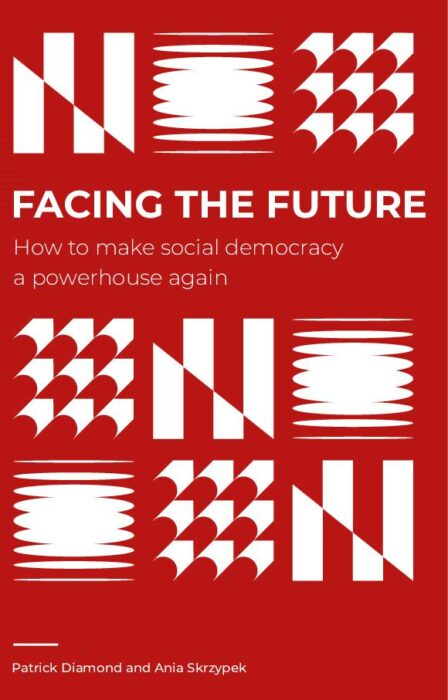
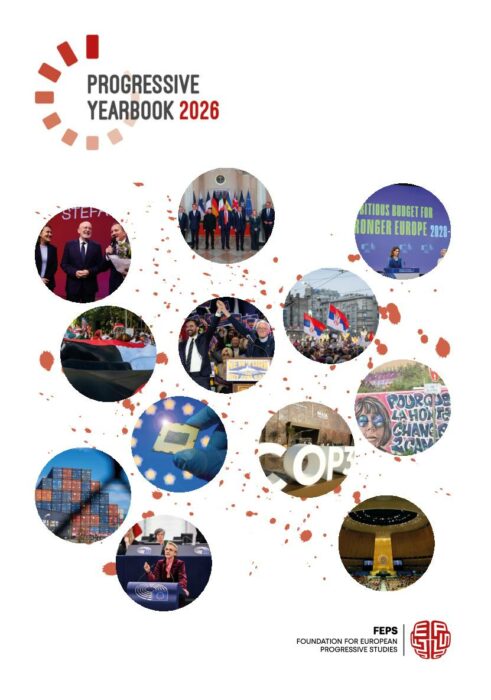
Facing the future: How to make Social Democracy a powerhouse again

Rethinking social democracy in an age of change This publication was launched at FEPS’ fringe […]
25/08/2025

Next Left country case studies

Exploring the state of Social Democracy in France, Austria, Romania, the Netherlands, Italy and Australia
04/08/2025

Next Left Vol. 16

The Progressive Compass
24/06/2025

Serbia’s civic awakening: the 2024-2025 student protests in focus

Friends of the Western Balkans series
Find all related events
Events
Upcoming
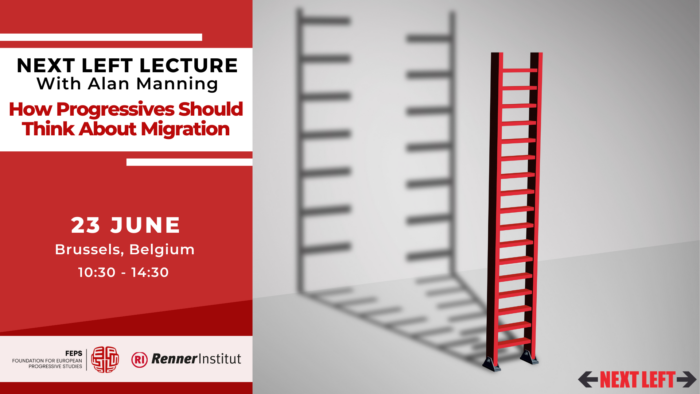
14 - 16/12/2025
Oxford, United Kingdom (Expert Meeting)

11th Oxford Symposium

FEPS, Progressive Britain, and the Karl-Renner-Institut are proud to co-organise yet another edition (11th) of […]
Past
01 - 03/12/2025
FEPS HQ, Brussels

FEPS Annual Autumn Academy 2025

For a Europe of peace, prosperity and progress
20 - 22/11/2025
Belgrade, Serbia

How the new EU budget will shape a wider Union

Friends of the Western Balkans Conference
Load more...
Find all related news
News
21/10/2025

Maria João Rodrigues at PES Congress 2025

🇳🇱 🌹 FEPS attended the Party of European Socialists (PES) Congress in Amsterdam, which included […]
18/10/2025

FEPS at PES Congress 2025

🇳🇱 🌹Within PES Congress, there were full rooms on insightful discussion on a range of […]
10/09/2025

Von der Leyen – walking the walk at last?

FEPS reaction to The State of the European Union 2025
16/05/2025

Joint statement by the Friends of the Western Balkans (FoWB)

Ljubljana, 16th May 2025 We, the Friends of the Western Balkans (FoWB) – representatives of […]
Find all related in the media
In the media

‘Bruselas, ¿te Quiero?’ Tras un verano cruel, Von der Leyen pide a Europa que “luche”

by Euronews 16/09/2025
After a harsh summer, Von der Leyen calls on Europe to ‘fight’” Episode of Euronews’ Brussels, my Love? featuring Beatriz Abellán, FEPS Policy Analyst on International Relations, discussing Von der Leyen’s State of the Union speech, the EU’s trade deal with the United States, and the future of multilateralism. She also stresses that the EU’s credibility is at stake due to its delayed response to the genocide in Palestine.

László Andor: «En Hongrie, malgré l’érosion de la popularité d’Orbán, la gauche peine à regagner en crédibilité»

by Le Figaro 25/08/2025
“László Andor: In Hungary, despite Orbán’s declining popularity, the left struggles to regain credibility” Interview with FEPS Secretary General László Andor in Le Figaro (FR), analysing the rise of populists in Central Europe and the challenges faced by social democracy in rebuilding credibility and addressing deep economic grievances.

Ласло Андор: България не губи нищо от присъединяването си към еврозоната

by BNR 15/07/2025
"Bulgaria has nothing to lose by joining the eurozone” Interview with FEPS Secretary General László Andor on Bulgarian National Radio, where he explains that Bulgaria has already borne the costs of financial stability and will benefit from eurozone accession.

En Europe, les partis sociaux-démocrates se sont contentés d’une approche technocratique

by Le Point 04/07/2025
“In Europe, social democratic parties have relied too heavily on a technocratic approach” Interview with FEPS Secretary General László Andor in Le Point (FR), reflecting on the decline of social democracy in Europe and the need to renew its political vision in the face of nationalist challenges.