
08/12/2025
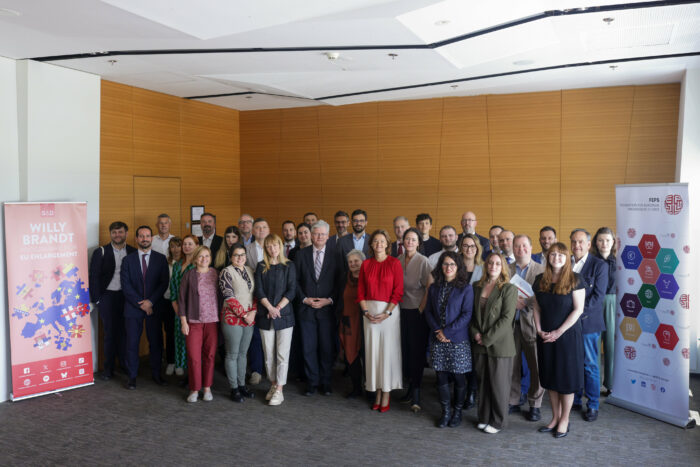
Belgrade, 21 November 2025
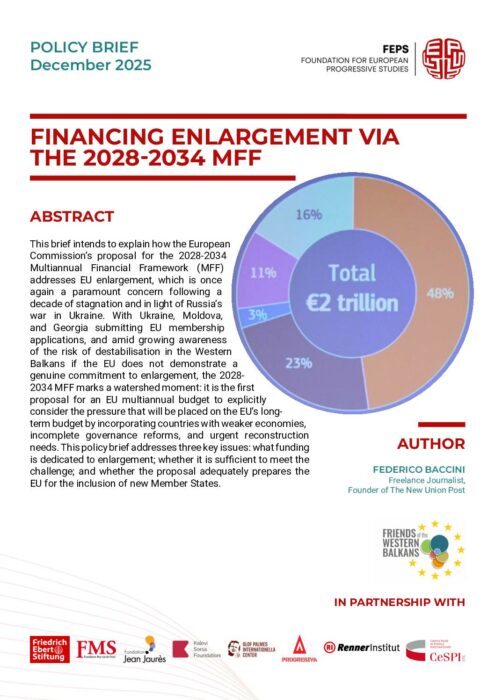
We, the Friends of the Western Balkans (FoWB) – representatives of the European social democratic community, including members of national and European parliaments, political foundations, parties and civil society organisations from across Europe and the region – have convened for our eighth meeting in Belgrade to discuss the situation in Serbia, the future of enlargement and implications of the European Commission’s proposal for the 2028-2034 Multiannual Financial Framework (MFF). As the EU enters negotiations that will define its priorities for the next decade, we underline the need for a budget that sustains the Union’s commitment to enlargement, democracy, and social cohesion.
Multiannual Financial Framework
The Friends of the Western Balkans emphasise that the next MFF must be outward-looking and enlargement-driven, and must ensure an enlargement that is just, inclusive and green. Despite being presented as the largest EU budget ever, the current proposal offers only a modest real increase and risks underfunding reforms in candidate countries. Enlargement is not a geopolitical accessory, but the EU’s most transformative project, rooted in peace, democracy, rule of law and shared prosperity. The Union must therefore back its words with resources, providing clear, predictable and accessible funding, and preparing internally with budgetary headroom, phased pre-accession participation, stronger administrative capacity, and governance reform to ensure that a 30+ member EU can work effectively. The merging of the pre-accession instrument into a single Global Europe framework risks weakening clarity and diluting targeted action.
The budget needs to treat enlargement as a priority, to deliver on the Union’s promise to the accession countries, as well as strengthen the EU’s geostrategic ambition to become a strong and influential stakeholder. Hence, the next MFF must send a clear message: Europe is preparing to grow, integrate and invest in a common future where new members and current ones advance together.
The Friends of the Western Balkans call for a next MFF that:
- Reinstates the Instrument for Pre-Accession Assistance (IPA) and ensures that funds directly support the rule of law, public administration reform, social and territorial cohesion, and the empowerment of local civil society actors and independent media;
- Preserves cohesion, agriculture and social funds for existing member states as pull factors for enlargement, keeping the balance between internal solidarity and external engagement;
- Provides for the accession of new member states with a mandatory MFF revision clause;
- Ensures transparency and democratic accountability through a strong role for the European Parliament and local partners in programming and monitoring of the disbursement of the EU funds;
- Develops new, fair and sustainable own resources, allowing the EU to finance enlargement, development and the green transition without undermining its social and cohesion goals;
- Develops a real social dimension of the enlargement with a stronger social and economic convergence by promoting the EU social acquis in the candidate countries, which includes better conditions and fair wages for decent work, equal treatment and general well-being at home, social protection, gender equality and opportunities for the younger generations across the continent;
- Supports an EU competitiveness agenda that prioritises public investment (such as education, innovation and communal infrastructures) for the people of the region to thrive.
Serbia
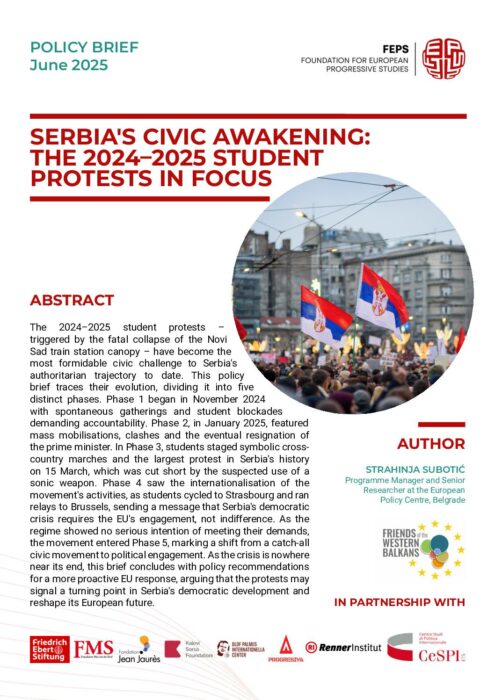
The Friends of the Western Balkans stand with the citizens and students of Serbia, demanding a state that serves its people, not an autocracy that is heading towards dictatorship. Their call is the European call: rule of law, accountability, free media, and genuinely free and fair elections. In the wake of the Novi Sad tragedy, Serbia’s democratic backsliding and state violence in the last decade, systemic failures must be named and responsibility ensured.
This is a test of the European Union’s credibility. The Union must stop looking away from the kleptocratic apparatus led by President Vučić, intimidation of democratic forces and anti-EU rhetoric. Serbia is a key country in the region; its instability affects the entire Western Balkans, is slowing down the whole region’s accession process and inflaming conflicts in the region. The true stabilising force would not be the autocratic regime, but a democratic Serbia that protects the rights and freedoms of its citizens, including those of minorities.
We welcome the Commission’s firmer tone in the 2025 Enlargement Package and the European Parliament’s latest resolution with a clear message that the EU will not trade democracy for ‘stabilitocracy’. The Union must now match its words with action and stand decisively with the people of Serbia and their European future.
We call on the European Commission, the Council and the member states to act in a unified way and:
- Adopt targeted sanctions against those responsible for serious human rights violations;
- Apply strict rule-of-law conditionality and redirect EU funds towards independent media, civil society and justice reform, while maintaining important funding for the educational and healthcare systems;
- Tie all political engagement to concrete progress on OSCE/ODIHR recommendations, including implementation of the full voter register audit, and reinforce pre-electoral monitoring;
- Support efforts to counter disinformation and foreign interference undermining Serbia’s democratic process to ensure fair, objective and informative public broadcasting, and obtain independent and professional REM.
We repeat the call on the Serbian authorities to:
- End repression against protesters, the academic community, political opposition, journalists and civil society, and end impunity for those responsible;
- Conduct a fully transparent, independent investigation into the Novi Sad tragedy, addressing corruption and negligence resulting in clear and swift judicial verdicts;
- Have a strong cooperation with the European institutions on the usage of European funds;
- Follow the demands of the students to organise and guarantee free, fair and necessary snap elections, implement OSCE/ODIHR recommendations, and safeguard media and academic freedom;
- Immediately end all the arbitrary detention and release all political prisoners.
The future of enlargement
With all the challenges the Western Balkans are facing, accession to the EU is Europe’s most powerful investment in democracy, peace, and long-term stability on the continent. With two frontrunners now leading the way, the message is clear: the region is moving forward, and so must the EU.
We, the Friends of the Western Balkans, warmly welcome the 2025 Enlargement Package’s positive message, recognising progress in Montenegro and Albania in the accession process. Their progress shows that reform delivers results, and we hope it will inspire others in the region to accelerate their own democratic and rule-of-law reforms.
At the same time, the Union must prepare internally and act strategically. Of course, integrating Montenegro and Albania, with a combined population of around three million, would not significantly affect the EU’s financial or decision-making processes. However, the EU should use this momentum to advance internal reform, becoming a more agile, democratic and geo-strategic Union capable of acting effectively during the future accession rounds. We also welcome the Commission’s commitment to communicate more effectively with EU citizens about the long-term benefits of enlargement for the whole continent. We anticipate the same from the candidate countries. Without citizens’ understanding and support, enlargement risks losing its democratic legitimacy. It should be a moment of renewal and celebration for all Europeans, not only for the citizens of the candidate countries.
We therefore call on the Council, the Commission and the High Representative to:
- Ensure that enlargement is merit-based, transparent and credible, linking democratic and rule-of-law reforms directly to measurable progress;
- Maintain the momentum of the frontrunners’ accession, without losing sight of all candidates, ensuring that verified reforms translate into swift and concrete progress toward membership;
- Launch as soon as possible the promised pre-enlargement policy review to align EU institutions and decision-making with the needs of an enlarged Union, including extending qualified majority voting where possible;
- Ensure that the announced new safeguard clauses in accession treaties are fair, non-discriminatory, and accompanied by stronger mechanisms for upholding the same standards inside the Union;
- Align future EU funding, including the next MFF, with the goals of democratic resilience, rule of law, independent judiciary, media freedom and good governance, ensuring that investments in security also reinforce democracy and public trust.
The Friends of the Western Balkans conclude that:
1. EU enlargement is a democratic, social and generational project, not a technocratic exercise, but a renewal of the European promise for a new generation;
2. A credible enlargement process requires a credible social agenda: investing in people, in fair economies, in the green and digital transitions, and in equality for all;
3. Our progressive family in Europe will continue to stand with the citizens of the Western Balkans: for democracy, for social justice, and for a Europe that protects, empowers and unites.
Signatories
Jonas ANDERSSON, Programme Manager PAO Western Balkans, Olof Palme International Center, Sweden
László ANDOR, Secretary General, Foundation for European Progressive Studies, Belgium/Hungary
Roy BASHAJ, Secretary of Youth, Socialist Party of Albania, Albania
Dylan BOUTIFLAT, International Secretary, Parti Socialiste, France
Christian CASTAGNA, Director, Voisinages, France
Lauri FINÉR, Director, Kalevi Sorsa Foundation, Finland
Knut FLECKENSTEIN, Special Adviser Western Balkans, Foundation for European Progressive Studies, Germany
Daniele FRIGERI, President, CeSPI, Italy
Sébastien GRICOURT, Co-Director, Balkans Observatory of the Foundation Jean Jaurès, France
Tamás HARANGOZÓ, Deputy Leader of the Parliamentary Group, Hungarian Socialist Party, Hungary
Dušan JOVČIĆ, Student, Faculty of Political Sciences, Serbia
Mojca KEKUŠ KLEVA, President, Društvo Progresiva, Slovenia
Joško KLISOVIĆ, International Secretary of Social Democratic Party, Croatia
Kido KOENIG, Director, Foundation Max van der Stoel, Netherlands
Aleksandra KUZMANOVIĆ, Student, Faculty of Political Sciences, Serbia
Ksenija MARKOVIĆ, International Secretary, Democratic Party, Serbia
Sascha OBRECHT, Director, Karl-Renner-Institut, Vienna, Austria
Pinja PERHOLEHTO, Member of the Finnish Parliament, Social Democratic Party of Finland, Finland
Anna PIC, Member of the National Assembly, Parti Socialiste, France
Tonino PICULA, Member of the European Parliament, S&D Group, Croatia
Aleksa POPOVIĆ, Student, Faculty of Political Sciences, Serbia
Pierre PRIBETICH, Member of the National Assembly, Parti Socialiste, France
Tonči RESTOVIĆ, Member of Parliament, Croatia
Thijs REUTEN, Member of the European Parliament, S&D Group, Netherlands
Chloé RIDEL, Member of the European Parliament, S&D Group, France
Sabina SALI, Student, Faculty of Political Sciences, Serbia
Konstantin SAMOFALOV, International Secretary, Party of Freedom and Justice, Serbia
Andreas SCHIEDER, Member of the European Parliament, S&D Group, Austria
Mirko STANIĆ, Main Board President of SDP Montenegro, Montenegro
Paul STICH, Member of the Austrian National Council, Austria
Kathleen VAN BREMPT, Member of the European Parliament, S&D Group, Belgium
Tom VAN DER LEE, Member of the Dutch Parliament, GroenLinks-PvdA, Netherlands
Panagiotis VLACHOS, Coordinator of ETERON Advisory Board, Greece
Milan F. ŽIVKOVIĆ, Secretariat of the Social Democratic Party of Croatia, Croatia
Network

Find all related publications
Publications


Find all related events
Events
Past
20 - 22/11/2025
Belgrade, Serbia
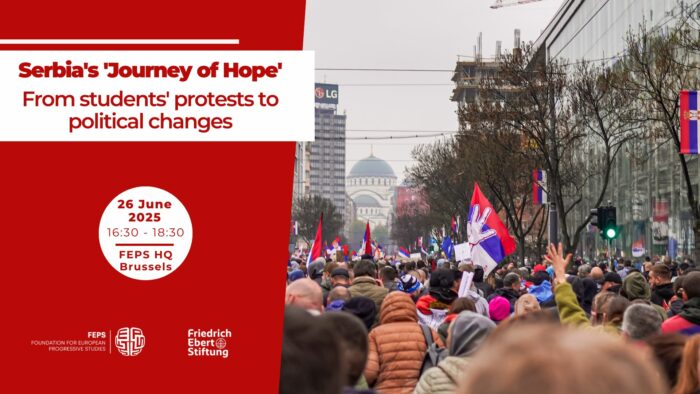
26/06/2025
FEPS HQ, Brussels
15 - 16/05/2025
Ljubljana, Slovenia (Expert meeting)
Load more...
Find all related news
News
Find all related in the media
In the media
NATO-bővítés sok vitával: érvek, ellenérvek és lobbik a Clinton-elnökség idején
by BBC History 07/07/2024
EU-VÍZIÓ, Dull Szabolcs újságíró Andor Lászlóval beszélget
by MÚOSZ Magyar Újságírók Országos Szövetsége 11/04/2024