FEPS Newsletter 10 Feb 2023 – Climate mainstreaming, Fit for 55 package and more!

📅 FEPS Newsletter: Climate mainstreaming, Fit for 55 package and more! Share Tweet Share Share […]

10/02/2023
📅 FEPS Newsletter: Climate mainstreaming, Fit for 55 package and more!
Fit for 55 policy study, Progressive Post & recap of event in FEPS HQ
 ‌ ‌ ‌ ‌ ‌ ‌ ‌ ‌ ‌ ‌ ‌ ‌ ‌ ‌ ‌ ‌ ‌ ‌ ‌ ‌ ‌ ‌ ‌ ‌ ‌ ‌ ‌ ‌ ‌ ‌ ‌ ‌ ‌ ‌ ‌ ‌ ‌ ‌ ‌ ‌ ‌ ‌ ‌ ‌ ‌ ‌ ‌ ‌ ‌ ‌ ‌ ‌ ‌ ‌ ‌ ‌ ‌ ‌ ‌ ‌ ‌ ‌ ‌ ‌ ‌ ‌ ‌ ‌ ‌ ‌ ‌ ‌ ‌ ‌ ‌ ‌ ‌ ‌ ‌ ‌ ‌ ‌ ‌ ‌ ‌ ‌ ‌ ‌ ‌ ‌ ‌ ‌ ‌ ‌ ‌ ‌ ‌ ‌ ‌ ‌ ‌ ‌ ‌ ‌ ‌ ‌ ‌ ‌ ‌ ‌ ‌ ‌ ‌ ‌ ‌ ‌ ‌ ‌ ‌ ‌ ‌ ‌ ‌ ‌ ‌ ‌
Upcoming Events
There cannot be climate justice without social justice! This week, we focus on the inclusion of social issues in climate policies and on climate mainstreaming in gender, health and digital policies. We also discuss NextGenerationEU, the EU single market and more.
Climate change is a systemic issue that cannot be addressed by siloed thinking. The transition to a political, social and economic model needs a holistic understanding to address the planetary emergencies and to implement the commitments of the EU Climate Law. Transforming societies and economies while respecting sustainability principles means mainstreaming environmental concerns whenever we design policies for all other areas.

The ‘Climate mainstreaming: Breaking down the silos’ series comprises four policy briefs that disentangle these interlinkages by connecting climate matters with different disciplinary backgrounds. The objective is to assist progressive policymakers who want to adopt environmentally sustainable policies that can remedy rather than exacerbate existing inequalities.
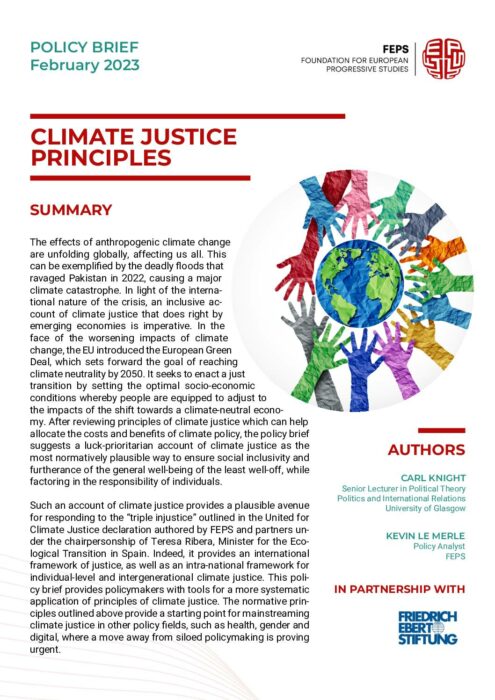
By Carl Knight and Kevin Le Merle

This policy brief provides policymakers with tools for a more systematic application of principles of climate justice. The normative principles explored provide a starting point for mainstreaming climate justice in other policy fields, such as health, gender and digital, where a move away from siloed policymaking is proving urgent. Read more.
By Gill Allwood

Gender equality and climate change should both be mainstreamed throughout all EU internal and external activities. This policy brief argues that the synergies between them should be fully explored in order to achieve the greatest co-benefits. Together, they will contribute to the systemic transformative change which is essential to both gender and climate justice. Read more.
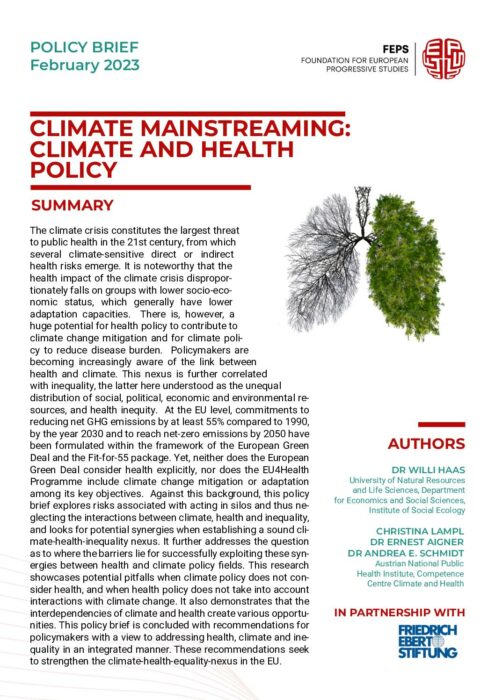
By Willi Haas, Christina Lampl, Andrea Schmidt and Ernest Aigner

There is a huge potential for health policy to contribute to climate change mitigation and for climate policy to reduce disease burden. This policy brief also looks for potential synergies when establishing a sound climate-health-inequality nexus. Read more.
By Kerstin Hotte

What are the positive and negative interactions across the processes of technological advances involved in climate change mitigation and digitalisation? This policy brief shows how current EU policy strategies take account of these interactions. It proceeds by outlining 15 principles around which policies for climate change mitigation, adaptation, and compensation should be designed to ensure justice and to leverage the greatest synergies with the ongoing process of digitalisation. Read more.
By Sanna Markkanen, Krisztina Zálnoky and Francesco Giannelli

New climate policies could exacerbate existing inequalities if the costs and benefits of the transition are not equitably distributed. This policy study by FEPS, University of Cambridge Institute for Sustainability Leadership (CISL) and Friedrich-Ebert-Stiftung (FES) examines how the social elements of the Fit for 55 package evolved in the context of the climate, energy, and cost-of-living crises. Read more.
PAST EVENT
7 February – FEPS HQ, Brussels

How can we better negotiate and implement the Fit for 55 package in a fair and inclusive way? Fostering a dialogue between members of different political groups, researchers and policy experts, we aimed to provide crucial inputs on the role of the EU Parliament in shaping the meaning of the social dimension of climate policy through concrete policy interventions.

Participants were invited to share their views on how the meaning of the social aspects in the Fit for 55 Package is evolving in the changing (geo)political context.

The new report from FEPS, CISL and FES, explores the ways social issues have been included in climate policies by the EU Commission. The research results, based on qualitative interviews and frequency counting of selected key terms relating to social considerations, found progress towards inclusive economic transition, but there is also an urgent need for further improvements in two key areas: the development of clear definitions for crucial terms and explicit reference to the most severely affected social groups. Read more.
Events
UPCOMING EVENT
23 February – Online

This event will mark the first anniversary of the Russian invasion of Ukraine. Paying tribute to the defenders of Ukrainian independence, we will highlight the EU solidarity efforts and preparations for reconstruction.

It will also be an opportunity to take stock of FEPS work since February 2022 and outline forthcoming action. Among the participants, László Andor, FEPS Secretary General and Uwe Optenhoegel, FEPS Vice-President, editors of the soon-to-be-published FEPS-London Publishing Partnership book on the ongoing war in Ukraine, and many more.
Events
By Marie Charrel

László Andor, FEPS Secretary General, share his views in Le Monde, on the analysis of the last thirty years since the implementation of the single market in Europe. Read more.

Photo credits: Shutterstock/BalkansCat
By Ernst Hillebrand

The Eastern member states of the EU have seen impressive economic growth since joining the European Union. This is especially true for the Visegrád countries (Czech Republic, Slovakia, Poland and Hungary), but also, for example, for Slovenia, Romania or Lithuania. In almost all of the ‘accession countries’, the economic development was far better than predicted (or feared) at the time of EU accession. Read more.
Photo credits: Shutterstock/VizUalni
By Luca Jahier

After more than 15 years of crises – from the rejection of the Constitutional Treaty, over the financial crisis, to Brexit – Brussels no longer seems a place of opportunities and solidarity, but it is seen as synonymous with austerity, inequality and growing divergences, in the face of divisive sovereignty. However, the 2019 European elections and the resulting Von der Leyen Commission represented a turning point that reversed the prospects. One could say that, after years of deadlocked defence, the EU has gone on the attack. Read more.

A slightly different version of this article was originally published in Italian on cespi.it within the framework of the Forum ‘Verso una nuova fase dell’Unione europea‘.
Photo credits: Shutterstock/PPPhotos
Twitter
Facebook
Linkedin
Instagram
Youtube
Website


Copyright © 2023 FEPS Europe, All rights reserved.
You are receiving this email because you participated in one of FEPS’ events and/or have registered for FEPS’ newsletter.
If you wish not to receive FEPS’ communications anymore, please click here: unsubscribe now


Email Marketing by ActiveCampaign
Find all related Progressive Post
Progressive Post
12/02/2026

Europe needs animal spirits again – and deregulation will not stimulate them

Europe’s competitiveness debate is accelerating under a growing sense of urgency. Slowing growth, geopolitical rivalry […]
11/02/2026

Ensuring tax justice in a fragile and unequal world economy

When a handful of economists met over a century ago in Geneva to deliver a […]
11/02/2026

The elephant in the European room

Critical raw materials and open strategic autonomy
Find all related Magazine
Magazine
  • cover book

    # Issue 29 Progressive Post

# Issue 29

From the war in Ukraine to the devastation of Gaza since 2023, the words ‘war’ […]
  • cover book

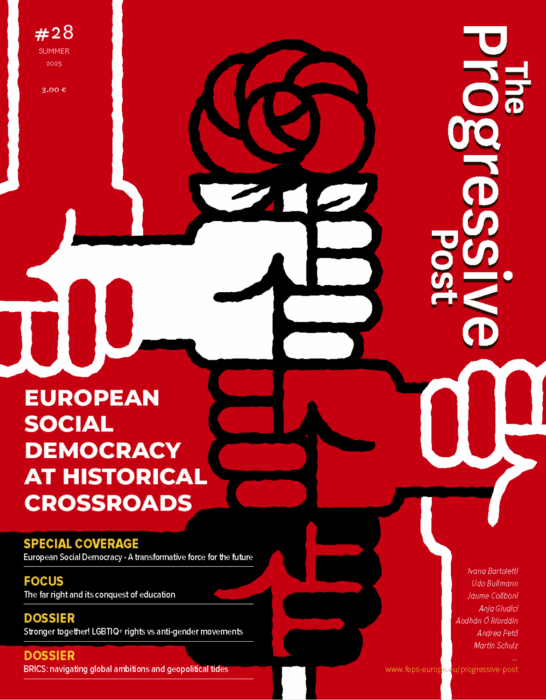
    # Issue 28 Progressive Post

# Issue 28

European Social Democracy at historical crossroads
  • cover book

    #Issue 27 Progressive Post

#Issue 27

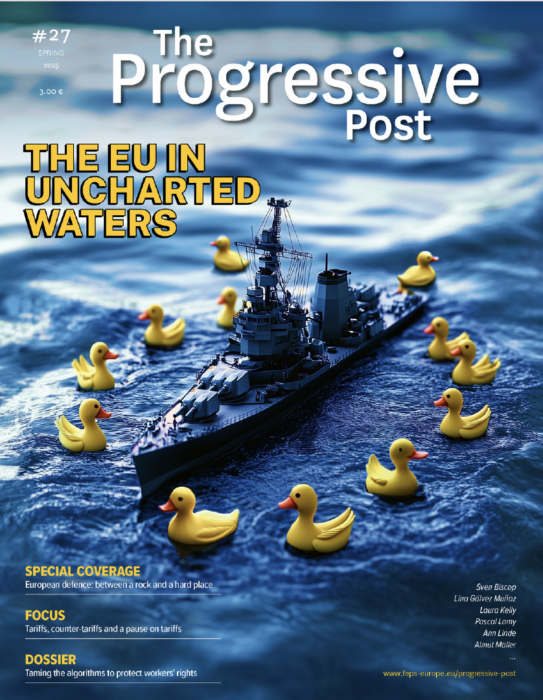
The EU in uncharted waters
Find all related publications
Publications
29/01/2026

Progressive Yearbook 2026

In an eerie manner, 2025 resembled the ‘time of monsters’, which, according to the great […]
15/01/2026

Financing enlargement via the 2028-2034 MFF

This brief intends to explain how the European Commission’s proposal for the 2028-2034 Multiannual Financial […]
19/12/2025

Moving beyond neoliberalism in EU trade policy

European Union trade policy finds itself at a crossroads. After three decades of neoliberal dominance in the […]
15/12/2025

The great unravelling

“The great unravelling” examines the challenges that the new era of globalisation poses for progressive […]
Find all related news
News
29/01/2026

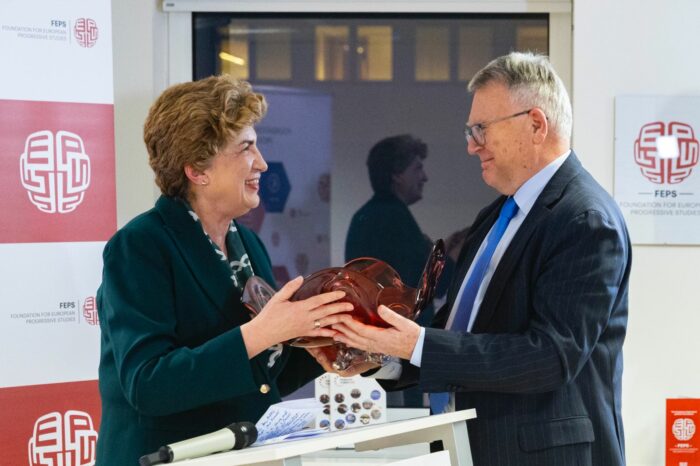
Maria João Rodrigues departs from FEPS Presidency, transitions to Nicolas Schmit

After completing eight years in the role, Maria Joâo Rodrigues has departed the role of […]
29/01/2026

Marianna Mazzucato awarded FEPS ‘Progressive Person of the Year’

FEPS Progressive Person of the Year 2025-2026
21/01/2026

Call for tender – HR consulting services

Applications to be submitted before 18 February
06/01/2026

Venezuela is not about drugs: Trump’s Regional Expansionism and Europe’s Test

FEPS Commentary on US military intervention in Venezuela
Find all related in the media
In the media

España los forma, Europa los contrata: así es el mapa de la nueva fuga de cerebros

by El Confidencial 10/02/2026
Spain trains them, Europe hires them: the map of the new brain drain: László Andor, FEPS Secretary-General, discusses the 'brain drain' as a result of the EU’s single market and highlights the need for a fairer mobility and retention strategy across the EU.

Von der Leyen’s management style ‘not good for Europe,’ says ex-commissioner

by POLITICO 02/02/2026
In this article published by POLITICO, FEPS New President Nicolas Schmit raises concerns about the Commission’s long-term vision and strategic planning, while noting its limited response to U.S. sanctions against Thierry Breton.

‘Regreso al futuro. El gran reseteo’ by Lina Gálvez

by Tinta Libre 02/02/2026
“Back to the Future: The Great Reset” Opinion article by FEPS Vice-President, Lina Gálvez reflecting on the current global crisis marked by rising authoritarianism, digital power and extreme inequality, and tracing its roots through a historical analysis of capitalism — from the post-1945 social and geopolitical settlement led by social democratic forces, through neoliberal financialisation, to what she describes as a new phase of fascist capitalism.

Luxembourg’s former EU Commissioner appointed to head Brussels think tank

by Luxembourg Times 30/01/2026
The Luxembourg Times covered the nomination of former European Commissioner Nicolas Schmit as President of FEPS.