The Eurozone and the need for a paradigm shift

This paper written by FEPS Economic Advisor Giovanni Cozzi, argues that a new deal for […]

Book

09/10/2014

This paper written by FEPS Economic Advisor Giovanni Cozzi, argues that a new deal for Europe should be based a better understanding of the causes and the historical neoliberal origins of the crisis. Neoliberal policies, which are fully embraced in the European Single Market rules and in the European Treaties, have significantly restrained the possibility to use fiscal policies for ensuring high-levels of aggregate demand. Ultimately, this has led to a significant pressure of economic adjustment on the labour market.  The paper calls for an economic paradigm shift and for institutional transformation in order to achieve real solidarity in Europe, in terms of job creation, growth and equity.

The Eurozone and the need for a paradigm shift

10 fundamental challenges

1. A new Deal for Europe should be based on a better understanding of the origins and the historical “neoliberal” roots of the crisis.

2. Make a clear assessment of the European Single Market and its restrictive

notion of solidarity.

3. Re-evaluate the limitations that the European Treaties have imposed on fiscal policies and the subsequent pressure of economic adjustments on the labour market.

4. Fiscal austerity will not succeed in promoting growth and creating jobs.

5. Fiscal policy should be seen as having the function of ensuring high-levels of aggregate demand, and the EU budget should be increased to act as a counter-cyclical mechanism.

6. A common labour policy and a shift away from wage repression are indispensable for Europe.

7. Focusing only on financial regulation misses out how finance is related to the rest of the economy.

8. Debt relief and consolidation should be discussed as part of a progressive policy package.

9. Supranational fiscal and labour authorities are required for increasing coordination across Europe.

10. The Stability and Growth Pact and the Six Pack have to be reformed so that fiscal policies are not reduced to a tool for simply balancing the budget.

Introduction

The crises (economic, financial, ecological, institutional and political) affecting the Eurozone have sparkled the debate on the need for a new deal on European economic and social policies. Words such as “responsibility”, “solidarity”, and “coordination” have entered the policy debate at European and national level among progressive political circles.To this end, it has been argued that the way out from the crises should  combine budget consolidation and debt control with stronger growth, employment and social cohesion. In other words, fiscal responsibility should be combined with economic effectiveness and social fairness (Rasmussen and Schulz, 2010).

However, whilst highlighting the need to shift away from an exclusive focus on public deficit and debt reduction, it is questionable that the current progressive policy proposals are setting the foundations for a different model of development, let alone representing a real paradox shift from the current austerity policies.

This paper argues that in order to provide a concrete and real economic alternative for Europe it is important to gain a better understanding of the causes of the crises and their historical roots which can be traced back to the beginning of the neoliberal counter-revolution of the 1970s. Indeed, too often economic and financial crises have only been seen temporary displacement which requires emergency measures rather thanbeing embedded in the structural development of the economic system.

The disregard of the systemic dimension of the crisis has limited the scope of alternative policy recommendations predominantly to “preventive” and “reactive” measures and has led to a neglect of those policies essential for building the institutional and economic foundations that would put Europe onto a different and more equitable developmental trajectory where solidarity (at least in terms of job creation and equitable growth) takes centre stage. Indeed, so far the ongoing crises has often been seen as a ‘crass exception that makes extraordinary measures necessary, only to return to normal once the crisis seems to have evaporated’ (Arestis and Sawyer, 2010 :331). In other words, most of the political decisions and discussions have amounted to the perpetuation of business as usual (Harvey, 2010), which translated into support of the current institutional and capitalist settings.

This paper begins by presenting a critical review of the causes and origins of the economic crisis and recession with a particular angle on Europe. This will be followed by a discussion of alternative economic and institutional policy proposals which could put Europe on a more sustainable economic trajectory.

Find all related publications
Publications
18/11/2025

Public investment in the proposed 2028-2034 EU budget

Needs, gaps and options
26/06/2025

Strengthening and mainstreaming Just Transition goals in the EU Budget

The EU’s legally binding commitment to achieve climate neutrality by 2050 demands a far-reaching socio-economic […]
17/06/2025

Lessons learned from the Recovery and Resilience Facility for a future European fiscal capacity

The creation of the Recovery and Resilience Fund (RRF) as a response to the pandemic […]
05/05/2025

Shaping a European budget fit for climate action and a just transition

The negotiations for the next EU Multiannual Financial Framework (MFF) – the long-term budget at […]
Find all related Progressive Post
Progressive Post
11/12/2025

Unpacking competitiveness

Since Mario Draghi published his report on The future of European competitiveness, its recommendations have […]
18/09/2025

Submission is not a strategy: Von der Leyen’s missed moment

The world is sliding into a new order where the strong impose their rule and […]
10/09/2025

EU budget 2028-2034: beware of a big ugly deal!

The EU’s 2028–2034 budget proposal centralises the new ‘shiny’ priorities of the European Commission while […]
Find all related events
Events
Upcoming
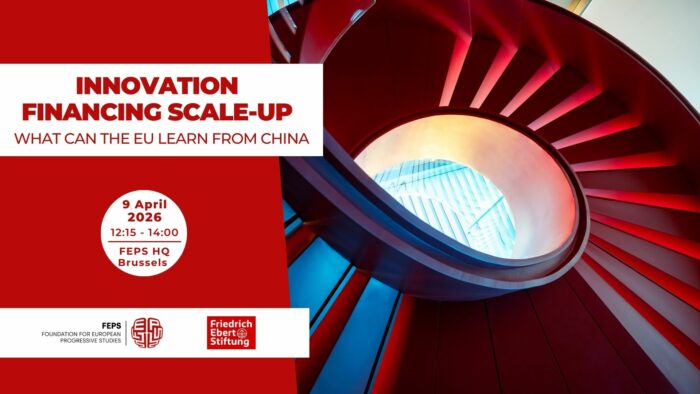
28/01/2026
FEPS HQ

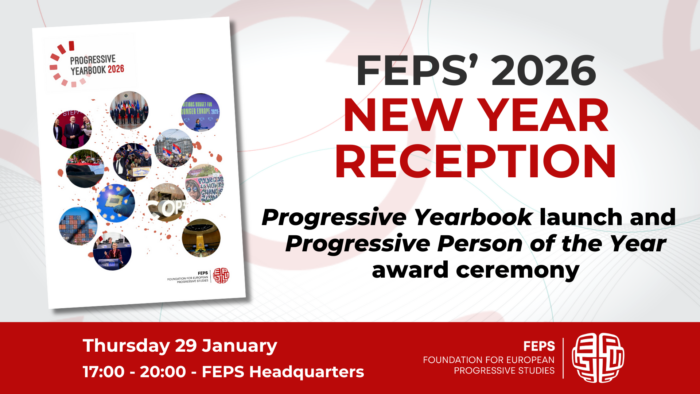
FEPS’ New Year Reception & Progressive Yearbook launch

7th edition
Past
17/11/2025
FEPS HQ, Brussels (Expert meeting)

New own resources in the MFF proposal

EU Investment Capacity Group 2025
08/11/2025
Santa Marta, Colombia

EU-LAC dialogue on Just Transition and trade

Despite the EU’s growing emphasis on sustainability, its trade and investment policies remain largely disconnected […]
Load more...
Find all related Audiovisual
Audiovisual
17/11/2025

New own resources in the MFF proposal

Photo album of the ‘New own resources in the MFF proposal‘ event at FEPS HQ, […]
13/11/2025

‘Evolutionary leap of the European trade policy’ Flickr album

Photo album of the ‘Evolutionary leap of the European trade policy‘ event at FEPS HQ, […]
06/10/2025

‘The profit-price spiral: How to prevent the cost of living crises’ Flickr album

Photo album of the ‘The profit-price spiral: How to prevent the cost of living crises‘ […]
04/09/2025

‘Inflation preparedness in the EU’ Flickr album

Photo event of the ‘Inflation preparedness in the EU‘ event in Brussels. On 3 September […]
Find all related news
News
10/09/2025

Von der Leyen – walking the walk at last?

FEPS reaction to The State of the European Union 2025
18/07/2025

A European Commission against the Social Contract

FEPS commentary on the MMF 2028-2034
26/02/2025

FEPS reaction to the European Commission’s Clean Industrial Deal

What Teresa Ribera presented today is an ambitious plan that makes the case for Europe […]
07/02/2025

FEPS President on the European car industry and the Competitive Compass on Euronews ‘Brussels, my love?’

FEPS President Maria João Rodrigues took part in the Euronews talk show ‘Brussels, my love?‘ […]
Find all related in the media
In the media

László Andor: Miből fejleszt az EU ezután?

by Portfolio 28/08/2025
“What will the EU develop from now on?” Analysis by FEPS Secretary General László Andor in Portfolio (HU), highlighting the new MFF’s shift toward increasing EU own-resources, boosting funding for strategic domains like defense, stabilisation and competitiveness, and calling for a flexible crisis-response mechanism such as the proposed Emergency Crisis Response Mechanism

Започва нов ЕС-бюджетен цикъл

by Novi Vremena 26/08/2025
“A new EU budget cycle begins” Article by FEPS Secretary General László Andor in Novi Vremena (BG), highlighting that while Europe must strengthen fiscal capacity to support balanced growth and strategic autonomy, priorities such as cohesion, defense, and social investment must be built into the next multiannual financial framework.

Ласло Андор: България не губи нищо от присъединяването си към еврозоната

by BNR 15/07/2025
"Bulgaria has nothing to lose by joining the eurozone” Interview with FEPS Secretary General László Andor on Bulgarian National Radio, where he explains that Bulgaria has already borne the costs of financial stability and will benefit from eurozone accession.

Tévedés azt hinni, hogy Trump után visszatérhetünk a régi kerékvágásba

by telex 24/04/2025
“It’s a mistake to think we can go back to the old normal after Trump”. Interview with FEPS Secretary General László Andor in Telex (HU), where he discusses the global trade tensions triggered by Trump-era tariffs, the shifting US-China dynamic, and the need for the EU to develop a new strategic approach in a permanently changed world order.