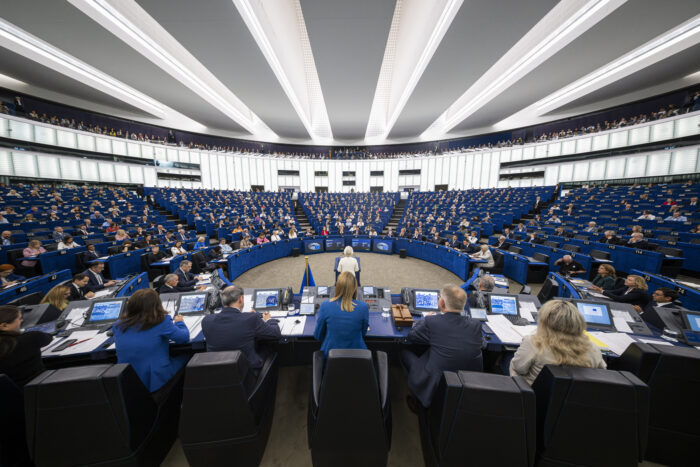

Models of (s)electing a pan-European Leading candidate

Policy Study

09/10/2014

The paper “Models of (s)electing a pan-European leading candidate” was elaborated Ania SKRZYPEK, FEPS Senior Research Fellow, within the Next Left Project of FEPS – Foundation for European Progressive Studies, which has been run for over a year in cooperation and with the support of Renner Institute, Austria.

This particular study was concluded as a research on possible mechanisms of nominating, selecting and deciding on who and how could become so called “top candidate” for the next European elections. The concrete setting that was chosen for explorations was PES – Party of European Socialists, which political resolutions and statutory solutions were examined.
What is important to underline is that the paper provides simplified models, analysing eventual impacts of one or another method, without an ambition to recommend any strategy in particular. Choice of the most feasible one is a decision of a political nature and hence can only be taken by the political actors within the PES.

The motivation to present the paper is to fulfil the FEPS core mission, which is to initiate and enhance the debate on the European issue. This is why, the crucial questions that this study points out as the one that needs exploration are the ones on the future of the participatory democracy, evolution and perspectives for the party political system and the understanding of what citizenship means on the EU level. And this debate will be continued within FEPS and its broad network of academics, researchers and experts.

1. Introduction

1.1 Why to have a top candidate in the EU elections?
1.2 What is to be considered, why selecting a method?

2. How can a top candidate be nominated?
2.1 PES President
2.2 PES Presidency and PES Presidency Nominating Committee
2.3 PES Leaders
2.4 PES Member Parties / Organizations
2.5 PES activists
2.6 PES Primaries

3. (S)electing a candidate
3.1 PES Presidency
3.2 PES Leaders
3.3 PES Member Parties – PES Council / Congress
3.4 PES activists
3.5 PES Primaries

4. Deciding on a candidate

5. Conclusions


Network
Karl Renner Institut
Find all related publications
Publications
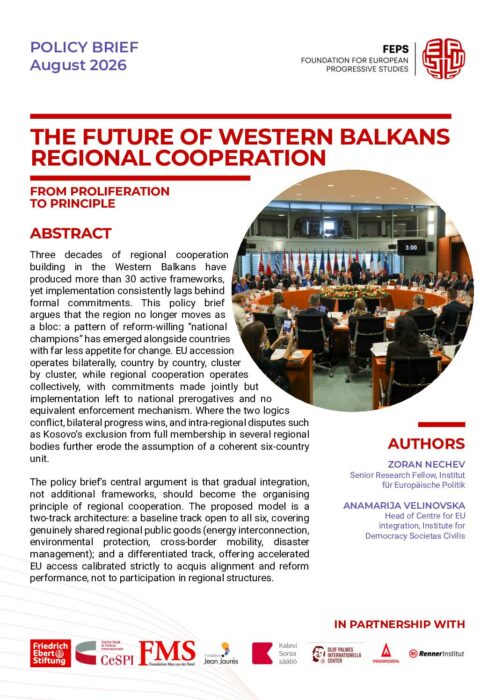
15/10/2024

The social and economic impact of Brexit across Northern Ireland

Regional and Sectoral Perspectives
15/10/2024

The Windsor Framework and its implications – for Britain, Northern Ireland and the EU

17/05/2024

External influences in the Western Balkans: Where are we at?

Balkan Focus Series
13/05/2024

Labour migration from the European periphery to the EU’s core

FEPS YAN Series
Find all related Progressive Post
Progressive Post
Find all related events
Events
Upcoming
20 - 22/11/2024
FEPS HQ, Brussels (Expert meeting)

Friends of the Western Balkans – Brussels

How will the new balance of power in Europe impact the accession process?
Past
16 - 17/10/2024
FEPS HQ

Beyond the border 

The implications of Brexit for the island of Ireland
22/09/2024
Liverpool, UK

The Future for the UK and Europe under a Labour Government

Find all related news
News
17/09/2024

New European Commission composition proposal – Reaction by FEPS Secretary General

29/04/2024

FEPS celebrates 20 years of the biggest EU enlargement

02/04/2024

Interview with Maria João Rodrigues on the need for EU treaty changes with Euronews

18/03/2024

FEPS President on Euronews talk-show ‘Brussels, my love?’

NATO extension, Portuguese elections, far-right and gender equality were the topics of the debate
Find all related in the media
In the media

Controversial Hungarian Gets EU Health Portfolio Nomination

by Medscape Medical News 18/09/2024
Read this article on the controversial appointment of Hungarian Olivér Várhelyi by Ursula von der Leyen as Commissioner for Health and Animal Welfare—a candidacy strongly questioned by László Andor, FEPS Secretary General

Podcast interview on the new European Parliament

by Encompass 23/07/2024
Listen to this podcast featuring László Andor, Secretary General of FEPS, and Paul Adamson, Founder of Encompass, as they explore the rise and impact of Viktor Orban and the shifting power dynamics in the European Parliament.

NATO-bővítés sok vitával: érvek, ellenérvek és lobbik a Clinton-elnökség idején

by BBC History 07/07/2024
"The controversial NATO enlargement: pros, cons and lobbying during the Clinton presidency" This article, written by FEPS Secretary General László Andor, looks back to the 1990s when the Eastern enlargement of NATO was requested, discussed, orchestrated, and eventually completed.

Orbánov boj z zunanjim sovražnikom ni bil kos inflaciji

by DELO 28/05/2024
In an article in Delo, László Andor criticises Viktor Orbán government's economic policies, such as not allowing Hungary to join the euro area, which he believes would have helped curb inflation. He also criticises the government for blaming external enemies such as the President of the European Commission, to cover up its own failures.