29/05/2024
Over the upcoming five years, the European Union will cope with very different and challenging trends. The combination of all these trends might directly threaten the European project. However, another way is possible, if the European Union is able to build up the EU defence capability, economic security and social and democratic resilience. Nevertheless, these new priorities on the external front must not come at the price of sacrificing other priorities notably stepping up the green transition with social justice, regulating the digital revolution according to European values and implementing the European Social Pillar to tackle inequalities. Hence, a crucial issue for the next legislature will be how to deliver and finance all these compelling priorities – all these European public goods – at the same time.
The European Union will cope with a very different and challenging context. At the planetary scale, a still expanding population with increasing needs will put mounting pressure on resources, increase the challenges of the multifaceted climate crisis and trigger even larger migration flows. This, in turn, will raise the urgency to change the energy and technological solutions as well as the growth model in order to meet these needs with less pressure on natural resources.
The digital revolution will transform everything beyond our imagination with a myriad of sensors, apps, platforms and AI algorithms: all sectors and supply chains will be reorganised, all jobs, working conditions, skills and education will be re-designed, and social, cultural as well as political relationships will be multiplied – all this with great potential benefits but also with great risks.
All these challenges would be easier to address with much higher international cooperation. Nevertheless, the logic of geopolitical competition for areas of influence risks becoming predominant not only between the US and China but also between other global players, including aggressive ones, such as Russia, driven by Putin’s imperialist dreams.
The combination of all these trends would directly threaten the European project, notably if:
– the war in Ukraine becomes a prolonged one, requiring an extraordinary effort from the European side,
– the process of enlargement is disturbed by Russian influence,
– the tensions in the neighbour regions – Middle East, Africa – raise the migration pressure on Europe,
– Europe is not able to build up its resilience in terms of security, defence, energy, food, critical raw materials and supply chains,
– Europe is not able to shape its own way and strategic autonomy in the digital revolution,
– the EU lacks the financial means to ensure a fair green transition, triggering social tensions and revolts by different groups: farmers, workers losing their jobs, vulnerable households dealing with unbearable energy, transport and housing prices,
– social inequalities increase within and between regions and generations, unleashing forced migration and brain drain,
– the democratic debate for better solutions is disturbed by political forces resisting European cooperation, preferring nationalistic retrenchment and increasing their influence with populist messages in social networks.
Such a scenario became possible (and arguably the most likely one!) in the near future. However, another one is possible, if the European Union is able:
– to build up its security, resilience and strategic autonomy by improving its external policy coordination, developing the EU defence capability and strengthening economic security and social resilience,
– to act as a global player, building better solutions for international cooperation, developing new EU strategic partnerships and strengthening EU role in global governance,
– to reorganise its relationships with neighbour regions, implementing the EU Pact on Migration and Asylum and conducting successfully a new wave of enlargement with a new gradual approach.
However, these new priorities on the external front must not come at the price of sacrificing other compelling priorities notably:
– stepping up the green transition with social justice in each sector, combining a strong social policy and a real European industrial policy to develop the EU’s innovation system,
– regulating the digital revolution according to European values, increasing the EU’s digital capabilities and framing the impact of digitalisation on labour and employment,
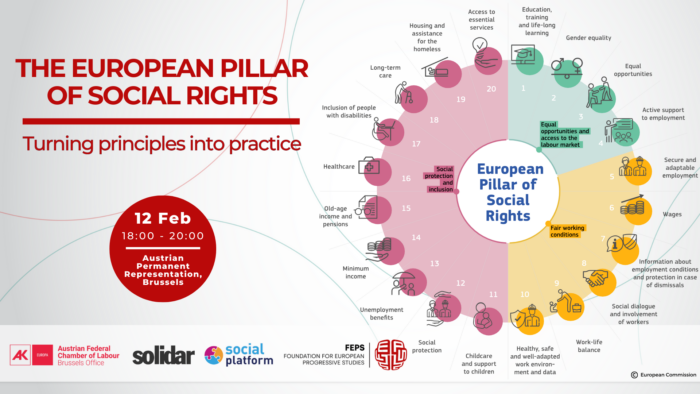
– implementing the European Social Pillar, notably in social services of general interest, such as health and education, developing a new care sector and launching a European Plan for housing.
Hence, the crucial question for the next legislature will be: how to deliver and finance all these priorities – all these European public goods – at the same time? More should be done at the national level. The recent reform of the economic governance and national fiscal rules will require member states to conduct four-year fiscal and structural plans that combine reforms and investments with more fiscal space. Private investment should be mobilised at all levels by completing the Capital Markets Union and developing the European Investment Programme conducted by the European Investment Bank.
Nevertheless, the European public capacity for investment must also be strengthened to address central European public goods priorities in security, defence, energy and digital infrastructures, and to cope with shocks with social impact as happened during the pandemic. This ambition should also be present when preparing the next multiannual financial framework (MFF), from 2026 onwards.
All these concerns should be reflected in the reforms of EU tax policy, for more tax fairness and also because new own resources must be found. Most of the above-mentioned challenges will require stronger European solutions, and if the capacity to deliver them fails, the rise of the far right and anti-European forces will become even more visible across Europe.
Hence, protecting and transforming the democratic systems at local, national and European levels should also be a priority for the next legislature with some central concerns: better enforcing the rule of law, developing the connections between the EU and European citizens in both representative and participatory democracy and developing the media infrastructure for stronger democracy. Finally, target changes in the EU treaties should not be considered a taboo if they become decisive to ensure the capacity to decide and to act on issues that European citizens demand.
This is what is at stake when voting in the next European elections.
Photo Credits: Shutterstock.com/StunningArt
Find all related Progressive Post
Progressive Post

Find all related events
Events
No upcoming events at the moment.
Siena, Italy
FEPS HQ

Siena, Italy
Austrian Permanent Representation, Brussels
Load more...
Find all related publications
Publications
Find all related Audiovisual
Audiovisual
06/11/2026
06/11/2026

17/10/2024

10/10/2024