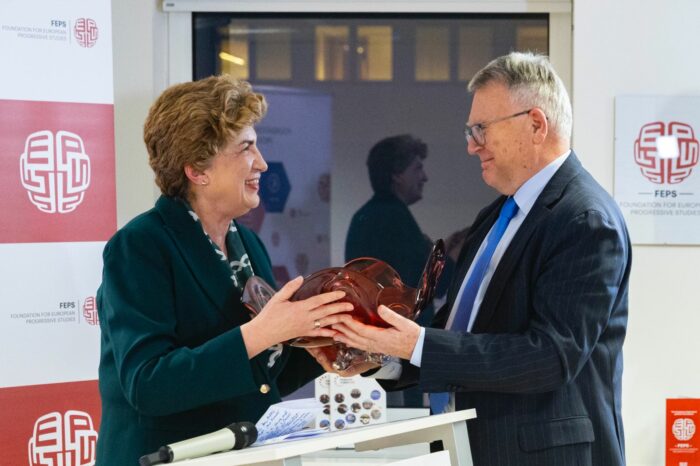

FEPS Young Academics Network 12th seminar

The Young Academics Network (YAN) was established in March 2009 by the Foundation of European […]
Speakers

31 - 04/10/2013
00:00:00 - 00:00:00
Karl Renner Institut, Vienna, Austria Khleslplatz 12 A 1120 Vienna, Austria
FEPS Young Academics Network 12th seminar
55978
111-feps-young-academics-network-12th-seminar
0

In order to give you access to our events, FEPS processes your personal data together with any other organiser of this event mentioned in the description of the event and in accordance with 'FEPS’ data protection policy.

The Young Academics Network (YAN) was established in March 2009 by the Foundation of European Progressive Studies (FEPS) with the support of the Renner Institut to gather progressive PhD candidates and young PhD researchers, who are ready to use their academic experience in a debate about the Next Europe. The founding group was composed of awardees of the “Call for Paper” entitled “Next Europe, Next Left” – whose articles also help initiating the FEPS Scientific Magazine “Queries”. Quickly after, with the help of the FEPS member foundations, the group enlarged – presently incorporating around 30 outstanding and promising young academics.

FEPS YAN meets in the Viennese premises of Renner Institut, which offers great facilities for both reflections on the content and also on the process of building the network as such. Both elements constitute mutually enhancing factors, which due to innovative methods applied makes this Network also a very unique project. Additionally, the groups work has been supervised by the Chair of the Next Left Research Programme, Dr. Alfred Gusenbauer – who at multiple occasions joined the sessions of the FEPS YAN, offering his feedback and guidance.

Each of the meetings is an opportunity for the FEPS YAN to discuss the current state of their research, presenting their findings and questions both in the plenary, as also in the respective working groups. The added value of their work is the pan-European, innovative, interdisciplinary character – not to mention, that it is by principle that FEPS wishes to offer a prominent place to this generation of academics, seeing in it a potential to construct alternative that can attract young people to progressivism again. Though the process is very advanced already, the FEPS YAN remains a Network – and hence is ready to welcome new participants.

FEPS YAN plays also an important role within FEPS structure as a whole. The FEPS YAN members are asked to join different events (from large Conferences, such as FEPS “Call to Europe” or “Renaissance for Europe” and PES Convention to smaller High Level Seminars and Focus Group Meetings) and encouraged to provide inputs for publications (i.e. for FEPS Scientific Magazine “Queries”). Enhanced participation of the FEPS YAN Members in the overall FEPS life and increase of its visibility remains one of the strategic goals of the Network for 2013.

For more information please contact the FEPS colleagues in charge of the FEPS YAN’s coordination: Ania Skrzypek, FEPS Senior Research Fellow at ania.skrzypek@feps-europe.eu, or Judit Tanczos, FEPS Policy Advisor at judit.tanczos@feps-europe.eu.

Network
Karl Renner Institut
Find all related publications
Publications
15/12/2025

The great unravelling

“The great unravelling” examines the challenges that the new era of globalisation poses for progressive […]
09/12/2025

Tackling the housing crisis in Europe

Progressive ideas for affordable and sustainable housing policies
28/11/2025

Smarter spending today, safer societies tomorrow

Digitally-enabled capabilities for European defence
28/11/2025

More money, more dependence?

Financing European Union defence for autonomy and cooperation
Find all related Audiovisual
Audiovisual
15/12/2025

FEPS Extraordinary General Assembly 2025

10/12/2025

‘Tackling the housing crisis in Europe’ Flickr album

Photo album of the ‘Tackling the housing crisis in Europe‘ event at the European Parliament […]
17/11/2025

New own resources in the MFF proposal

Photo album of the ‘New own resources in the MFF proposal‘ event at FEPS HQ, […]
15/11/2025

‘Africa Day 2025’ Flickr album

Photo album of the ‘Africa Day 2025‘ event in Amsterdam, Netherlands. Africa Day has been […]
Find all related news
News
12/12/2025

FEPS elects Nicolas Schmit as new President

After eight years in the role, outgoing President Maria João Rodrigues requested to be replaced, considering her mission accomplished. 
08/12/2025

Friends of the Western Balkans’ joint statement

Belgrade, 21 November 2025 We, the Friends of the Western Balkans (FoWB) – representatives of […]
04/12/2025

It is high time that the goal is set on “Quality”

FEPS commentary on the Quality Jobs Roadmap
27/11/2025

Is a bad COP outcome better than no outcome at all?

FEPS Commentary on COP30
Find all related in the media
In the media

Liberal democracy’s social, societal fabric under threat – Live from the EPC Annual Conference 2025

by EPC 08/12/2025
In a podcast by the European Policy Centre (EPC), FEPS Secretary General, László Andor, discusses how liberal democracy in Europe is being challenged not only at the institutional level but also through the erosion of social rights and what Europe must do to defend its social foundations.

« La souveraineté numérique européenne est un défi d’ordre civilisationnel »

by Le Monde 15/11/2025
"European digital sovereignty is a challenge for civilisation as a whole". In an opinion piece in the newspaper Le Monde, FEPS President Maria João Rodrigues shares her concerns about European digital dependence on American and Asian giants

When Algorithms Undermine Democracy: Europe’s Wake-Up Call

by Social Europe 11/11/2025
Maja Fjaestad and Simon Vinge, co-editors of FEPS book "Algorithmic rule", wrote this op-ed on the power of algorithms and how they threaten the foundations of democratic oversight

Los mapas de las fronteras internas que alimentan el voto ultra en Europa

by El Confidencial 13/10/2025
"The internal border maps that fuel the far-right vote in Europe" - FEPS Secretary-General László Andor discusses the impact of cohesion policies on social inequalities and the rise of the far-right across Europe in this El Confidencial article.