Just Transition: How to manage the social and economic aspects towards more sustainability

Without effective leadership, accountability and management, the transition to sustainability is likely to face considerable […]
Speakers

09 - 11/07/2015
00:00:00 - 00:00:00
Riga Riga
Just Transition: How to manage the social and economic aspects towards more sustainability
56074
207-just-transition-how-to-manage-the-social-and-economic-aspects-towards-more-sustainability
0

In order to give you access to our events, FEPS processes your personal data together with any other organiser of this event mentioned in the description of the event and in accordance with 'FEPS’ data protection policy.

Without effective leadership, accountability and management, the transition to sustainability is likely to face considerable resistance from communities and regions that are fearful of disruption change as well as the perception of a loss of livelihoods in a low-carbon future. These emotions have to be managed if we are to tackle climate change within in the next 30 years if humanity is to remain below the 2 degrees threshold.

Building a new sustainable socio-fabric is vital but equally important is ensuring workers, communities and future generations have access to it. This requires much greater attention to how the change is managed rather than current policy-makers fixation on development of new technologies. Miguel Arias Cañete, Commissioner for Climate Action and Energy, alluded to this when introducing the deep transformation the new Energy Union framework would bring and that it “[W]ill not be easy and require trust, respect and cooperation”.

Identifying a transferable governance architecture which encapsulates joint accountability, ownership and management of change will help breed an environment of trust, cooperation and inclusive participation which is essential to the success of the transformation. The key is to integrate industrial policy with energy transition and social harmony.

This round-table aims to gather policy-makers, politicians, trade union representatives, education, workers from industry, business representatives etc.

Key questions to address in the discussions:

How to encourage joint accountability, ownership and management of change?

How can we create an environment of trust, cooperation and inclusive participation to work towards common goals?

Social dialogue will be a key part of the change, who, how and what should this involve?

In what ways will a changing energy policy affect industrial policy?

What institutional or governance architecture will be needed to secure these changes effectively?

What is the role of local, regional, national, European governments and Trade Unions in a Just Transition?

You can find out more information related to this topic on FEPS project ‘Managing the Just Transition’

Find all related publications
Publications
15/12/2025

The Great Unravelling

“The great unravelling” examines the challenges that the new era of globalisation poses for progressive […]
09/12/2025

Tackling the housing crisis in Europe

Progressive ideas for affordable and sustainable housing policies
28/11/2025

Smarter spending today, safer societies tomorrow

Digitally-enabled capabilities for European defence
28/11/2025

More money, more dependence?

Financing European Union defence for autonomy and cooperation
Find all related Audiovisual
Audiovisual
15/12/2025

FEPS Extraordinary General Assembly 2025

10/12/2025

‘Tackling the housing crisis in Europe’ Flickr album

Photo album of the ‘Tackling the housing crisis in Europe‘ event at the European Parliament […]
17/11/2025

New own resources in the MFF proposal

Photo album of the ‘New own resources in the MFF proposal‘ event at FEPS HQ, […]
15/11/2025

‘Africa Day 2025’ Flickr album

Photo album of the ‘Africa Day 2025‘ event in Amsterdam, Netherlands. Africa Day has been […]
Find all related news
News
12/12/2025

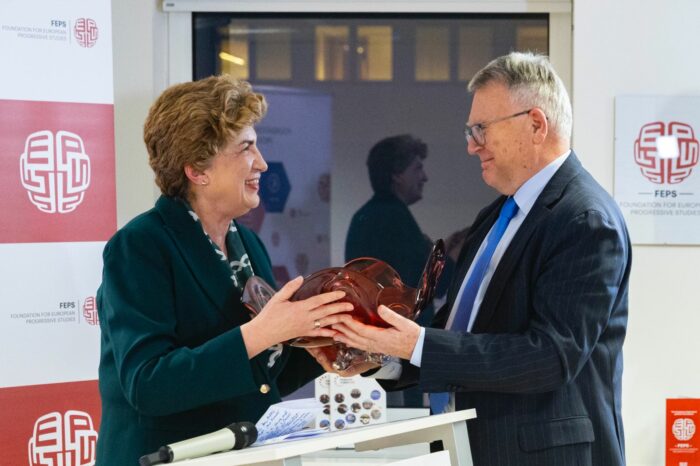
FEPS elects Nicolas Schmit as new President

After eight years in the role, outgoing President Maria João Rodrigues requested to be replaced, considering her mission accomplished. 
08/12/2025

Friends of the Western Balkans’ joint statement

Belgrade, 21 November 2025 We, the Friends of the Western Balkans (FoWB) – representatives of […]
04/12/2025

It is high time that the goal is set on “Quality”

FEPS commentary on the Quality Jobs Roadmap
27/11/2025

Is a bad COP outcome better than no outcome at all?

FEPS Commentary on COP30
Find all related in the media
In the media

Liberal democracy’s social, societal fabric under threat – Live from the EPC Annual Conference 2025

by EPC 08/12/2025
In a podcast by the European Policy Centre (EPC), FEPS Secretary General, László Andor, discusses how liberal democracy in Europe is being challenged not only at the institutional level but also through the erosion of social rights and what Europe must do to defend its social foundations.

« La souveraineté numérique européenne est un défi d’ordre civilisationnel »

by Le Monde 15/11/2025
"European digital sovereignty is a challenge for civilisation as a whole". In an opinion piece in the newspaper Le Monde, FEPS President Maria João Rodrigues shares her concerns about European digital dependence on American and Asian giants

When Algorithms Undermine Democracy: Europe’s Wake-Up Call

by Social Europe 11/11/2025
Maja Fjaestad and Simon Vinge, co-editors of FEPS book "Algorithmic rule", wrote this op-ed on the power of algorithms and how they threaten the foundations of democratic oversight

Los mapas de las fronteras internas que alimentan el voto ultra en Europa

by El Confidencial 13/10/2025
"The internal border maps that fuel the far-right vote in Europe" - FEPS Secretary-General László Andor discusses the impact of cohesion policies on social inequalities and the rise of the far-right across Europe in this El Confidencial article.