10th Next Left Economic Circle: Towards Progressive alternatives for Europe

The 10th Roundtable took place at FEPS with Prof. Lord John Eatwell of Queens’ College […]

16/05/2013

The 10th Roundtable took place at FEPS with Prof. Lord John Eatwell of Queens’ College Cambridge and Jonathan Portes (Director of the National Institute of Economic and Social Research). Jonathan Portes presented possible progressive alternatives for creating jobs and achieving growth in Europe. In particular, he emphasises that in order to increase consensus the euro requires a fiscal and a banking union. Furthermore, alternative policies should focus on tackling youth unemployment, invest in innovation and increase public service productivity. Lord Eatwell assessed the role played by financial markets in the Eurozone crisis and on the importance of identifying the correct tool for stabilising the financial system.

Read the presentation

–> by Lord Eatwell

–> by Jonathan Portes

Background on the guests:
John Leonard Eatwell, Baron Eatwell, was born on 2nd of February 1945. Lord Eatwell was educated at Queens’ College at the University of Cambridge, where he gained a B.A., followed by Harvard University as a Kennedy Scholar, where he obtained a Ph.D. and returned to Queens’ as a research fellow. In 1988, together with Lord Hollick, he set up the Institute for Public Policy Research (one of Britain’s leading think-tanks). In1996 he was elected President of Queens’. He is Labour’s frontbench spokesperson for Treasury and Economic Affairs in the House of Lords. He joined the House of Lords as a life peer in 1992. He is President of Queens’ College, Cambridge, and Professor of Financial Policy in the University.  He has been a teaching fellow at Harvard University and a Visiting Professor at Columbia University, the University of Massachusetts at Amherst and the University of Amsterdam.  John is a Director of the Centre for Financial Analysis and Policy (CFAP) at the Judge Business School at Cambridge, and is also a Professor of Economics at the University of Southern California. He is currently a director of SAV Credit Limited and an adviser to the private equity firms Warburg Pincus & Company International Ltd and Palamon Capital Partners.

Jonathan Portes has a degree in Mathematics from the University of Oxford, and a Masters in Public Affairs from Princeton University. Mr. Portes started his career in HM Treasury in 1987, where he worked in several policy divisions before becoming Speechwriter and Private Secretary to the Chancellor of the Exchequer in 1991. Mr. Portes moved to the U.S. in 1995, where he combined a senior role in private sector economic consultancy, working on financial, regulatory and competition issues, with an advisory position on debt management issues at the U.S. Department of the Treasury. He returned to the UK in 1999 where he led an influential project on migration for the Prime Minister’s Strategy Unit. From 2000 to 2002, he was a partner in an international development consultancy, leading missions to Uganda, Albania and Former Yugoslav Republic of Macedonia to examine the European Commission’s economic and social development programmes and overall country strategy. Nowadays, he is a member of advisory committees at a number of economic research institutes and is a Trustee of the Coram Foundation. He is a Director of the National Institute of Economic and Social Research. Previously, he was Chief Economist at the Cabinet Office, where he advised the Cabinet Secretary, Gus O’Donnell, and Number 10 Downing Street on economic and financial issues. Before that he held a number of other senior economic policy posts in the UK government.

Antolín Sánchez Presedo was born on 5th of April 1955. He is graduated in law from the University of Santiago de Compostela (1972-1977) and has a master’s degree in European Union studies from Carlos III University, Madrid (1994-1996). He worked as a lawyer for five years after finishing his studies. While he was practising law He was elected member of Betanzos and Municipal Council’s. Four years later he became mayor of Betanzos and Member of the Galician Regional Parliament, positions that held until 1985 and 1997 respectively. On the other hand, from 1982 to 1994 he was member of the PSOE Federal Committee and Secretary-General of the PSdeG (Galician Socialist Party) from 1985 to 1997. In 1996 he went back to work as a lawyer and in 2001 assistant professor, MBA section, University of La Coruña. Finally, in 2004 he leaves the last positions and became Member of the European Parliament.

Professor Stephany Griffith Jones (BA Chile, PhD Cambridge), who is currently Financial Markets Program Director at the Initiative for Policy Dialogue at Columbia University. An economist working on global capital flows, with special reference to flows to emerging markets; macro-economic management of capital flows in Latin America, Eastern Europe and sub-Saharan Africa; proposals for international measures to diminish volatility of capital flows and reduce likelihood of currency crises; analysis of national and international capital markets; proposals for international financial reform


Find all related publications
Publications
29/01/2026

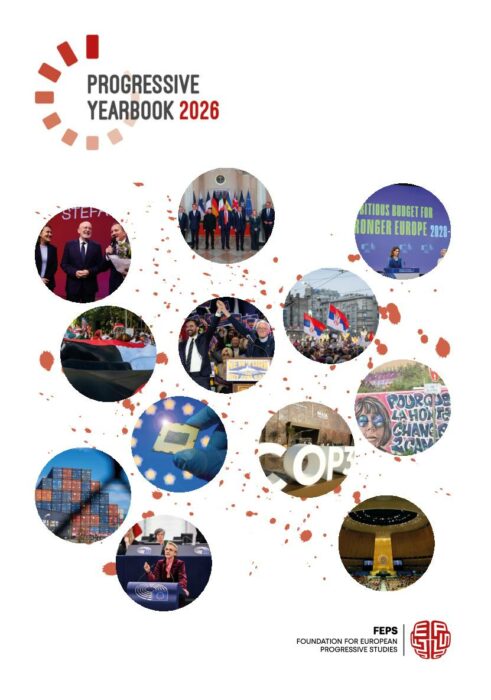
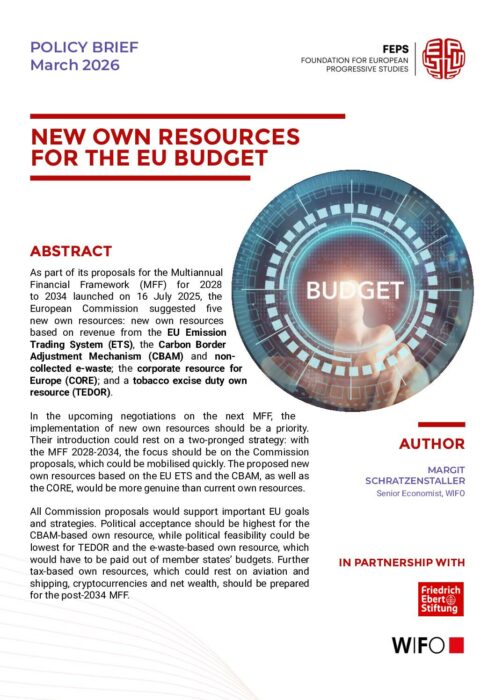
Progressive Yearbook 2026

In an eerie manner, 2025 resembled the ‘time of monsters’, which, according to the great […]
15/01/2026

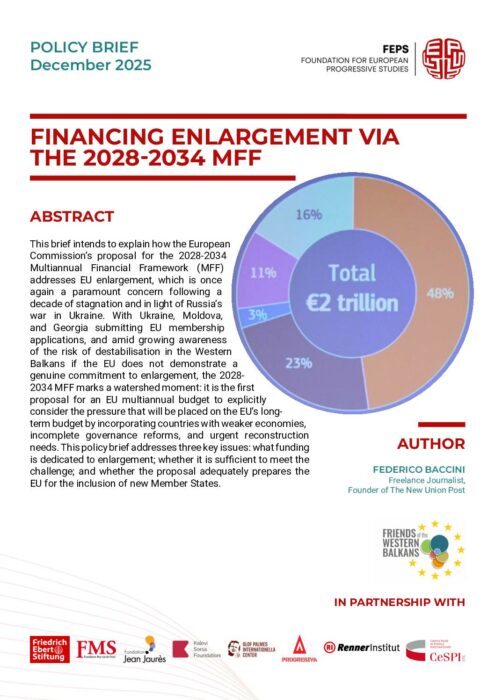
Financing enlargement via the 2028-2034 MFF

This brief intends to explain how the European Commission’s proposal for the 2028-2034 Multiannual Financial […]
19/12/2025

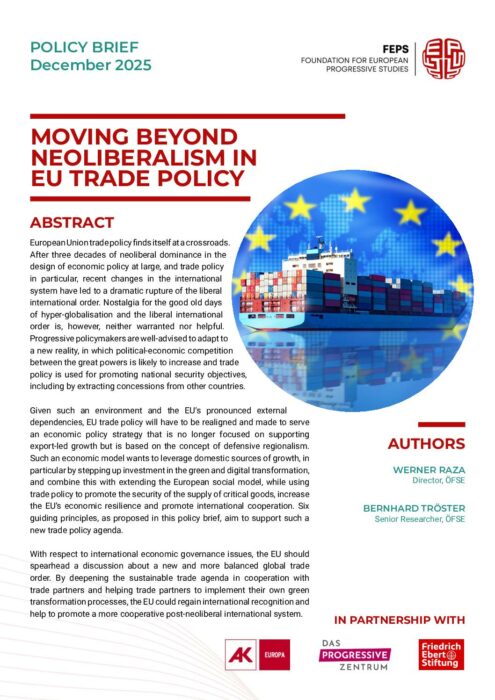
Moving beyond neoliberalism in EU trade policy

European Union trade policy finds itself at a crossroads. After three decades of neoliberal dominance in the […]
18/11/2025

Public investment in the proposed 2028-2034 EU budget

Needs, gaps and options
Find all related events
Events
Upcoming
19/03/2026
FEPS HQ

Place-based industrial policy in Europe

Any serious discussion of industrial policy must begin with the recognition that economic activity is […]
Past
29/01/2026
FEPS HQ

FEPS’ New Year Reception & Progressive Yearbook launch

7th edition
17/11/2025
FEPS HQ, Brussels (Expert meeting)

New own resources in the MFF proposal

EU Investment Capacity Group 2025
Load more...
Find all related news
News
29/01/2026

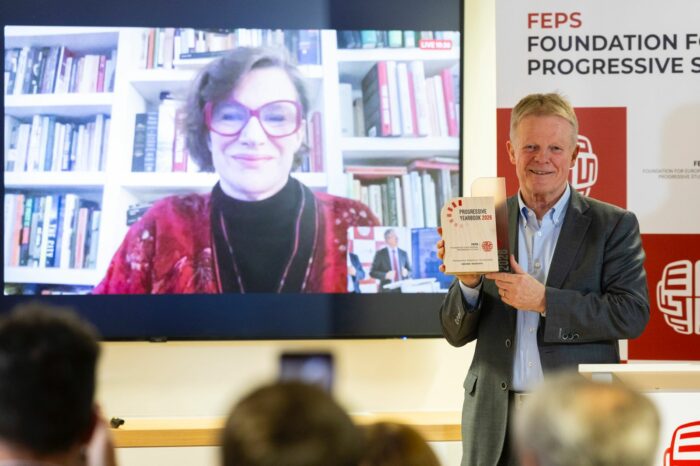
Marianna Mazzucato awarded FEPS ‘Progressive Person of the Year’

FEPS Progressive Person of the Year 2025-2026
10/09/2025

Von der Leyen – walking the walk at last?

FEPS reaction to The State of the European Union 2025
18/07/2025

A European Commission against the Social Contract

FEPS commentary on the MMF 2028-2034
26/02/2025

FEPS reaction to the European Commission’s Clean Industrial Deal

What Teresa Ribera presented today is an ambitious plan that makes the case for Europe […]
Find all related in the media
In the media

España los forma, Europa los contrata: así es el mapa de la nueva fuga de cerebros

by El Confidencial 10/02/2026
Spain trains them, Europe hires them: the map of the new brain drain: László Andor, FEPS Secretary-General, discusses the 'brain drain' as a result of the EU’s single market and highlights the need for a fairer mobility and retention strategy across the EU.

‘Regreso al futuro. El gran reseteo’ by Lina Gálvez

by Tinta Libre 02/02/2026
“Back to the Future: The Great Reset” Opinion article by FEPS Vice-President, Lina Gálvez reflecting on the current global crisis marked by rising authoritarianism, digital power and extreme inequality, and tracing its roots through a historical analysis of capitalism — from the post-1945 social and geopolitical settlement led by social democratic forces, through neoliberal financialisation, to what she describes as a new phase of fascist capitalism.

László Andor: Miből fejleszt az EU ezután?

by Portfolio 28/08/2025
“What will the EU develop from now on?” Analysis by FEPS Secretary General László Andor in Portfolio (HU), highlighting the new MFF’s shift toward increasing EU own-resources, boosting funding for strategic domains like defense, stabilisation and competitiveness, and calling for a flexible crisis-response mechanism such as the proposed Emergency Crisis Response Mechanism

Започва нов ЕС-бюджетен цикъл

by Novi Vremena 26/08/2025
“A new EU budget cycle begins” Article by FEPS Secretary General László Andor in Novi Vremena (BG), highlighting that while Europe must strengthen fiscal capacity to support balanced growth and strategic autonomy, priorities such as cohesion, defense, and social investment must be built into the next multiannual financial framework.