
26/11/2024
12:30 - 15:30
FEPS HQ (Expert meeting)
The EU’s recent shift towards geo-economic instruments, and its emphasis on economic security and competitiveness, does not need to entail the sidelining of environmental and social objectives. Building resilient supply chains is just as much a question of responding to calls for equal partnerships, and integrating justice considerations in the EU’s external environmental action as it is about diversifying energy-related partnerships. As such, the creation of a common and coherent understanding of justice, especially in situations of scarce resources, would go a long way in accelerating the wide-scale social, political, and economic transformations that are needed to face climate change.
The scale of the transition requires us to tackle existing global socio-economic inequalities that stand in the way of ambitious climate policies. Social and environmental objectives must therefore become inextricably linked to avoid climate and environmental policies from having further negative distributional impacts and exacerbating tensions in global fora.
As part of this discussion, some of the conclusions from the policy study ‘Evaluating the Impact of CBAM on Developing Countries‘ were presented by its authors, Suranjali Tandon and Kevin Le Merle. Given the severity of the climate crisis and its global ramifications, the EU cannot act alone on the question of climate change, further underlining the importance of justice-based approaches across the EU’s external environmental policies.

This event explored avenues for considering the international, intranational, and intergenerational dimensions of resource use from a global distributive justice perspective. We focused specifically on questions of critical resources used in global supply chains and sought solutions for balancing resilience against the imperatives of global cooperation and the protection of biodiversity.
For more information regarding this event, please do not hesitate to contact Luis Sáez Jiménez, Project Officer, at luis.saez@feps-europe.eu

Network
Related publications

Related Audiovisual
Audiovisual

Find all related publications
Publications
Find all related Progressive Post
Progressive Post

Find all related events
Events
FEPS HQ
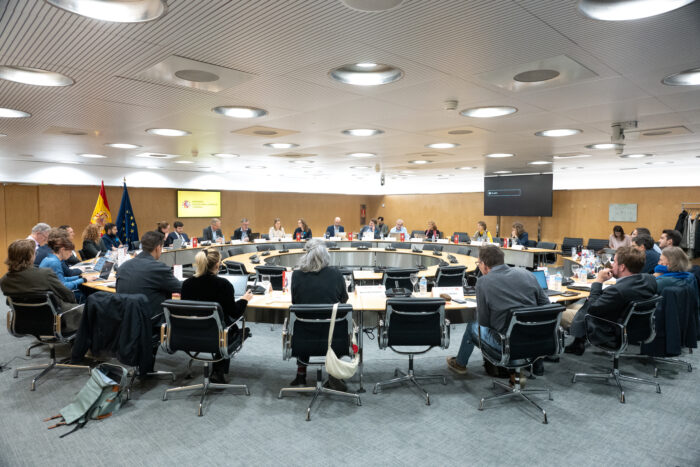
Madrid, Spain
Brussels, Belgium
Brussels, Belgium
Load more...
Find all related Audiovisual
Audiovisual
28/08/2026
28/08/2026

09/04/2026

25/03/2026
Find all related news
News

Find all related in the media
In the media
“Money is coming! Will Péter Magyar deliver on his promise?”
Video Interview published on KlikkTV (HU), featuring László Andor, FEPS Secretary General, discussing EU funds to Hungary, their political conditionality, and the importance of fair distribution, rule of law and social investment within the European Union.
España los forma, Europa los contrata: así es el mapa de la nueva fuga de cerebros
by El Confidencial 10/02/2026
“Back to the Future: The Great Reset”
Opinion article by FEPS Vice-President, Lina Gálvez reflecting on the current global crisis marked by rising authoritarianism, digital power and extreme inequality, and tracing its roots through a historical analysis of capitalism — from the post-1945 social and geopolitical settlement led by social democratic forces, through neoliberal financialisation, to what she describes as a new phase of fascist capitalism.
“What will the EU develop from now on?”
Analysis by FEPS Secretary General László Andor in Portfolio (HU), highlighting the new MFF’s shift toward increasing EU own-resources, boosting funding for strategic domains like defense, stabilisation and competitiveness, and calling for a flexible crisis-response mechanism such as the proposed Emergency Crisis Response Mechanism