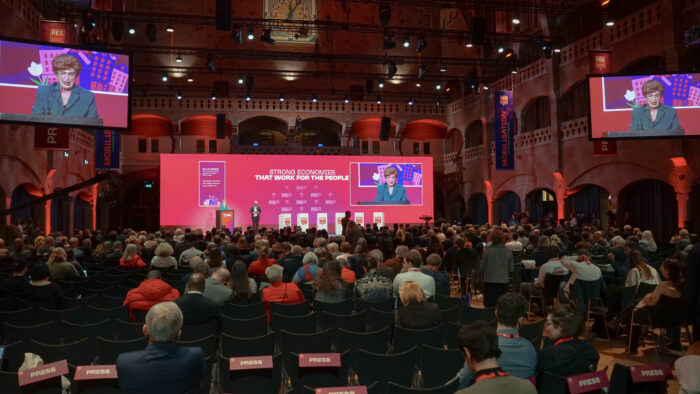
Launch of the report: next event Inequality and the top 10% in Europe

Did you know you may be among the better off? A great share the top […]

23/09/2020

Did you know you may be among the better off? A great share the top 10% income earners do not recognise themselves as rich or affluent

The study released today actually reveals that, even before the arrival of the Covid-19 pandemic, the most affluent in societies across Europe declared they are struggling with the cost of living and are feeling insecure and fearful about their future and that of their children.

Inequality and the top 10% in Europe is a two-years pioneering study conducted in four European countries which examines the financial position and attitudes towards inequality amongst the top 10% of income earners. Most inequality studies concentrate on contrasting the top 1% with the other 99%. However, given the high participation in conventional politics and the strong political influence of the top 10%, it is vital to understand their economic position, perceptions and values.

The study Inequality and the top 10% in Europe was conducted in the UK, Spain, Sweden and Ireland by the Foundation for Progressive Studies (FEPS) in collaboration with the Think Tank for Action on Social Change (TASC – Ireland), Compass (UK), Fundación Alternativas (Spain) and Arena Idé (Sweden).

Five Key Findings

1. Those in the top 10% do not think of themselves as ‘rich’. They compare themselves and look at the more affluent but rarely interact with those in the top 1% or 0.1%

2. They are further away from the top 1% than they are from the median earner (at 50%). The top 1% of earners is moving further away from the rest of population, also further from the rest of the 10%.

3. They feel politically alienated and disconnected from the rest of the society, despite their political influence.

4. They still hold on to meritocratic narratives to explain inequality; they tend to believe that working hard pays.

5. They support redistribution more than they used to – but of course, the want higher taxes to be targeted on those earning more than they do. Most are ambivalent about or supportive of taxes on wealth whilst they often oppose inheritance tax because they want to leave something for their children.

FEPS President Maria Joao Rodrigues: “This Report lifts the lid on how the so-called success stories of the most advantaged citizens are also failing. They are struggling, often because of the lack of key public service infrastructure in areas like health, education or housing. If the system isn’t working for them, then it certainly isn’t working for anyone else either, except the top 1%. And what about the others 90%? Even worst. We are in face of an extreme concentration of wealth

This research shows that any progressive messaging seeking to appeal to the top 10% has to stress that greater equality benefits everyone, even themselves, and public investment in public services provides the antidote to insecurity and financial vulnerability.

Read the report

Check the presentation by Marcos Gonzalez Hernando, Research coordinator for the project (slideshow) 

Find all related publications
Publications
18/11/2025

Public investment in the proposed 2028-2034 EU budget

Needs, gaps and options
26/06/2025

Strengthening and mainstreaming Just Transition goals in the EU Budget

The EU’s legally binding commitment to achieve climate neutrality by 2050 demands a far-reaching socio-economic […]
17/06/2025

Lessons learned from the Recovery and Resilience Facility for a future European fiscal capacity

The creation of the Recovery and Resilience Fund (RRF) as a response to the pandemic […]
05/05/2025

Shaping a European budget fit for climate action and a just transition

The negotiations for the next EU Multiannual Financial Framework (MFF) – the long-term budget at […]
Find all related events
Events
Past
17/11/2025
FEPS HQ, Brussels (Expert meeting)

New own resources in the MFF proposal

EU Investment Capacity Group 2025
13 - 15/11/2025
Vienna, Austria (Expert Meeting)

FEPS Young Academics Seminar

4th seminar of the 9th cycle
08/11/2025
Santa Marta, Colombia

EU-LAC dialogue on Just Transition and trade

Despite the EU’s growing emphasis on sustainability, its trade and investment policies remain largely disconnected […]
Load more...
Find all related news
News
10/09/2025

Von der Leyen – walking the walk at last?

FEPS reaction to The State of the European Union 2025
18/07/2025

A European Commission against the Social Contract

FEPS commentary on the MMF 2028-2034
26/02/2025

FEPS reaction to the European Commission’s Clean Industrial Deal

What Teresa Ribera presented today is an ambitious plan that makes the case for Europe […]
07/02/2025

FEPS President on the European car industry and the Competitive Compass on Euronews ‘Brussels, my love?’

FEPS President Maria João Rodrigues took part in the Euronews talk show ‘Brussels, my love?‘ […]
Find all related in the media
In the media

László Andor: Miből fejleszt az EU ezután?

by Portfolio 28/08/2025
“What will the EU develop from now on?” Analysis by FEPS Secretary General László Andor in Portfolio (HU), highlighting the new MFF’s shift toward increasing EU own-resources, boosting funding for strategic domains like defense, stabilisation and competitiveness, and calling for a flexible crisis-response mechanism such as the proposed Emergency Crisis Response Mechanism

Започва нов ЕС-бюджетен цикъл

by Novi Vremena 26/08/2025
“A new EU budget cycle begins” Article by FEPS Secretary General László Andor in Novi Vremena (BG), highlighting that while Europe must strengthen fiscal capacity to support balanced growth and strategic autonomy, priorities such as cohesion, defense, and social investment must be built into the next multiannual financial framework.

Ласло Андор: България не губи нищо от присъединяването си към еврозоната

by BNR 15/07/2025
"Bulgaria has nothing to lose by joining the eurozone” Interview with FEPS Secretary General László Andor on Bulgarian National Radio, where he explains that Bulgaria has already borne the costs of financial stability and will benefit from eurozone accession.

Tévedés azt hinni, hogy Trump után visszatérhetünk a régi kerékvágásba

by telex 24/04/2025
“It’s a mistake to think we can go back to the old normal after Trump”. Interview with FEPS Secretary General László Andor in Telex (HU), where he discusses the global trade tensions triggered by Trump-era tariffs, the shifting US-China dynamic, and the need for the EU to develop a new strategic approach in a permanently changed world order.