FEPS Newsletter 1 Sept 2023 – We are back!

📅 FEPS Newsletter: we are back! Share Tweet Share Share Western Balkans, gender, Sahel, employment, […]

01/09/2023
📅 FEPS Newsletter: we are back!
Western Balkans, gender, Sahel, employment, care and much more
 ‌ ‌ ‌ ‌ ‌ ‌ ‌ ‌ ‌ ‌ ‌ ‌ ‌ ‌ ‌ ‌ ‌ ‌ ‌ ‌ ‌ ‌ ‌ ‌ ‌ ‌ ‌ ‌ ‌ ‌ ‌ ‌ ‌ ‌ ‌ ‌ ‌ ‌ ‌ ‌ ‌ ‌ ‌ ‌ ‌ ‌ ‌ ‌ ‌ ‌ ‌ ‌ ‌ ‌ ‌ ‌ ‌ ‌ ‌ ‌ ‌ ‌ ‌ ‌ ‌ ‌ ‌ ‌ ‌ ‌ ‌ ‌ ‌ ‌ ‌ ‌ ‌ ‌ ‌ ‌ ‌ ‌ ‌ ‌ ‌ ‌ ‌ ‌ ‌ ‌ ‌ ‌ ‌ ‌ ‌ ‌ ‌ ‌ ‌ ‌ ‌ ‌ ‌ ‌ ‌ ‌ ‌ ‌ ‌ ‌ ‌ ‌ ‌ ‌ ‌ ‌ ‌ ‌ ‌ ‌ ‌ ‌ ‌ ‌ ‌ ‌
Upcoming Events
Returning to work after the summer holidays is more appealing with the exciting rentrée agenda the FEPS team has prepared for you!

This summer, we travelled, in-person and with our minds. We went to the Western Balkans and got back with a fresh ‘Balkan Focus’ series: a dive into the current political developments of this region. As much as we like to look at their present and future, these countries have a past to learn from.

In the following days, among other activities, we’ll host public events on Sahel, care economy and AI in the workplace. Join us and stay tuned, many more will be announced soon!
The new Balkan Focus series provides background analyses on current political developments in the Western Balkan countries and the debate and process of European enlargement.

The policy briefs are published in cooperation with Centro Studi di Politica Internazionale (CeSPI) and Karl Renner Institut, in synergy with the Friends of the Western Balkan (FoWB) project.

The EU needs to reassess its regional engagement and provide a credible enlargement path for the Western Balkans.

What are the challenges and geopolitical shifts impacting the EU enlargement process for the Western Balkan (WB6) region? This policy brief also underlines the importance of including the WB6 in the EU for European security and stability at large. Read more.
POLICY BRIEF
Perspective on staged accession
By Sabrina De Silva

Find here a timely analysis of the most relevant proposals – developed both within the European institutions and by independent research centres – on the staged accession methodology for the EU Enlargement process toward the Western Balkans.

This policy brief also includes a summary of the discussion held at the network meeting of Friends of the Western Balkans in June 2023. It highlights the strengths and weaknesses of the proposal developed during the discussion. Read more.
Dive down into Montenegro’s recent political history. From the loss of Milo Djukanović, leader of the Democratic Party of Socialists, in favour of Jakov Milatović, leader of the ‘Europe Now!’ Movement, to the consequences of this loss for the country’s commitment to EU values and its application for the European Union membership. Read more.

Stay tuned! Three more policy briefs of the ‘Balkans Focus’ will be published soon.
PAST EVENT
25-26 August – Korčula, Croatia
What lessons can we learn from the Balkan conflicts of the ’90s? Through a gender lens, we looked at this region hoping to find guidance for resolving the ongoing crisis in Ukraine.

Initiated in 2012, the Korčula School brings together women and men political leaders from centre-left and social-democratic parties, experts, political activists and feminists, especially from South Eastern Europe, to discuss gender equality issues.

Among the speakers that took part in the debate were Ann Linde, former Minister for Foreign Affairs for Sweden; Zita Gurmai, PES Women President; Maria João Rodrigues, FEPS President; László Andor, FEPS Secretary General; Knut Fleckenstein, FEPS Special Advisor on Western Balkans; and Laeticia Thissen, FEPS Senior Policy Analyst on Gender Equality.

📕Women in the Western Balkans were also the focus of our policy studies on the implementation of gender mainstreaming and women’s political participation.

Are activation policies aimed at removing barriers to employment and strengthening the connection between social protection and work life? Their purpose, and effectiveness have been subject to an ongoing debate. Critics argue that it can serve as a disguise for deregulation policies.

This study reviews the nature of activation reforms in National Recovery and Resilience Plans and observes that the Recovery and Resilience Facility helped trigger, or even amplified, essential welfare recalibrations. Read more.

In 2023, the Sahel crisis entered its twelfth year and took on a worrying new dimension and the new dynamics in place seem to have challenged Europe’s ability to act.
On this occasion, together with Fondation Jean-Jaurès and Istituto Affari Internazionali, we will analyse the implementation by the EU of its Integrated Strategy 2021 for the Sahel. With an approach based on true partnership and equality, we will examine the challenges and opportunities of the new regional context.
6 September – Online

Do you know how much the need for care is projected to grow with the EU’s population ageing?
According to projections, the total age-dependency ratio could accelerate acutely and is expected to reach 76.1% by 2050.

Our next
policy lunch of the Care4Care series, organised with Friedrich-Ebert-Stiftung and the European Public Service Union, will discuss the importance of recognising care as a priority for EU sustainable investments.

If well managed, the care economy can generate positive economic impacts and become a major vector for sustainable growth
.

UPCOMING EVENT
Led by machines
21 September – Stockholm, Sweden
With the computer revolution, the workplace has seen a rapid introduction of digital technologies for gig work, remote work, surveillance, and algorithmic management of workers.
This public launch of the FEPS-Nordics Digital Programme on Algorithmic Management and Workers’ Rights will bring together researchers, policymakers, trade unionists and other stakeholders from the Nordic countries to discuss the effects of digital tech on the nature of work itself across the labour market.
PROGRESSIVE PAGE
The wheels are coming off
By László Andor
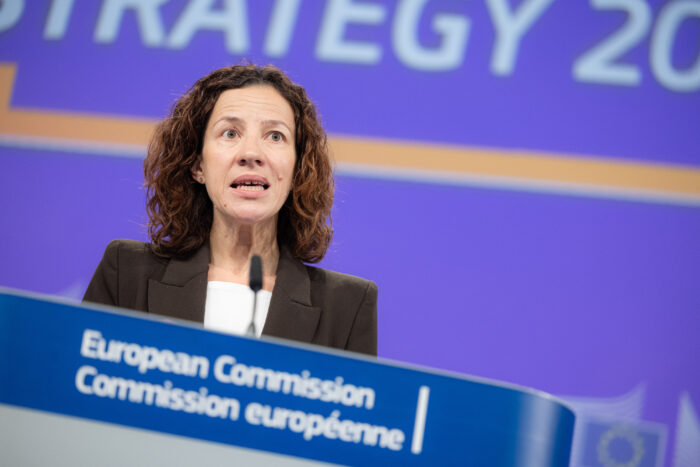
Frans Timmermans has stepped down as executive vice president of the European Commission. Margrethe Vestager is expected to become the president of the European Investment Bank, and Jutta Urpilainen is going to join the competition to become Finland’s new president.
These commissioners used to be political heavyweights in their home countries before moving to Brussels, which was certainly good for Europe. But due to their simultaneous departure more than one year before the end of the mandate of this Commission, added by the constant speculation about Ursula von der Leyen preparing for Jens Stoltenberg’s succession at the helm of NATO, the Commission’s leadership capacity is dramatically dropping. It gives the impression of the wheels coming off, and that the achievements of this cycle on major policy fields could remain incomplete. Read more.
Photo credits: Shutterstock/ Alexandros Michailidis
Twitter
Facebook
Linkedin
Instagram
Youtube
Website
Was this email forwarded to you?


Copyright © 2023 FEPS Europe, All rights reserved.
You are receiving this email because you participated in one of FEPS’ events and/or have registered for FEPS’ newsletter.
If you wish not to receive FEPS’ communications anymore, please click here: unsubscribe now


Email Marketing by ActiveCampaign
Find all related Progressive Post
Progressive Post
12/02/2026

Europe needs animal spirits again – and deregulation will not stimulate them

Europe’s competitiveness debate is accelerating under a growing sense of urgency. Slowing growth, geopolitical rivalry […]
11/02/2026

Ensuring tax justice in a fragile and unequal world economy

When a handful of economists met over a century ago in Geneva to deliver a […]
11/02/2026

The elephant in the European room

Critical raw materials and open strategic autonomy
Find all related Magazine
Magazine
  • cover book

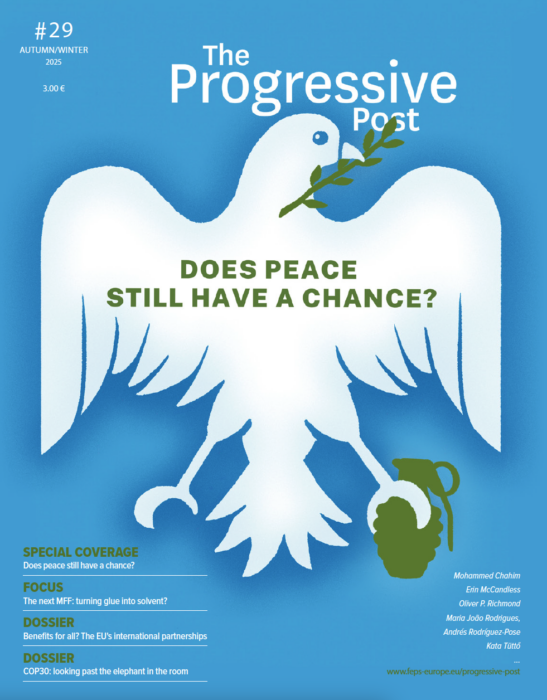
    # Issue 29 Progressive Post

# Issue 29

From the war in Ukraine to the devastation of Gaza since 2023, the words ‘war’ […]
  • cover book

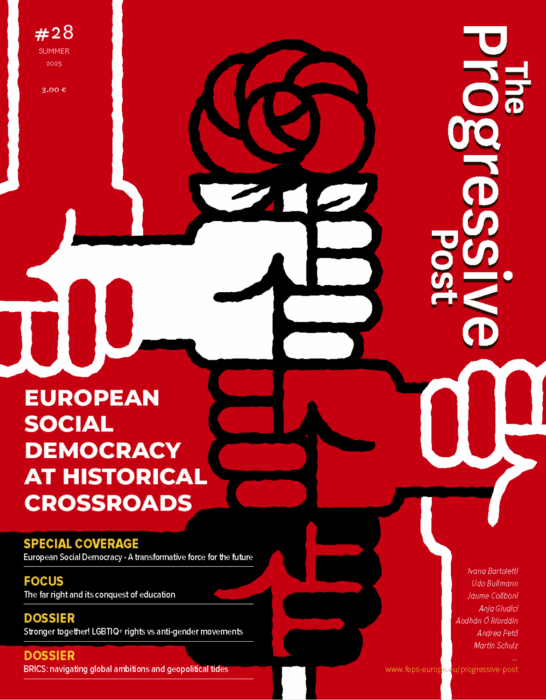
    # Issue 28 Progressive Post

# Issue 28

European Social Democracy at historical crossroads
  • cover book

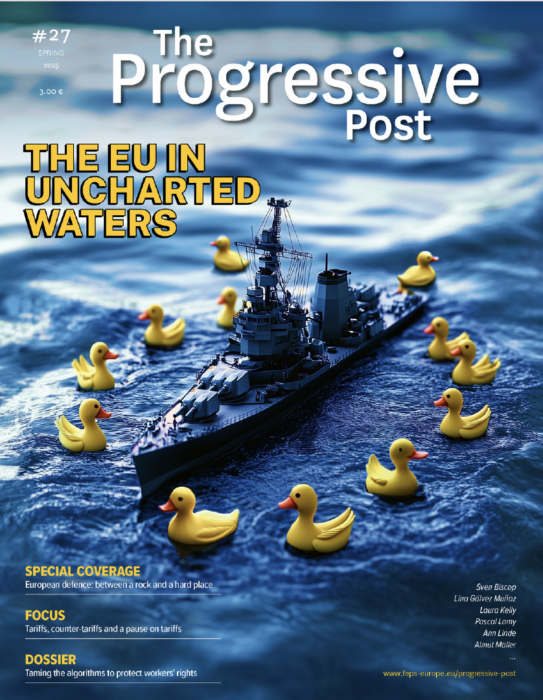
    #Issue 27 Progressive Post

#Issue 27

The EU in uncharted waters
Find all related publications
Publications
29/01/2026

Progressive Yearbook 2026

In an eerie manner, 2025 resembled the ‘time of monsters’, which, according to the great […]
15/01/2026

Financing enlargement via the 2028-2034 MFF

This brief intends to explain how the European Commission’s proposal for the 2028-2034 Multiannual Financial […]
19/12/2025

Moving beyond neoliberalism in EU trade policy

European Union trade policy finds itself at a crossroads. After three decades of neoliberal dominance in the […]
15/12/2025

The great unravelling

“The great unravelling” examines the challenges that the new era of globalisation poses for progressive […]
Find all related news
News
29/01/2026

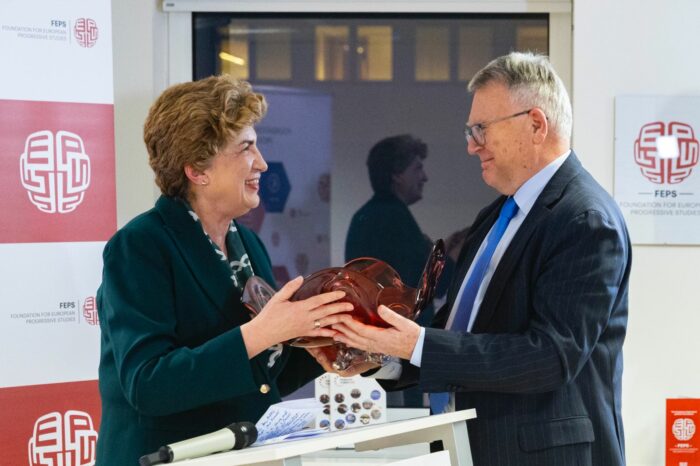
Maria João Rodrigues departs from FEPS Presidency, transitions to Nicolas Schmit

After completing eight years in the role, Maria Joâo Rodrigues has departed the role of […]
29/01/2026

Marianna Mazzucato awarded FEPS ‘Progressive Person of the Year’

FEPS Progressive Person of the Year 2025-2026
21/01/2026

Call for tender – HR consulting services

Applications to be submitted before 18 February
06/01/2026

Venezuela is not about drugs: Trump’s Regional Expansionism and Europe’s Test

FEPS Commentary on US military intervention in Venezuela
Find all related in the media
In the media

España los forma, Europa los contrata: así es el mapa de la nueva fuga de cerebros

by El Confidencial 10/02/2026
Spain trains them, Europe hires them: the map of the new brain drain: László Andor, FEPS Secretary-General, discusses the 'brain drain' as a result of the EU’s single market and highlights the need for a fairer mobility and retention strategy across the EU.

Von der Leyen’s management style ‘not good for Europe,’ says ex-commissioner

by POLITICO 02/02/2026
In this article published by POLITICO, FEPS New President Nicolas Schmit raises concerns about the Commission’s long-term vision and strategic planning, while noting its limited response to U.S. sanctions against Thierry Breton.

‘Regreso al futuro. El gran reseteo’ by Lina Gálvez

by Tinta Libre 02/02/2026
“Back to the Future: The Great Reset” Opinion article by FEPS Vice-President, Lina Gálvez reflecting on the current global crisis marked by rising authoritarianism, digital power and extreme inequality, and tracing its roots through a historical analysis of capitalism — from the post-1945 social and geopolitical settlement led by social democratic forces, through neoliberal financialisation, to what she describes as a new phase of fascist capitalism.

Luxembourg’s former EU Commissioner appointed to head Brussels think tank

by Luxembourg Times 30/01/2026
The Luxembourg Times covered the nomination of former European Commissioner Nicolas Schmit as President of FEPS.