FEPS Weekly Newsletter 16 Dec 2022 – International Migrants Day

📅FEPS Weekly: 🧳International Migrants Day Share Tweet Share Share Migration, Recovery Watch, energy and more…! […]

19/12/2022
📅FEPS Weekly: 🧳International Migrants Day
Migration, Recovery Watch, energy and more…!
 ‌ ‌ ‌ ‌ ‌ ‌ ‌ ‌ ‌ ‌ ‌ ‌ ‌ ‌ ‌ ‌ ‌ ‌ ‌ ‌ ‌ ‌ ‌ ‌ ‌ ‌ ‌ ‌ ‌ ‌ ‌ ‌ ‌ ‌ ‌ ‌ ‌ ‌ ‌ ‌ ‌ ‌ ‌ ‌ ‌ ‌ ‌ ‌ ‌ ‌ ‌ ‌ ‌ ‌ ‌ ‌ ‌ ‌ ‌ ‌ ‌ ‌ ‌ ‌ ‌ ‌ ‌ ‌ ‌ ‌ ‌ ‌ ‌ ‌ ‌ ‌ ‌ ‌ ‌ ‌ ‌ ‌ ‌ ‌ ‌ ‌ ‌ ‌ ‌ ‌ ‌ ‌ ‌ ‌ ‌ ‌ ‌ ‌ ‌ ‌ ‌ ‌ ‌ ‌ ‌ ‌ ‌ ‌ ‌ ‌ ‌ ‌ ‌ ‌ ‌ ‌ ‌ ‌ ‌ ‌ ‌ ‌ ‌ ‌ ‌ ‌
Upcoming Events
Ahead of International Migrants Day, FEPS wishes to remember the efforts and sacrifices of these women and men, who risk their lives every day to look for better opportunities elsewhere.

Throughout human history, migration has been a response to individuals’ wish to overcome adversity and improve their conditions and an expression of human resourcefulness. Nowadays, in Europe and elsewhere, migrants are often the object of discrimination, xenophobia and racism.

Yet, with their work and cultural heritage, they contribute to the development of the EU hosting countries’ societies and economies and help rejuvenate an otherwise ageing workforce.
Due to disinformation, a majority of Europeans believe that the migrant population in the EU is 16% when it is actually less than half that number! It’s just 7%.

Disinformation narratives about migration and migrants are widespread across Europe and very successful. They seek to exploit people’s concerns and anxieties to polarise public opinion and influence the political agenda.

FEPS, the European Policy Centre (EPC) and Friedrich-Ebert-Stiftung (FES) have been jointly working on a research project on Disinformation on Migration. It aims to analyse the issue in order to propose alternative strategies to tackle and prevent this phenomenon.
Boosting Europe’s resilience after Russia’s invasion
By Alberto-Horst Neidhardt

This is the last policy study of the Disinformation on Migration series.

Since Russia’s war on Ukraine, the EU has become the
epicentre of an information war. A large share of disinformation relating to the war concerns refugees, who are depicted, along with migrants, as a threat to Europeans.

Find here the two previous publications of the series:
OUTREACH CAMPAIGN

📺 Watch the animated video on how to fight disinformation in the EU
!

This video summarizes the results of a research project and presents concrete policy proposals to create the conditions for a more balanced and informed debate about migration.
EVENTS
Besides, a series of events have been organised in the last months:
This year’s edition of the international workshop ‘The EU asylum system in the aftermath of the Ukrainian humanitarian crisis?‘ focused on the positive – as well as negative – lessons learned from the management of large flows of refugees escaping the war in the Eastern European countries and its potential impact on the Pact on Asylum and Migration. The two policy briefs below respectively informed the debate among participants and summed up the main outcomes of the two-day meeting.
POLICY BRIEF
War in Ukraine, refugees, inclusion and human mobility: The challenges for a progressive EU policy?
By Andrea Stocchiero

This policy brief analyses the main EU decisions on the reception and integration of Ukrainian refugees, with reference to the decision to activate the Temporary Protection Directive. The flows from Ukraine are largely composed of women and children. This poses a pressing need for integration into schooling and the labour market, raising the problems of brain waste and segregation. Read more.
POLICY BRIEF
The EU asylum system in the aftermath of the Ukrainian humanitarian crisis
By Anna Ferro

How can the EU shape its asylum and migration policies, avoiding previous imbalances and injustice?

Analysing initial responses to the Ukraine refugee influx and taking stock of the evolution of the situation, this Policy Brief goes over current and potential legal responses in order to improve the outcome of the current migratory phenomenon. It calls for an upgrade in the institutional handling of migration. Read more.
By Philippe Fargues

On 15 November, the United Nations’ estimates of world population passed the 8-billion milestone. On that day, baby girl Vinice Mabansa, born in a maternity hospital of Manila, was designated as the eighth billionth person on earth. The choice of one of the global south’s busiest cities and the capital of the Philippines, a prominent origin state of migrants, was symbolic. Five weeks later, International Migrants Day should be an opportunity to raise awareness on how migration helps humanity to meet the challenge of keeping our planet inhabitable. Read more.
NEW ISSUE OF THE PROGRESSIVE POST MAGAZINE
Towards a healthier Union

In this winter issue of The Progressive Post magazine, the Special Coverage looks at the European Health Union that shall ensure the EU’s preparedness for future health emergencies.

The
Focus on multilateralism and international cooperation investigates the faults of the current international system. The Dossier on the State of the Union looks at how to realise an ever closer union finally. And in the Dossier on Next Left, we spotlight viable political alternatives to the narrative of the right.
Read more.
15 December – Rome, Italy

We presented the first results of the ‘Recovery Watch‘ research project to the Italian public.

Speakers included Fabrizio Barca, former Italian Minister and Co-coordinator of Forum Disuguaglianze e Diversità (FDD), national and local policymakers, experts and representatives from civil society organisations.

We focused on the themes linked to three policy contributions of the project: 1) Care policies and their gender dimension; 2) Childcare policies; 3) Climate measures’ impact on employment, particularly in the energy and automotive sectors.

This event was organised by FEPS, FES, and Institut Emile Vandervelde (IEV), with the support of FDD. It has been covered by media such as Corriere della sera.
12 December – Online

Which markets is the EU currently tapping into to diversify away from Russian imports? Will the EU’s energy policy strategy accelerate decarbonisation within this decade?

Together with FES, we discussed those questions and the geopolitics of the EU energy transition during this expert webinar. At the same time, we launched our latest Policy Brief by Dr Caroline Kuzemko.
Check the following job vacancies:

  • Digital Policy Analyst: Substantiate FEPS’ work on digital policy with particular attention given to issues of artificial intelligence and automation, technological change and innovation, digital single market, data governance and, not lastly, future of work. Deadline to apply: 20 December.
  • Project Officer: Plan and coordinate the administrative execution of assigned projects’ activities, including scheduling, reporting, document control, as well as the organization of related events. Deadline to apply: 2 January.
Website
Facebook
Twitter
Youtube
Instagram


Copyright © 2022 FEPS Europe, All rights reserved.
You are receiving this email because you participated in one of FEPS’ events and/or have registered for FEPS’ newsletter.
If you wish not to receive FEPS’ communications anymore, please click here: unsubscribe now


Email Marketing by ActiveCampaign
Find all related Progressive Post
Progressive Post
05/03/2026

Poverty is not a fatality

In 2024, more than 93 million Europeans, representing 21 per cent of the EU-population have […]
05/03/2026

Poverty is the result of political choices

On 12 February, the European Parliament voted on the report of the parliament’s committee on […]
Find all related Magazine
Magazine
  • cover book

    # Issue 29 Progressive Post

# Issue 29

From the war in Ukraine to the devastation of Gaza since 2023, the words ‘war’ […]
  • cover book

    # Issue 28 Progressive Post

# Issue 28

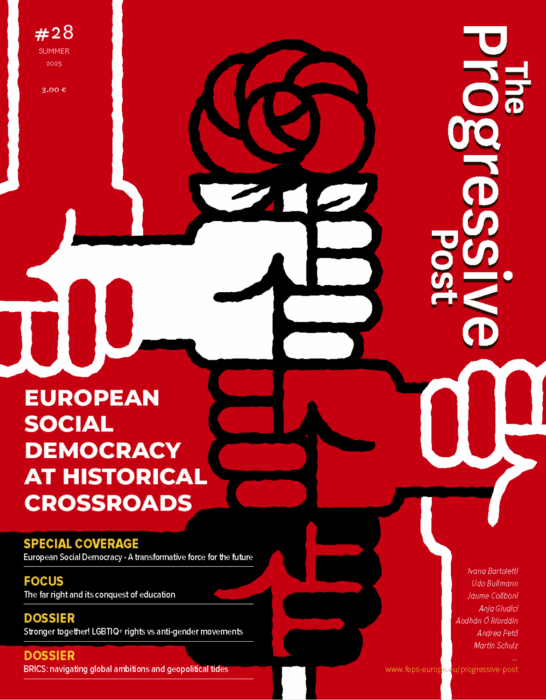
European Social Democracy at historical crossroads
  • cover book

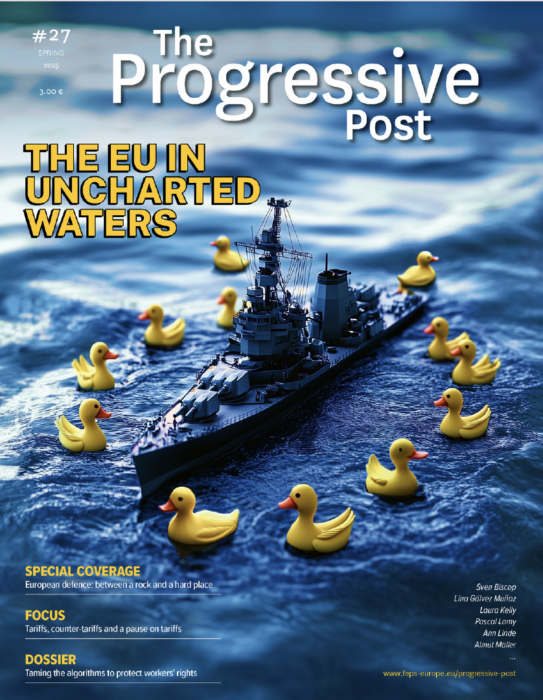
    #Issue 27 Progressive Post

#Issue 27

The EU in uncharted waters
Find all related publications
Publications
03/03/2026

Digital sovereignty and a new multilateralism for the AI era

Artificial intelligence (AI) is transforming not only economies but the very nature of global power, […]
03/03/2026

Progressive pathways for a resilient (re)construction of Ukraine: Towards a new social contract

This policy study places labour at the centre of reconstruction planning for Ukraine as the […]
03/03/2026

European sovereignty and the social dimension

Reasserting Europe’s social-democratic model in turbulent times
29/01/2026

Progressive Yearbook 2026

In an eerie manner, 2025 resembled the ‘time of monsters’, which, according to the great […]
Find all related news
News
05/03/2026

FFPPVC commentary on the new EU Gender Equality Strategy 2026-2030

Commentary by the Feminist Foreign Policy Progressive Voices Collective (FFPPVC)
03/03/2026

Wag the dog?

FEPS commentary on the US-Israel attack on Iran
03/03/2026

Closing ceremony of the Progressive Ukraine programme

The graduation ceremony completed the programme which was part of the Open Progressive University (OPU).
29/01/2026

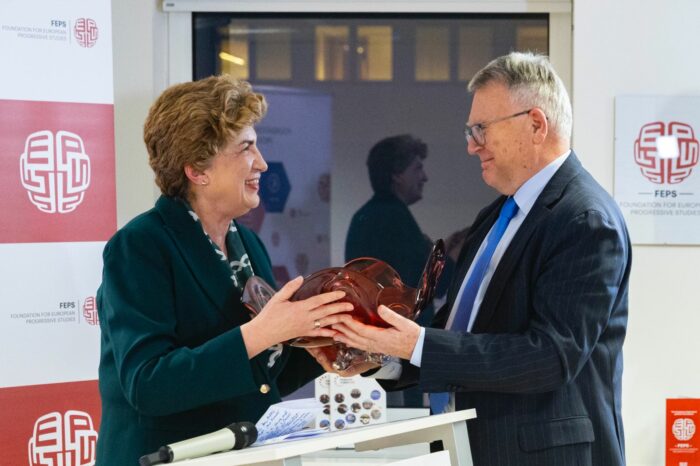
Maria João Rodrigues departs from FEPS Presidency, transitions to Nicolas Schmit

After completing eight years in the role, Maria Joâo Rodrigues has departed the role of […]
Find all related in the media
In the media

Africa and Europe Must Rethink Clean Energy Partnership After COP30 Setback

by News Ghana 27/02/2026
Read this article from News Ghana on the highlights of FEPS' event "Governing the global just transition", where diverse stakeholders discussed the EU's role in supporting a just transition from fossil fuels to clean energy in Africa

EUfória podcast Andor Lászlóval: Mire képes az EU saját erejéből és mennyire van kiszolgáltatva a világnak?

by EUrologus 26/02/2026
Listen to the EUfória podcast with László Andor, Secretary General of FEPS, on what the EU can achieve on its own, how to tackle its competitiveness challenge and how the Hungarian government’s stance shapes the EU’s image.

Can the EU ever become a superpower?

by Euronews 20/02/2026
In this episode of the podcast Brussels, My Love, FEPS President Nicolas Schmit discusses the informal meeting of the Antwerp European Industrial Summit and the Munich Security Council.

España los forma, Europa los contrata: así es el mapa de la nueva fuga de cerebros

by El Confidencial 10/02/2026
Spain trains them, Europe hires them: the map of the new brain drain: László Andor, FEPS Secretary-General, discusses the 'brain drain' as a result of the EU’s single market and highlights the need for a fairer mobility and retention strategy across the EU.