Next Left Working Group

Next Left Working Group Meetings

  • The Next Left Working Group is a gathering of academics researching on the field of comparative politics in terms of partisan and euro-partisan system. Composed of 15 members, it launched a pilot research programme in 2012 on Eurodemocracy and europarties 20 years after Maastricht, moving in 2013 to the theme Politicising Europe, Europeanising Social Democracy. The research papers completed within the pilot phase was published within the 7th volume of the FEPS Next Left Book Series.

2014

> 4th June (Brussels, Belgium) - Turning point of May 2014. Progressive European Reflections. The meeting gathered academics and policy makers from all over Europe to reflect on the campaign and the outcomes to define the opportunities for the progressive agenda to change the directions for Europe.

> 18th - 20th September (Warsaw, Poland) - 1st Polish National Congress of European Studies

> 19th - 21st (Vilnius, Lithuania) - Meeting tough choices and uniting a societal coalition – in the name of a modern welfare society. The subject of deliberations was chosen in conjunction with the main focus undertaken within the FEPS Next Left Research Programme this year – which is “Future for Welfare Societies”. Following the successful gatherings in Barcelona, Ljubljana and Lisbon – the discussions led in Vilnius provided an interesting, specific contribution with emphasis on the perspective of the north-eastern and central-eastern Europe.

2013

> 10th – 11th March (Vienna, Austria) - During which session the abstracts were discussed and the working methods were agreed upon. The ambition of this year’s work was to embed the deliberation more strongly within the contexts of the upcoming European Elections 2014.

> 20th – 21st October (Vienna, Austria) - Which meeting offered an opportunity to peer-review the first drafts of the respective papers. Additionally, the NL WG members engaged in an exchange with Andreas Schieder (then State Secretary in the Ministry of Finances, by now the President of SPÖ Group in the Federal Parliament; and the Head of the PES Finances Network).

> 15th – 16th December (Vienna, Austria) - Of which objectives were to offer final feedbacks to this year’s papers, to evaluate the year and to discuss planning for 2014. The members agreed that an effective way to promote the work of the NL WG would be to engage in academic conferences and hold panels there, for which the European Studies Congress in Warsaw (September) would serve as a great opportunity. Dr. Saskia Richter joined the WG at this session, involving in a debate with the presentation of her first abstract.

The topics chosen for research, and consequently discussed within the FEPS NL WG were: Responding to new patterns of social contestation: the politics of protest management during the global economic crisis; The 2014 European Parliamentary Elections and the issue of inter-EU immigration: responses from the centre-left; The PES and the financial crisis: options for 2014; From Euroscepticism to Eurorejectionism: Analysing discontent with European widening and deepening with EES and EU profiler data; From monetary to economic union? The Party of European Socialists’ quest for Economic Governance; PES restoring its credentials in 2014 critical elections; European Integration, the Radical Left and the Destabilisation of the Radical Project; Consensus, Coalition and Conflict – possibilities for transformation of the European partisan system; Never waste a good crisis? Europarties, economic governance and the role in EU democracy.

2012

The pilot phase of the FEPS Next Left Working Group was the year 2012, when the group was initiated. The invitations to join were sent those honourable scholars, whose unique scope of work focuses on the areas of: evolution of the europartisan system and history of social democracy in the context of transforming national party political systems. The invitation included a call for abstracts, which then would constitute the framing elements of the research programme for the year ahead. Subsequently, Working Group convened twice in those first twelve months – for the first time in hospitable premises of Renner Institut, for the second within the framework of the FEPS Next Left symposium in Berlin (joining in an exchange with the FEPS Next Left Focus Group).

> 13th – 14th May (Vienna, Austria) – The meeting offered a possibility for initial exchange on the bases of the abstract outlining respective research proposals. The participants, who then became the WG members, welcomed the initiative enthusiastically – underlining its originality and potential that such an opening within a European think tank world carries.

> 8th – 9th November in (Berlin, Germany) – Within the framework of the FEPS Next Left Symposium that was organized with the support of Renner Institut and thanks to the hospitality of SPD, the FEPS Next Left Working Group reconvened in Willy-Brandt-House. The objectives of the meeting were: to review of the drafts (which had been elaborated following the earlier debate on abstracts), to enable the first exchange between the Focus Group and the Working Group; to enter into a dialogue with invited politicians. For the details – please see the section “High Level Seminars”.

In the course of 2012, following themes were elaborated in form of abstracts and subsequently discussed at the meeting: European Democracy after Social Democracy. Conceptualizing the role of transnational parties; Is the party over or has it just begun? The importance of party members as a link between Europarties and citizens; The politicization and the EU politics – the PES and the financial crisis; The electoral vulnerability of social democratic parties in Europe; Nature and policies: The PES and socio-economic challenge; Economic Crisis, Fiscal Governance and Democratic Legitimacy: Transnational parties as a potential bridge between member states and the EU; The end of “pragmatically unstructured politics”? Debt crisis, the Europarties, and the programmatic leap forward of the PES; Between MLG and ECI – New Challenges and Opportunities for European Political Parties; Ideology, Politicisation and Identification – the role of the europarties in providing citizens with democratic choice; Summitry of Political Parties on the European Level: The case of the PES Leaders Meetings. The final papers constitute the content of the FEPS Next Left vol. 7 “In the Name of Political Union – Europarties on the Rise”.

FEPS Next Left Working Group

Dr. David Bailey, Lecturer at the Department of Political Science and International Studies at the University of Birmingham

Amandine Crespy, Assistant Professor of Political Science/ EU Studies at the Free University of Brussels (ULB)

Dr. Isabelle Hertner, Lecturer in German and European Politics and Society, Deputy Director of the Institute for German Studies at the University of Birmingham

Dr. Michel Holmes, Senior Lecturer in politics at the Department of History and Politics at the Liverpool Hope University

Dr. André Krowel, Associate Professor at the Faculty of Social Sciences at the University of Amsterdam (VU)

Dr. Erol Külahci , Associated Member of the Centre d’étude de la vie politique (CEVIPOL) at the Department of Social Sciences at the Free University of Brussels (ULB)

Prof. Robert Ladrech, Professor of European Polictics at the Faculty of Humanities and Social Sciences at Keele University

Dr. Simon Lightfoot, Senior Lecturer in European Politics at the Faculty of Education, Social Sciences and Law at Leeds University

Dr. Gerassimos Moschonas, Associate Professor in Comparative Politics at the Department of Political Science and History of Panteion University

Dr. Saskia Richter, Lecturar at the University of Hildesheim, Germany

Dr. Ania Skrzypek, Senior Research Fellow at the Foundation for European Progressive Studies (FEPS)

Dr. Ruy Teixeira Assistant Professor at the Faculty of Social Sciences at the University of Leuven (KU Leuven)

Dr. Steven Van Hecke, Assistant Professor at the Faculty of Social Sciences at the University of leuven (KU Leuven)

11/05/2018

Next Left Working Group Meetings

  • The Next Left Working Group is a gathering of academics researching on the field of comparative politics in terms of partisan and euro-partisan system. Composed of 15 members, it launched a pilot research programme in 2012 on Eurodemocracy and europarties 20 years after Maastricht, moving in 2013 to the theme Politicising Europe, Europeanising Social Democracy. The research papers completed within the pilot phase was published within the 7th volume of the FEPS Next Left Book Series.

2014

> 4th June (Brussels, Belgium)Turning point of May 2014. Progressive European Reflections. The meeting gathered academics and policy makers from all over Europe to reflect on the campaign and the outcomes to define the opportunities for the progressive agenda to change the directions for Europe.

> 18th – 20th September (Warsaw, Poland) – 1st Polish National Congress of European Studies

> 19th – 21st (Vilnius, Lithuania) – Meeting tough choices and uniting a societal coalition – in the name of a modern welfare society. The subject of deliberations was chosen in conjunction with the main focus undertaken within the FEPS Next Left Research Programme this year – which is “Future for Welfare Societies”. Following the successful gatherings in Barcelona, Ljubljana and Lisbon – the discussions led in Vilnius provided an interesting, specific contribution with emphasis on the perspective of the north-eastern and central-eastern Europe.

2013

> 10th – 11th March (Vienna, Austria) – During which session the abstracts were discussed and the working methods were agreed upon. The ambition of this year’s work was to embed the deliberation more strongly within the contexts of the upcoming European Elections 2014.

> 20th – 21st October (Vienna, Austria) – Which meeting offered an opportunity to peer-review the first drafts of the respective papers. Additionally, the NL WG members engaged in an exchange with Andreas Schieder (then State Secretary in the Ministry of Finances, by now the President of SPÖ Group in the Federal Parliament; and the Head of the PES Finances Network).

> 15th – 16th December (Vienna, Austria) – Of which objectives were to offer final feedbacks to this year’s papers, to evaluate the year and to discuss planning for 2014. The members agreed that an effective way to promote the work of the NL WG would be to engage in academic conferences and hold panels there, for which the European Studies Congress in Warsaw (September) would serve as a great opportunity. Dr. Saskia Richter joined the WG at this session, involving in a debate with the presentation of her first abstract.

The topics chosen for research, and consequently discussed within the FEPS NL WG were: Responding to new patterns of social contestation: the politics of protest management during the global economic crisis; The 2014 European Parliamentary Elections and the issue of inter-EU immigration: responses from the centre-left; The PES and the financial crisis: options for 2014; From Euroscepticism to Eurorejectionism: Analysing discontent with European widening and deepening with EES and EU profiler data; From monetary to economic union? The Party of European Socialists’ quest for Economic Governance; PES restoring its credentials in 2014 critical elections; European Integration, the Radical Left and the Destabilisation of the Radical Project; Consensus, Coalition and Conflict – possibilities for transformation of the European partisan system; Never waste a good crisis? Europarties, economic governance and the role in EU democracy.

2012

The pilot phase of the FEPS Next Left Working Group was the year 2012, when the group was initiated. The invitations to join were sent those honourable scholars, whose unique scope of work focuses on the areas of: evolution of the europartisan system and history of social democracy in the context of transforming national party political systems. The invitation included a call for abstracts, which then would constitute the framing elements of the research programme for the year ahead. Subsequently, Working Group convened twice in those first twelve months – for the first time in hospitable premises of Renner Institut, for the second within the framework of the FEPS Next Left symposium in Berlin (joining in an exchange with the FEPS Next Left Focus Group).

> 13th – 14th May (Vienna, Austria) – The meeting offered a possibility for initial exchange on the bases of the abstract outlining respective research proposals. The participants, who then became the WG members, welcomed the initiative enthusiastically – underlining its originality and potential that such an opening within a European think tank world carries.

> 8th – 9th November in (Berlin, Germany) – Within the framework of the FEPS Next Left Symposium that was organized with the support of Renner Institut and thanks to the hospitality of SPD, the FEPS Next Left Working Group reconvened in Willy-Brandt-House. The objectives of the meeting were: to review of the drafts (which had been elaborated following the earlier debate on abstracts), to enable the first exchange between the Focus Group and the Working Group; to enter into a dialogue with invited politicians. For the details – please see the section “High Level Seminars”.

In the course of 2012, following themes were elaborated in form of abstracts and subsequently discussed at the meeting: European Democracy after Social Democracy. Conceptualizing the role of transnational parties; Is the party over or has it just begun? The importance of party members as a link between Europarties and citizens; The politicization and the EU politics – the PES and the financial crisis; The electoral vulnerability of social democratic parties in Europe; Nature and policies: The PES and socio-economic challenge; Economic Crisis, Fiscal Governance and Democratic Legitimacy: Transnational parties as a potential bridge between member states and the EU; The end of “pragmatically unstructured politics”? Debt crisis, the Europarties, and the programmatic leap forward of the PES; Between MLG and ECI – New Challenges and Opportunities for European Political Parties; Ideology, Politicisation and Identification – the role of the europarties in providing citizens with democratic choice; Summitry of Political Parties on the European Level: The case of the PES Leaders Meetings. The final papers constitute the content of the FEPS Next Left vol. 7 “In the Name of Political Union – Europarties on the Rise”.

FEPS Next Left Working Group

Dr. David Bailey, Lecturer at the Department of Political Science and International Studies at the University of Birmingham

Amandine Crespy, Assistant Professor of Political Science/ EU Studies at the Free University of Brussels (ULB)

Dr. Isabelle Hertner, Lecturer in German and European Politics and Society, Deputy Director of the Institute for German Studies at the University of Birmingham

Dr. Michel Holmes, Senior Lecturer in politics at the Department of History and Politics at the Liverpool Hope University

Dr. André Krowel, Associate Professor at the Faculty of Social Sciences at the University of Amsterdam (VU)

Dr. Erol Külahci , Associated Member of the Centre d’étude de la vie politique (CEVIPOL) at the Department of Social Sciences at the Free University of Brussels (ULB)

Prof. Robert Ladrech, Professor of European Polictics at the Faculty of Humanities and Social Sciences at Keele University

Dr. Simon Lightfoot, Senior Lecturer in European Politics at the Faculty of Education, Social Sciences and Law at Leeds University

Dr. Gerassimos Moschonas, Associate Professor in Comparative Politics at the Department of Political Science and History of Panteion University

Dr. Saskia Richter, Lecturar at the University of Hildesheim, Germany

Dr. Ania Skrzypek, Senior Research Fellow at the Foundation for European Progressive Studies (FEPS)

Dr. Ruy Teixeira Assistant Professor at the Faculty of Social Sciences at the University of Leuven (KU Leuven)

Dr. Steven Van Hecke, Assistant Professor at the Faculty of Social Sciences at the University of leuven (KU Leuven)
Find all related Progressive Post
Progressive Post
05/03/2026

Poverty is not a fatality

In 2024, more than 93 million Europeans, representing 21 per cent of the EU-population have […]
05/03/2026

Poverty is the result of political choices

On 12 February, the European Parliament voted on the report of the parliament’s committee on […]
Find all related Magazine
Magazine
  • cover book

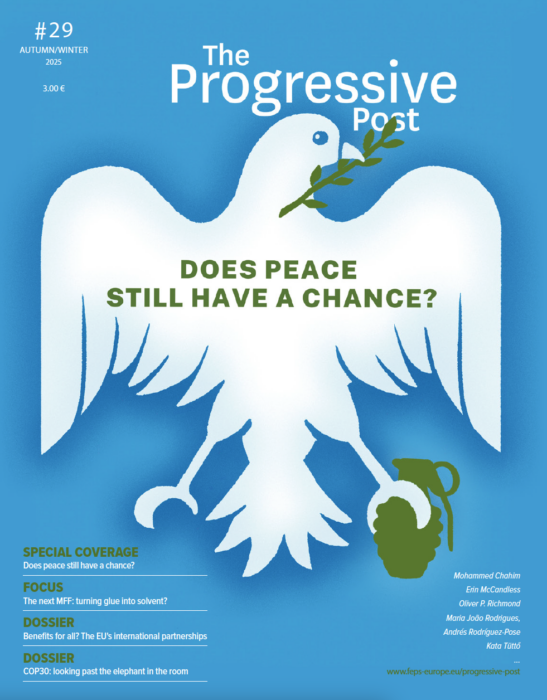
    # Issue 29 Progressive Post

# Issue 29

From the war in Ukraine to the devastation of Gaza since 2023, the words ‘war’ […]
  • cover book

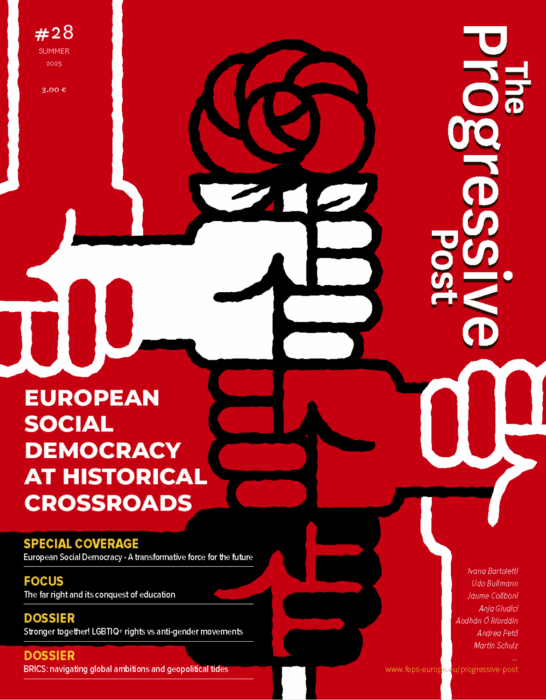
    # Issue 28 Progressive Post

# Issue 28

European Social Democracy at historical crossroads
  • cover book

    #Issue 27 Progressive Post

#Issue 27

The EU in uncharted waters
Find all related publications
Publications
05/03/2026

Digital sovereignty and a new multilateralism for the AI era

Artificial intelligence (AI) is transforming not only economies but the very nature of global power, […]
03/03/2026

Progressive pathways for a resilient (re)construction of Ukraine: Towards a new social contract

This policy study places labour at the centre of reconstruction planning for Ukraine as the […]
03/03/2026

European sovereignty and the social dimension

Reasserting Europe’s social-democratic model in turbulent times
29/01/2026

Progressive Yearbook 2026

In an eerie manner, 2025 resembled the ‘time of monsters’, which, according to the great […]
Find all related news
News
05/03/2026

FFPPVC commentary on the new EU Gender Equality Strategy 2026-2030

Commentary by the Feminist Foreign Policy Progressive Voices Collective (FFPPVC)
03/03/2026

Wag the dog?

FEPS commentary on the US-Israel attack on Iran
03/03/2026

Closing ceremony of the Progressive Ukraine programme

The graduation ceremony completed the programme which was part of the Open Progressive University (OPU).
29/01/2026

Maria João Rodrigues departs from FEPS Presidency, transitions to Nicolas Schmit

After completing eight years in the role, Maria Joâo Rodrigues has departed the role of […]
Find all related in the media
In the media

Africa and Europe Must Rethink Clean Energy Partnership After COP30 Setback

by News Ghana 27/02/2026
Read this article from News Ghana on the highlights of FEPS' event "Governing the global just transition", where diverse stakeholders discussed the EU's role in supporting a just transition from fossil fuels to clean energy in Africa

EUfória podcast Andor Lászlóval: Mire képes az EU saját erejéből és mennyire van kiszolgáltatva a világnak?

by EUrologus 26/02/2026
Listen to the EUfória podcast with László Andor, Secretary General of FEPS, on what the EU can achieve on its own, how to tackle its competitiveness challenge and how the Hungarian government’s stance shapes the EU’s image.

Can the EU ever become a superpower?

by Euronews 20/02/2026
In this episode of the podcast Brussels, My Love, FEPS President Nicolas Schmit discusses the informal meeting of the Antwerp European Industrial Summit and the Munich Security Council.

España los forma, Europa los contrata: así es el mapa de la nueva fuga de cerebros

by El Confidencial 10/02/2026
Spain trains them, Europe hires them: the map of the new brain drain: László Andor, FEPS Secretary-General, discusses the 'brain drain' as a result of the EU’s single market and highlights the need for a fairer mobility and retention strategy across the EU.