European public opinions and migration: the political backlash

Key partners:

Friedrich Ebert Stiftung (Brussels and Budapest Offices)

Fondatione Pietro Nenni

Fondation Jean Jaurès

Policy Solutions

The refugee and migration crisis of the last couple of years has exposed the fact that migration remains a very sensitive issue for European public opinions – which show an increasingly shrinking willingness to offer protection to refugees and even less to welcome so-called economic migrants – as well as for the European political parties, even more so for the progressive parties, torn between the need to uphold their values of solidarity and respect for human rights and their propensity to please the electorate to gain political consensus and win elections.

The political implications of the refugee crisis have been so wide that even the endurance of the European project has been jeopardised by the deepening of cleavages among Member States, whose mutual solidarity has dramatically strained. Within most EU member states, populist and extremist parties have gained momentum riding on and feeding the climate of fear and insecurity generated by years of economic, political and social crises.

Against this background and in the context of the upcoming European elections, the Foundation for European Progressive Studies in cooperation with the Friedrich Ebert Stiftung, Fondazione Pietro Nenni, Fondation Jean Jaurès and Policy Solutions has launched a project aimed at understanding the dynamics that concur to shape the European citizens’ opinions on migration, how and to what extent these opinions impact on political parties’ and governments’ decision-making process in seven EU Member States, namely Austria, France, Germany, Hungary, Italy, Sweden, United Kingdom. Final goal of the project is the formulation of progressive recommendations for Euroepan Socialist and Social-Democratic political parties.

Budapest, 7 May 2018 Kick-off meeting

Rome, 13 July 2018 Workshop

22/06/2018

Key partners:

Friedrich Ebert Stiftung (Brussels and Budapest Offices)

Fondatione Pietro Nenni

Fondation Jean Jaurès

Policy Solutions

The refugee and migration crisis of the last couple of years has exposed the fact that migration remains a very sensitive issue for European public opinions – which show an increasingly shrinking willingness to offer protection to refugees and even less to welcome so-called economic migrants – as well as for the European political parties, even more so for the progressive parties, torn between the need to uphold their values of solidarity and respect for human rights and their propensity to please the electorate to gain political consensus and win elections.

The political implications of the refugee crisis have been so wide that even the endurance of the European project has been jeopardised by the deepening of cleavages among Member States, whose mutual solidarity has dramatically strained. Within most EU member states, populist and extremist parties have gained momentum riding on and feeding the climate of fear and insecurity generated by years of economic, political and social crises.

Against this background and in the context of the upcoming European elections, the Foundation for European Progressive Studies in cooperation with the Friedrich Ebert Stiftung, Fondazione Pietro Nenni, Fondation Jean Jaurès and Policy Solutions has launched a project aimed at understanding the dynamics that concur to shape the European citizens’ opinions on migration, how and to what extent these opinions impact on political parties’ and governments’ decision-making process in seven EU Member States, namely Austria, France, Germany, Hungary, Italy, Sweden, United Kingdom. Final goal of the project is the formulation of progressive recommendations for Euroepan Socialist and Social-Democratic political parties.

Budapest, 7 May 2018 Kick-off meeting

Rome, 13 July 2018 Workshop

Find all related Progressive Post
Progressive Post
12/12/2025

For a progressive alternative to the far right in the 21st century

We are living in a strange world. Humankind lacks the global governance capacity to cope […]
11/12/2025

Unpacking competitiveness

Since Mario Draghi published his report on The future of European competitiveness, its recommendations have […]
27/11/2025

COP30 shows that it is hard to lead when isolated

Set against the Amazon, guided by the idea of mutirão, and backed by a broad […]
Find all related Magazine
Magazine
  • cover book

    # Issue 29 Progressive Post

# Issue 29

From the war in Ukraine to the devastation of Gaza since 2023, the words ‘war’ […]
  • cover book

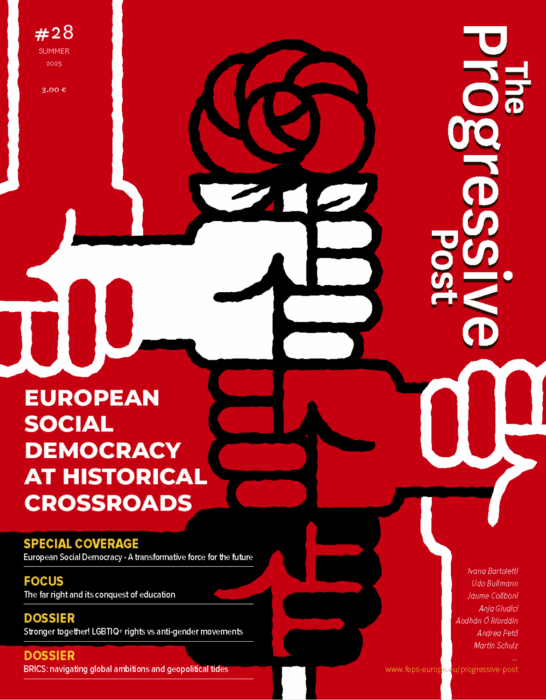
    # Issue 28 Progressive Post

# Issue 28

European Social Democracy at historical crossroads
  • cover book

    #Issue 27 Progressive Post

#Issue 27

The EU in uncharted waters
Find all related publications
Publications
15/12/2025

The Great Unravelling

“The great unravelling” examines the challenges that the new era of globalisation poses for progressive […]
09/12/2025

Tackling the housing crisis in Europe

Progressive ideas for affordable and sustainable housing policies
28/11/2025

Smarter spending today, safer societies tomorrow

Digitally-enabled capabilities for European defence
28/11/2025

More money, more dependence?

Financing European Union defence for autonomy and cooperation
Find all related news
News
12/12/2025

FEPS elects Nicolas Schmit as new President

After eight years in the role, outgoing President Maria João Rodrigues requested to be replaced, considering her mission accomplished. 
08/12/2025

Friends of the Western Balkans’ joint statement

Belgrade, 21 November 2025 We, the Friends of the Western Balkans (FoWB) – representatives of […]
04/12/2025

It is high time that the goal is set on “Quality”

FEPS commentary on the Quality Jobs Roadmap
27/11/2025

Is a bad COP outcome better than no outcome at all?

FEPS Commentary on COP30
Find all related in the media
In the media

Liberal democracy’s social, societal fabric under threat – Live from the EPC Annual Conference 2025

by EPC 08/12/2025
In a podcast by the European Policy Centre (EPC), FEPS Secretary General, László Andor, discusses how liberal democracy in Europe is being challenged not only at the institutional level but also through the erosion of social rights and what Europe must do to defend its social foundations.

« La souveraineté numérique européenne est un défi d’ordre civilisationnel »

by Le Monde 15/11/2025
"European digital sovereignty is a challenge for civilisation as a whole". In an opinion piece in the newspaper Le Monde, FEPS President Maria João Rodrigues shares her concerns about European digital dependence on American and Asian giants

When Algorithms Undermine Democracy: Europe’s Wake-Up Call

by Social Europe 11/11/2025
Maja Fjaestad and Simon Vinge, co-editors of FEPS book "Algorithmic rule", wrote this op-ed on the power of algorithms and how they threaten the foundations of democratic oversight

Los mapas de las fronteras internas que alimentan el voto ultra en Europa

by El Confidencial 13/10/2025
"The internal border maps that fuel the far-right vote in Europe" - FEPS Secretary-General László Andor discusses the impact of cohesion policies on social inequalities and the rise of the far-right across Europe in this El Confidencial article.