Guidelines for a progressive policy of acceptation and inclusion of migrants and exiles in Italy and

Key partner: Associazione Socialismo

Comunità di Sant’Egidio

The goal of an effective integration of long-time and recently arrived migrants into European societies and the build up of a strong social cohesion of post-migration European societies is, in spite of the long history of migrants’ communities in Europe, still very much overlooked, in Europe in general and Italy in particular.

Migration is still largely understood as an emergency issue, and priority is given to temporary ad hoc measures that fail to address the structural nature of the phenomenon. At European level, this is reflected, for example, in the fact that the public debate has mainly focused on border control and access to Europe rather than in the construction of a consistent and harmonised asylum system or in the promotion of a common integration policy, such policies being left to the individual Member States.

The difficulties to develop sound local, regional and overall policies towards contemporary migrations are related as well to the high peak of controversy reached in the political arena about the subjects and to the increasingly wide diffusion in Europe of xenophobic and anti-migration positions, which are reflected in the outcomes of national elections in some European Union member states, from Austria to Hungary and Italy, and which gain force from the actual or supposed economic and social costs of migration for the Member States. This is leading to the misperception of migrations as a temporary phenomenon, and to underestimate the opportunities.

Also, this kind of misperception may lead to overlook the actual necessities of a policy dealing with long-term challenges. In order to update the agenda of migrations, maintain that migration represents an important demographic and economic resource of our aging societies, the research that FEPS and Associazione Socialismo will carry out in collaboration also with the Comunità di Sant’Egidio, will aim at the formulation of progressive guidelines for the reception and inclusion of migrants in Italy and Europe, and will focus particularly on the need to preserve the social cohesion of the hosting communities, to prevent clashes between different cultural and religious identities, and to ensure a common framework for immigrant and native citizens that is badly needed to strengthen our democracies.

22/06/2018

Key partner: Associazione Socialismo

Comunità di Sant’Egidio

The goal of an effective integration of long-time and recently arrived migrants into European societies and the build up of a strong social cohesion of post-migration European societies is, in spite of the long history of migrants’ communities in Europe, still very much overlooked, in Europe in general and Italy in particular.

Migration is still largely understood as an emergency issue, and priority is given to temporary ad hoc measures that fail to address the structural nature of the phenomenon. At European level, this is reflected, for example, in the fact that the public debate has mainly focused on border control and access to Europe rather than in the construction of a consistent and harmonised asylum system or in the promotion of a common integration policy, such policies being left to the individual Member States.

The difficulties to develop sound local, regional and overall policies towards contemporary migrations are related as well to the high peak of controversy reached in the political arena about the subjects and to the increasingly wide diffusion in Europe of xenophobic and anti-migration positions, which are reflected in the outcomes of national elections in some European Union member states, from Austria to Hungary and Italy, and which gain force from the actual or supposed economic and social costs of migration for the Member States. This is leading to the misperception of migrations as a temporary phenomenon, and to underestimate the opportunities.

Also, this kind of misperception may lead to overlook the actual necessities of a policy dealing with long-term challenges. In order to update the agenda of migrations, maintain that migration represents an important demographic and economic resource of our aging societies, the research that FEPS and Associazione Socialismo will carry out in collaboration also with the Comunità di Sant’Egidio, will aim at the formulation of progressive guidelines for the reception and inclusion of migrants in Italy and Europe, and will focus particularly on the need to preserve the social cohesion of the hosting communities, to prevent clashes between different cultural and religious identities, and to ensure a common framework for immigrant and native citizens that is badly needed to strengthen our democracies.

Find all related Progressive Post
Progressive Post
12/12/2025

For a progressive alternative to the far right in the 21st century

We are living in a strange world. Humankind lacks the global governance capacity to cope […]
11/12/2025

Unpacking competitiveness

Since Mario Draghi published his report on The future of European competitiveness, its recommendations have […]
27/11/2025

COP30 shows that it is hard to lead when isolated

Set against the Amazon, guided by the idea of mutirão, and backed by a broad […]
Find all related Magazine
Magazine
  • cover book

    # Issue 29 Progressive Post

# Issue 29

From the war in Ukraine to the devastation of Gaza since 2023, the words ‘war’ […]
  • cover book

    # Issue 28 Progressive Post

# Issue 28

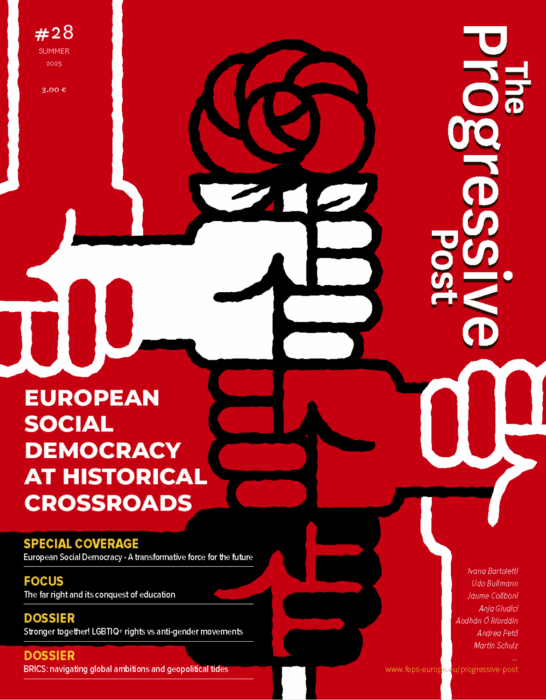
European Social Democracy at historical crossroads
  • cover book

    #Issue 27 Progressive Post

#Issue 27

The EU in uncharted waters
Find all related publications
Publications
15/12/2025

The Great Unravelling

“The great unravelling” examines the challenges that the new era of globalisation poses for progressive […]
09/12/2025

Tackling the housing crisis in Europe

Progressive ideas for affordable and sustainable housing policies
28/11/2025

Smarter spending today, safer societies tomorrow

Digitally-enabled capabilities for European defence
28/11/2025

More money, more dependence?

Financing European Union defence for autonomy and cooperation
Find all related news
News
12/12/2025

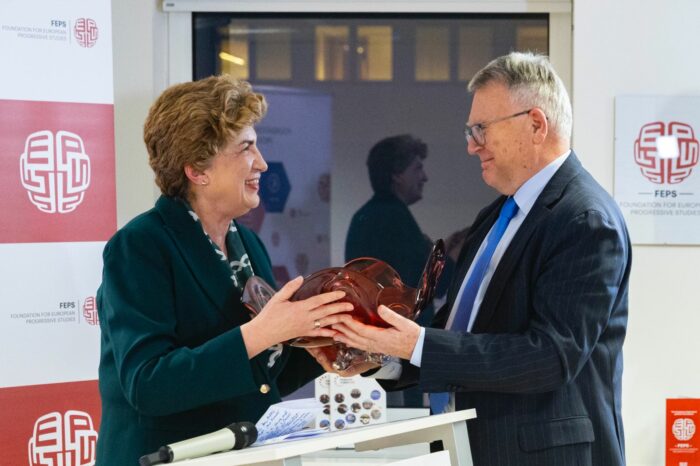
FEPS elects Nicolas Schmit as new President

After eight years in the role, outgoing President Maria João Rodrigues requested to be replaced, considering her mission accomplished. 
08/12/2025

Friends of the Western Balkans’ joint statement

Belgrade, 21 November 2025 We, the Friends of the Western Balkans (FoWB) – representatives of […]
04/12/2025

It is high time that the goal is set on “Quality”

FEPS commentary on the Quality Jobs Roadmap
27/11/2025

Is a bad COP outcome better than no outcome at all?

FEPS Commentary on COP30
Find all related in the media
In the media

Liberal democracy’s social, societal fabric under threat – Live from the EPC Annual Conference 2025

by EPC 08/12/2025
In a podcast by the European Policy Centre (EPC), FEPS Secretary General, László Andor, discusses how liberal democracy in Europe is being challenged not only at the institutional level but also through the erosion of social rights and what Europe must do to defend its social foundations.

« La souveraineté numérique européenne est un défi d’ordre civilisationnel »

by Le Monde 15/11/2025
"European digital sovereignty is a challenge for civilisation as a whole". In an opinion piece in the newspaper Le Monde, FEPS President Maria João Rodrigues shares her concerns about European digital dependence on American and Asian giants

When Algorithms Undermine Democracy: Europe’s Wake-Up Call

by Social Europe 11/11/2025
Maja Fjaestad and Simon Vinge, co-editors of FEPS book "Algorithmic rule", wrote this op-ed on the power of algorithms and how they threaten the foundations of democratic oversight

Los mapas de las fronteras internas que alimentan el voto ultra en Europa

by El Confidencial 13/10/2025
"The internal border maps that fuel the far-right vote in Europe" - FEPS Secretary-General László Andor discusses the impact of cohesion policies on social inequalities and the rise of the far-right across Europe in this El Confidencial article.