Europe and Iran in a fast-changing Middle East: Confidence-building measures, security dialogue and

With Istituto Affari Internazionali

The regional order that prevailed in the Middle East since the end of the Cold War has come under increased strain as a result of the 2003 US-led invasion and occupation of Iraq and the consequent unraveling of regional balances, leading to the collapse of regimes, explosions of popular demonstrations, the expansion of non-state and quasi-state actors and resurgent foreign and regional meddling.

These challenges have invested Europe in an unprecedented way in a moment in which the capacity of the continent and of its national and supra-national institutions is constrained by inward-looking tendencies and mounting divisions and disagreements among member states. Against this backdrop of rising trends of conflictual multipolarity, discussions on the need to revamp multilateral security dialogue among key regional and international actors involved in the Middle East have taken on a new urgency. In particular, debates on a potential ‘Regional Dialogue Forum’ and the role of Iran and other regional players on the regional chessboard have multiplied.

This project, launched in April 2018 and due to finish in June 2019, is implemented by the Foundation for European Progressive Studies (FEPS) and Istituto Affari Internationali in Rome. It entails the drafting of four thematic reports and one final strategy paper. Each paper will be authored by a prominent European, Iranian or Middle Eastern expert. The project will also have a strong outreach component in the form of study visits. A concluding conference is foreseen to take place in Brussels presenting and discussing the findings of the research.


19/12/2018

With Istituto Affari Internazionali

The regional order that prevailed in the Middle East since the end of the Cold War has come under increased strain as a result of the 2003 US-led invasion and occupation of Iraq and the consequent unraveling of regional balances, leading to the collapse of regimes, explosions of popular demonstrations, the expansion of non-state and quasi-state actors and resurgent foreign and regional meddling.

These challenges have invested Europe in an unprecedented way in a moment in which the capacity of the continent and of its national and supra-national institutions is constrained by inward-looking tendencies and mounting divisions and disagreements among member states. Against this backdrop of rising trends of conflictual multipolarity, discussions on the need to revamp multilateral security dialogue among key regional and international actors involved in the Middle East have taken on a new urgency. In particular, debates on a potential ‘Regional Dialogue Forum’ and the role of Iran and other regional players on the regional chessboard have multiplied.

This project, launched in April 2018 and due to finish in June 2019, is implemented by the Foundation for European Progressive Studies (FEPS) and Istituto Affari Internationali in Rome. It entails the drafting of four thematic reports and one final strategy paper. Each paper will be authored by a prominent European, Iranian or Middle Eastern expert. The project will also have a strong outreach component in the form of study visits. A concluding conference is foreseen to take place in Brussels presenting and discussing the findings of the research.


Find all related Progressive Post
Progressive Post
05/03/2026

Poverty is not a fatality

In 2024, more than 93 million Europeans, representing 21 per cent of the EU-population have […]
05/03/2026

Poverty is the result of political choices

On 12 February, the European Parliament voted on the report of the parliament’s committee on […]
Find all related Magazine
Magazine
  • cover book

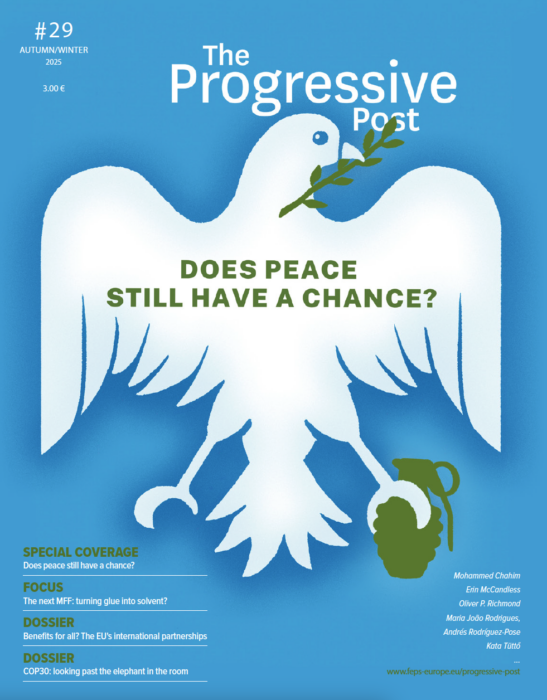
    # Issue 29 Progressive Post

# Issue 29

From the war in Ukraine to the devastation of Gaza since 2023, the words ‘war’ […]
  • cover book

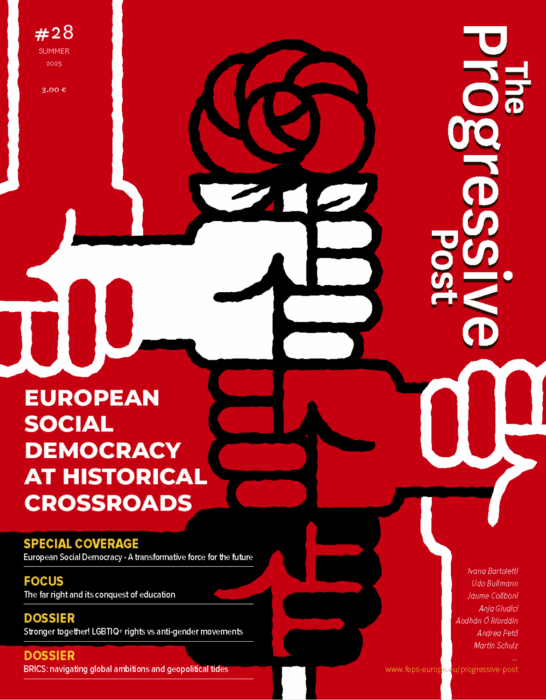
    # Issue 28 Progressive Post

# Issue 28

European Social Democracy at historical crossroads
  • cover book

    #Issue 27 Progressive Post

#Issue 27

The EU in uncharted waters
Find all related publications
Publications
05/03/2026

Digital sovereignty and a new multilateralism for the AI era

Artificial intelligence (AI) is transforming not only economies but the very nature of global power, […]
03/03/2026

Progressive pathways for a resilient (re)construction of Ukraine: Towards a new social contract

This policy study places labour at the centre of reconstruction planning for Ukraine as the […]
03/03/2026

European sovereignty and the social dimension

Reasserting Europe’s social-democratic model in turbulent times
29/01/2026

Progressive Yearbook 2026

In an eerie manner, 2025 resembled the ‘time of monsters’, which, according to the great […]
Find all related news
News
05/03/2026

FFPPVC commentary on the new EU Gender Equality Strategy 2026-2030

Commentary by the Feminist Foreign Policy Progressive Voices Collective (FFPPVC)
03/03/2026

Wag the dog?

FEPS commentary on the US-Israel attack on Iran
03/03/2026

Closing ceremony of the Progressive Ukraine programme

The graduation ceremony completed the programme which was part of the Open Progressive University (OPU).
29/01/2026

Maria João Rodrigues departs from FEPS Presidency, transitions to Nicolas Schmit

After completing eight years in the role, Maria Joâo Rodrigues has departed the role of […]
Find all related in the media
In the media

Africa and Europe Must Rethink Clean Energy Partnership After COP30 Setback

by News Ghana 27/02/2026
Read this article from News Ghana on the highlights of FEPS' event "Governing the global just transition", where diverse stakeholders discussed the EU's role in supporting a just transition from fossil fuels to clean energy in Africa

EUfória podcast Andor Lászlóval: Mire képes az EU saját erejéből és mennyire van kiszolgáltatva a világnak?

by EUrologus 26/02/2026
Listen to the EUfória podcast with László Andor, Secretary General of FEPS, on what the EU can achieve on its own, how to tackle its competitiveness challenge and how the Hungarian government’s stance shapes the EU’s image.

Can the EU ever become a superpower?

by Euronews 20/02/2026
In this episode of the podcast Brussels, My Love, FEPS President Nicolas Schmit discusses the informal meeting of the Antwerp European Industrial Summit and the Munich Security Council.

España los forma, Europa los contrata: así es el mapa de la nueva fuga de cerebros

by El Confidencial 10/02/2026
Spain trains them, Europe hires them: the map of the new brain drain: László Andor, FEPS Secretary-General, discusses the 'brain drain' as a result of the EU’s single market and highlights the need for a fairer mobility and retention strategy across the EU.