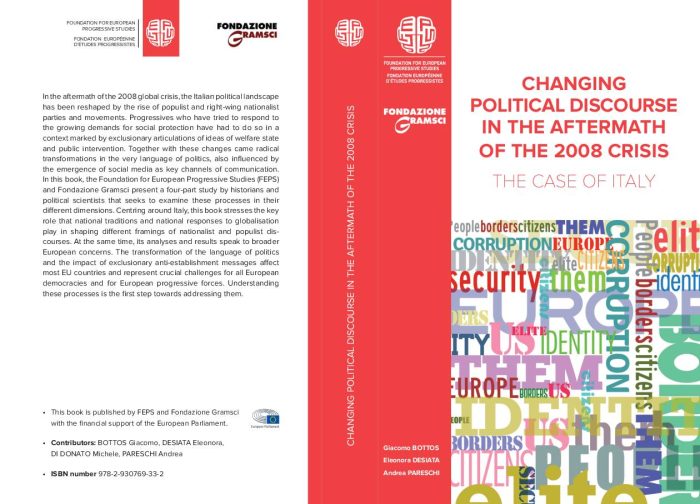
Changing Political Discourse in the Aftermath of the 2008 Crisis. The case of Italy

In the aftermath of the 2008 global crisis, the Italian political landscape has been reshaped […]

Book

24/06/2020

In the aftermath of the 2008 global crisis, the Italian political landscape has been reshaped by the rise of populist and right-wing nationalist parties and movements. Progressives who have tried to respond to the growing demands for social protection have had to do so in a context marked by exclusionary articulations of ideas of welfare state and public intervention. Together with these changes came radical transformations in the very language of politics, also influenced by the emergence of social media as key channels of communication. In this book, the Foundation for European Progressive Studies (FEPS) and Fondazione Gramsci present a four-part study by historians and political scientists that seeks to examine these processes in their different dimensions. Centring around Italy, this book stresses the key role that national traditions and national responses to globalisation play in shaping different framings of nationalist and populist discourses. At the same time, its analyses and results speak to broader European concerns. The transformation of the language of politics and the impact of exclusionary anti-establishment messages affect most EU countries and represent crucial challenges for all European democracies and for European progressive forces. Understanding these processes is the first step towards addressing them.

Network

Fondazione Gramsci
Find all related publications
Publications
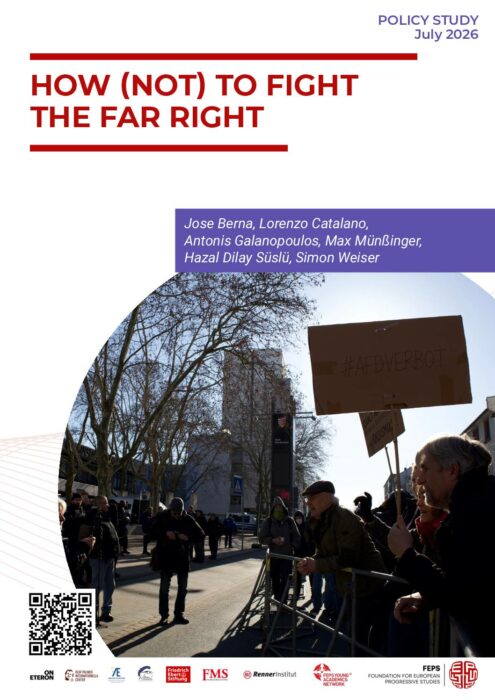
15/01/2026

Financing enlargement via the 2028-2034 MFF

This brief intends to explain how the European Commission’s proposal for the 2028-2034 Multiannual Financial […]
19/12/2025

Moving beyond neoliberalism in EU trade policy

European Union trade policy finds itself at a crossroads. After three decades of neoliberal dominance in the […]
09/12/2025

Tackling the housing crisis in Europe

Progressive ideas for affordable and sustainable housing policies
18/11/2025

Public investment in the proposed 2028-2034 EU budget

Needs, gaps and options
Find all related Progressive Post
Progressive Post

23/01/2026

Ending the US democratic experiment?

Pundits and experts have often urged EU policymakers to focus on US President Donald Trump’s […]
15/01/2026

Bulgaria’s Eurozone moment

Bulgaria has joined the world’s most ambitious integration project by adopting the euro in January […]
11/12/2025

Unpacking competitiveness

Since Mario Draghi published his report on The future of European competitiveness, its recommendations have […]
Find all related events
Events
Upcoming
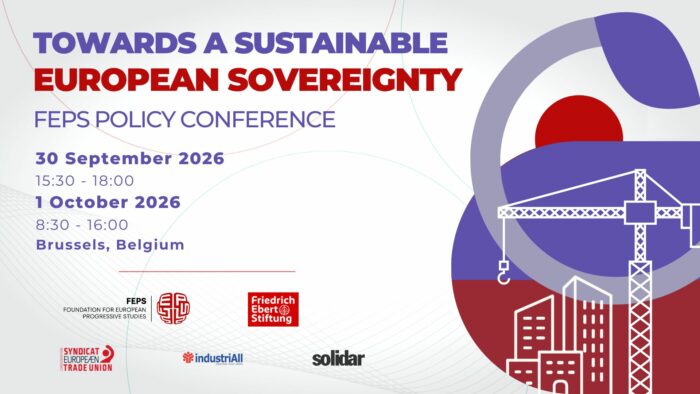
29/01/2026
FEPS HQ

FEPS’ New Year Reception & Progressive Yearbook launch

7th edition
Past
23/01/2026
Lisbon, Portugal (Expert meeting)

Mapping transnational far-right networks in Europe

The expert roundtable will bring together researchers, civil society actors, and progressive policymakers to examine […]
10/12/2025
EP, Brussels (Expert meeting)

Defending democratic values and advancing progressive policy in the EU institutions

FEPS in cooperation with FES Brussels convened a roundtable in the European Parliament to examine […]
Load more...
Find all related Audiovisual
Audiovisual
10/12/2025

‘Tackling the housing crisis in Europe’ Flickr album

Photo album of the ‘Tackling the housing crisis in Europe‘ event at the European Parliament […]
17/11/2025

New own resources in the MFF proposal

Photo album of the ‘New own resources in the MFF proposal‘ event at FEPS HQ, […]
13/11/2025

‘Evolutionary leap of the European trade policy’ Flickr album

Photo album of the ‘Evolutionary leap of the European trade policy‘ event at FEPS HQ, […]
27/10/2025

🧠 “MENTAL HEALTH is not an individual issue” With Sara Bojarczuk, Aida Bikic & Jana Michailidu

📺🔊 Available on YouTube, Spotify & Apple Podcast Europe is facing a growing mental health […]
Find all related news
News
16/12/2025

FEPS commentary on the EU Affordable Housing Plan

The announcement of the EU Affordable Housing Plan by Commissioner Dan Jørgensen is a historic milestone […]
04/12/2025

It is high time that the goal is set on “Quality”

FEPS commentary on the Quality Jobs Roadmap
21/10/2025

Maria João Rodrigues at PES Congress 2025

🇳🇱 🌹 FEPS attended the Party of European Socialists (PES) Congress in Amsterdam, which included […]
18/10/2025

FEPS at PES Congress 2025

🇳🇱 🌹Within PES Congress, there were full rooms on insightful discussion on a range of […]
Find all related in the media
In the media

Liberal democracy’s social, societal fabric under threat – Live from the EPC Annual Conference 2025

by EPC 08/12/2025
In a podcast by the European Policy Centre (EPC), FEPS Secretary General, László Andor, discusses how liberal democracy in Europe is being challenged not only at the institutional level but also through the erosion of social rights and what Europe must do to defend its social foundations.

Líderes progresistas internacionales se reunieron en Buenos Aires para ponerle un freno al avance de la extrema derecha

by Mi Valle 23/09/2025
“International progressive leaders met in Buenos Aires to push back against the rise of the far right” News article in Mi Valle reporting on the meeting of progressive leaders from Europe and Latin America in Buenos Aires, where FEPS President Maria João Rodrigues took part, stressing the need to build common strategies to defend democracy and social justice against the far right.

László Andor: Miből fejleszt az EU ezután?

by Portfolio 28/08/2025
“What will the EU develop from now on?” Analysis by FEPS Secretary General László Andor in Portfolio (HU), highlighting the new MFF’s shift toward increasing EU own-resources, boosting funding for strategic domains like defense, stabilisation and competitiveness, and calling for a flexible crisis-response mechanism such as the proposed Emergency Crisis Response Mechanism

Започва нов ЕС-бюджетен цикъл

by Novi Vremena 26/08/2025
“A new EU budget cycle begins” Article by FEPS Secretary General László Andor in Novi Vremena (BG), highlighting that while Europe must strengthen fiscal capacity to support balanced growth and strategic autonomy, priorities such as cohesion, defense, and social investment must be built into the next multiannual financial framework.