Launch of the report: next event Inequality and the top 10% in Europe

Did you know you may be among the better off? A great share the top […]

23/09/2020

Did you know you may be among the better off? A great share the top 10% income earners do not recognise themselves as rich or affluent

The study released today actually reveals that, even before the arrival of the Covid-19 pandemic, the most affluent in societies across Europe declared they are struggling with the cost of living and are feeling insecure and fearful about their future and that of their children.

Inequality and the top 10% in Europe is a two-years pioneering study conducted in four European countries which examines the financial position and attitudes towards inequality amongst the top 10% of income earners. Most inequality studies concentrate on contrasting the top 1% with the other 99%. However, given the high participation in conventional politics and the strong political influence of the top 10%, it is vital to understand their economic position, perceptions and values.

The study Inequality and the top 10% in Europe was conducted in the UK, Spain, Sweden and Ireland by the Foundation for Progressive Studies (FEPS) in collaboration with the Think Tank for Action on Social Change (TASC – Ireland), Compass (UK), Fundación Alternativas (Spain) and Arena Idé (Sweden).

Five Key Findings

1. Those in the top 10% do not think of themselves as ‘rich’. They compare themselves and look at the more affluent but rarely interact with those in the top 1% or 0.1%

2. They are further away from the top 1% than they are from the median earner (at 50%). The top 1% of earners is moving further away from the rest of population, also further from the rest of the 10%.

3. They feel politically alienated and disconnected from the rest of the society, despite their political influence.

4. They still hold on to meritocratic narratives to explain inequality; they tend to believe that working hard pays.

5. They support redistribution more than they used to – but of course, the want higher taxes to be targeted on those earning more than they do. Most are ambivalent about or supportive of taxes on wealth whilst they often oppose inheritance tax because they want to leave something for their children.

FEPS President Maria Joao Rodrigues: “This Report lifts the lid on how the so-called success stories of the most advantaged citizens are also failing. They are struggling, often because of the lack of key public service infrastructure in areas like health, education or housing. If the system isn’t working for them, then it certainly isn’t working for anyone else either, except the top 1%. And what about the others 90%? Even worst. We are in face of an extreme concentration of wealth

This research shows that any progressive messaging seeking to appeal to the top 10% has to stress that greater equality benefits everyone, even themselves, and public investment in public services provides the antidote to insecurity and financial vulnerability.

Read the report

Check the presentation by Marcos Gonzalez Hernando, Research coordinator for the project (slideshow) 

Find all related publications
Publications
29/01/2026

Progressive Yearbook 2026

In an eerie manner, 2025 resembled the ‘time of monsters’, which, according to the great […]
15/01/2026

Financing enlargement via the 2028-2034 MFF

This brief intends to explain how the European Commission’s proposal for the 2028-2034 Multiannual Financial […]
19/12/2025

Moving beyond neoliberalism in EU trade policy

European Union trade policy finds itself at a crossroads. After three decades of neoliberal dominance in the […]
09/12/2025

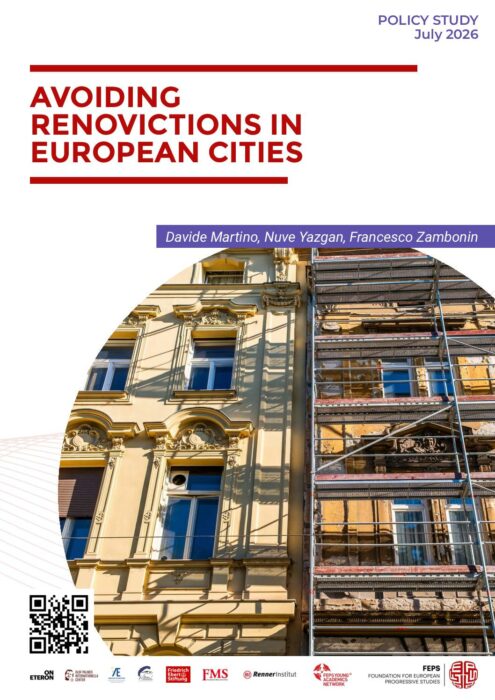
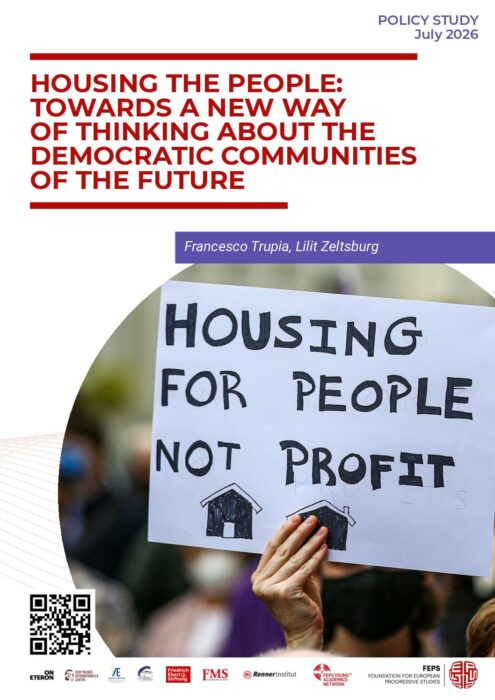
Tackling the housing crisis in Europe

Progressive ideas for affordable and sustainable housing policies
Find all related events
Events
Upcoming
19/03/2026
FEPS HQ

Place-based industrial policy in Europe

Any serious discussion of industrial policy must begin with the recognition that economic activity is […]
Past
03 - 04/02/2026
FEPS HQ

Go Beyond: Zero deaths at work

Brussels visit
30/01/2026
FEPS HQ (Expert meeting)

An EU social agenda for a geopolitical age

Five years after the Porto Social Summit and the adoption of the Action Plan for […]
Load more...
Find all related news
News
29/01/2026

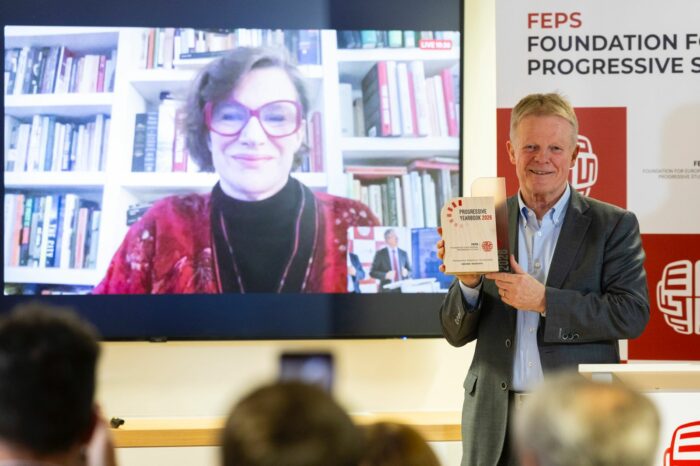
Marianna Mazzucato awarded FEPS ‘Progressive Person of the Year’

FEPS Progressive Person of the Year 2025-2026
16/12/2025

FEPS commentary on the EU Affordable Housing Plan

The announcement of the EU Affordable Housing Plan by Commissioner Dan Jørgensen is a historic milestone […]
04/12/2025

It is high time that the goal is set on “Quality”

FEPS commentary on the Quality Jobs Roadmap
21/10/2025

Maria João Rodrigues at PES Congress 2025

🇳🇱 🌹 FEPS attended the Party of European Socialists (PES) Congress in Amsterdam, which included […]
Find all related in the media
In the media

España los forma, Europa los contrata: así es el mapa de la nueva fuga de cerebros

by El Confidencial 10/02/2026
Spain trains them, Europe hires them: the map of the new brain drain: László Andor, FEPS Secretary-General, discusses the 'brain drain' as a result of the EU’s single market and highlights the need for a fairer mobility and retention strategy across the EU.

‘Regreso al futuro. El gran reseteo’ by Lina Gálvez

by Tinta Libre 02/02/2026
“Back to the Future: The Great Reset” Opinion article by FEPS Vice-President, Lina Gálvez reflecting on the current global crisis marked by rising authoritarianism, digital power and extreme inequality, and tracing its roots through a historical analysis of capitalism — from the post-1945 social and geopolitical settlement led by social democratic forces, through neoliberal financialisation, to what she describes as a new phase of fascist capitalism.

Liberal democracy’s social, societal fabric under threat – Live from the EPC Annual Conference 2025

by EPC 08/12/2025
In a podcast by the European Policy Centre (EPC), FEPS Secretary General, László Andor, discusses how liberal democracy in Europe is being challenged not only at the institutional level but also through the erosion of social rights and what Europe must do to defend its social foundations.

László Andor: Miből fejleszt az EU ezután?

by Portfolio 28/08/2025
“What will the EU develop from now on?” Analysis by FEPS Secretary General László Andor in Portfolio (HU), highlighting the new MFF’s shift toward increasing EU own-resources, boosting funding for strategic domains like defense, stabilisation and competitiveness, and calling for a flexible crisis-response mechanism such as the proposed Emergency Crisis Response Mechanism