
Day of Progressive Economic Policy 2023

Thinking Economics Forward

19 - 20/06/2023
Berlin, Germany (Hybrid)
Friedrich Ebert Stiftung Building 1, Hiroshimastraße 17 Building 2, Hiroshimastraße 28 10785 Berlin
Day of Progressive Economic Policy 2023
63136
thinking-economics-forward
0

In order to give you access to our events, FEPS processes your personal data together with any other organiser of this event mentioned in the description of the event and in accordance with 'FEPS’ data protection policy.

Climate change, coronavirus pandemic, the war against Ukraine – overcoming the multiple crises in Germany, Europe and the world is associated with massive investment and expenditure requirements. At the same time, we must reduce social inequalities and spur on transformation. On top of it all sits our deep dependency on imports of fossil fuels, intermediate products and raw materials, which puts European industry in jeopardy. The question increasingly arises about the future viability of the German and EU economic model.

An economic turning point is looming, which requires wise economic and financial policy design to weather the storm.

In 2023, on the Day of progressive economy, by the Friedrich-Ebert-Stiftung, in cooperation with IMK, Fiscal Future and DGB, we looked at the following questions:

  • What must progressive economic policy put on the table so as not to lose sight of long-term goals?
  • How do we distribute the burdens and crisis costs without endangering social cohesion?
  • What are we doing to transform our economy for the future and make it socially just?

We discussed all this questions with national and international experts on the 19 and 20 of June, 2023. Together we want to “think economics forward”!

Find more information about the programme: Thinking Economics Forward – Progressive Economic Policy Day 2023

For more information please contact: euleane.omez@feps-europe.eu

Network
Fiscal Future
Friedrich-Ebert-Stiftung
Macroeconomic Policy Institute (IMK)
Find all related publications
Publications
29/01/2026

Progressive Yearbook 2026

In an eerie manner, 2025 resembled the ‘time of monsters’, which, according to the great […]
15/01/2026

Financing enlargement via the 2028-2034 MFF

This brief intends to explain how the European Commission’s proposal for the 2028-2034 Multiannual Financial […]
19/12/2025

Moving beyond neoliberalism in EU trade policy

European Union trade policy finds itself at a crossroads. After three decades of neoliberal dominance in the […]
15/12/2025

The great unravelling

“The great unravelling” examines the challenges that the new era of globalisation poses for progressive […]
Find all related events
Events
Upcoming
19/03/2026
FEPS HQ

Place-based industrial policy in Europe

Any serious discussion of industrial policy must begin with the recognition that economic activity is […]
Past
03 - 04/02/2026
FEPS HQ

Go Beyond: Zero deaths at work

Brussels visit
30/01/2026
FEPS HQ (Expert meeting)

An EU social agenda for a geopolitical age

Five years after the Porto Social Summit and the adoption of the Action Plan for […]
Load more...
Find all related Audiovisual
Audiovisual
02/02/2026

‘An EU social agenda for a geopolitical age’ Flickr album

Photo album of the ‘An EU social agenda for a geopolitical age‘ event in FEPS […]
29/01/2026

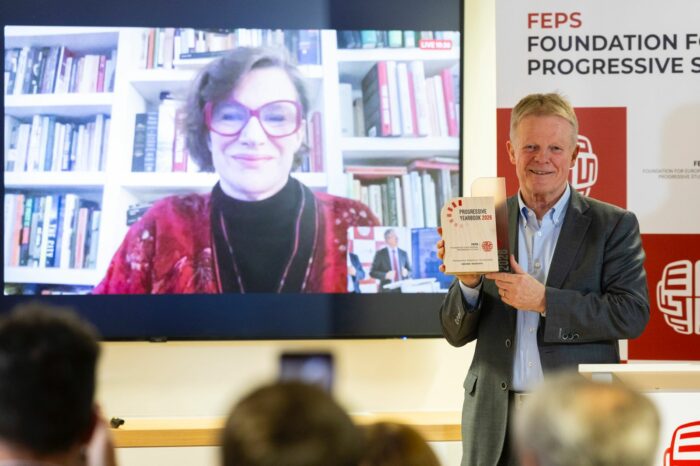
“SHAPING the market rather than FIXING its failures” M. Mazzucato | Progressive Person of the Year

In a year marked by political backsliding and a return to outdated economic thinking, FEPS […]
29/01/2026

“SHAPING the market rather than FIXING its failures” M. Mazzucato | Progressive Person of the Year

In a year marked by political backsliding and a return to outdated economic thinking, FEPS […]
29/01/2026

‘FEPS’ New Year Reception & Progressive Yearbook launch’ Flickr album

Photo album of the ‘FEPS’ New Year Reception & Progressive Yearbook launch‘ event in FEPS […]
Find all related news
News
29/01/2026

Marianna Mazzucato awarded FEPS ‘Progressive Person of the Year’

FEPS Progressive Person of the Year 2025-2026
16/12/2025

FEPS commentary on the EU Affordable Housing Plan

The announcement of the EU Affordable Housing Plan by Commissioner Dan Jørgensen is a historic milestone […]
04/12/2025

It is high time that the goal is set on “Quality”

FEPS commentary on the Quality Jobs Roadmap
21/10/2025

Maria João Rodrigues at PES Congress 2025

🇳🇱 🌹 FEPS attended the Party of European Socialists (PES) Congress in Amsterdam, which included […]
Find all related in the media
In the media

España los forma, Europa los contrata: así es el mapa de la nueva fuga de cerebros

by El Confidencial 10/02/2026
Spain trains them, Europe hires them: the map of the new brain drain: László Andor, FEPS Secretary-General, discusses the 'brain drain' as a result of the EU’s single market and highlights the need for a fairer mobility and retention strategy across the EU.

‘Regreso al futuro. El gran reseteo’ by Lina Gálvez

by Tinta Libre 02/02/2026
“Back to the Future: The Great Reset” Opinion article by FEPS Vice-President, Lina Gálvez reflecting on the current global crisis marked by rising authoritarianism, digital power and extreme inequality, and tracing its roots through a historical analysis of capitalism — from the post-1945 social and geopolitical settlement led by social democratic forces, through neoliberal financialisation, to what she describes as a new phase of fascist capitalism.

Liberal democracy’s social, societal fabric under threat – Live from the EPC Annual Conference 2025

by EPC 08/12/2025
In a podcast by the European Policy Centre (EPC), FEPS Secretary General, László Andor, discusses how liberal democracy in Europe is being challenged not only at the institutional level but also through the erosion of social rights and what Europe must do to defend its social foundations.

László Andor: Miből fejleszt az EU ezután?

by Portfolio 28/08/2025
“What will the EU develop from now on?” Analysis by FEPS Secretary General László Andor in Portfolio (HU), highlighting the new MFF’s shift toward increasing EU own-resources, boosting funding for strategic domains like defense, stabilisation and competitiveness, and calling for a flexible crisis-response mechanism such as the proposed Emergency Crisis Response Mechanism