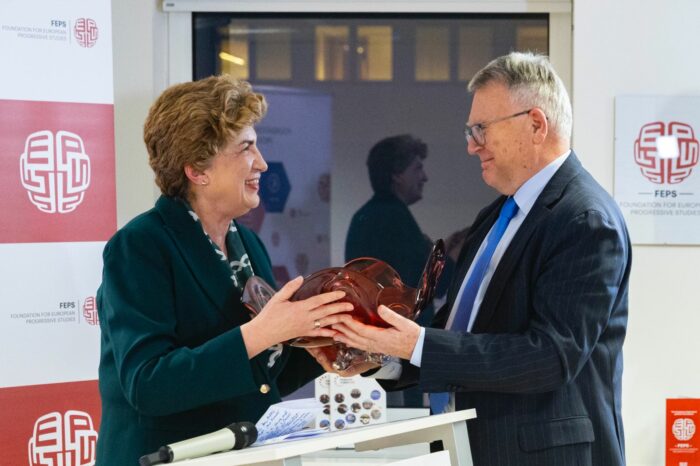
FEPS Newsletter 25 March 2025 – 🇵🇱 Call to Europe: Peace, Prosperity and Progress!

Peace, housing & democracy’s revitalisation – If you have problems displaying this email, follow this […]

25/03/2025
Peace, housing & democracy’s revitalisation –

If you have problems displaying this email, follow this link

Ukraine

21-22 MARCH – WARSAW, POLAND

Call to Europe: Peace, Prosperity and Progress – Europe!


FEPS’ flagship event Call to Europe, held in the host country of the Presidency of the Council of the EU, brings together policy-makers and experts for meaningful conversations on Europe’s most pressing challenges.


Held this time in Poland, under the slogan “Peace, Prosperity, and Progress”, this new edition of Call to Europe hosted conversations with high-level speakers including European and Polish government policymakers on leading topics:

Call to Europe: Peace, Prosperity and Progress – Europe!
    • Peace and prosperity: How can we avoid a “guns vs butter” debate? The EU will have to build up more of its own defence capabilities, but social policy, prosperity, and equality must not suffer.
    • Housing: Social democrats have pushed for housing to be a part of the European mandate. How can Europe deliver on its promise for housing?
    • Building resilient democracies: How can democracy prevail? What can be done to limit the influence of social media oligarchs and ensure governance based on respect for democracy, human rights, and the rule of law?
Europe and the war in Ukraine

BOOK

📕 Europe and the war in Ukraine

From Russian agression to a new Eastern policy

Edited by László Andor and Uwe Optenhögel – In collaboration with FES, Karl-Renner-Institut, Kalevi Sorsa Foundation, Foundation Max van der Stoel, Fondation Jean-Jaurès and Fundacja Amicus Europae


Our book ‘Europe and the war in Ukraine’ is now available in Ukrainian! Originally published in English in 2023, it has been updated to reflect recent developments in Ukraine and Europe’s role in the conflict. This book is the first volume of the translation, with the second expected before summer.

This book was translated in collaboration with Academic Studies Press. 

Peace and security

FEPS COMMENTARY

Europe’s defence strategy must be peace-oriented

By László Andor, Beatriz Abellán and David Rinaldi


“Europeans should avoid falling into Trump’s narrative, which suggests that the EU has been piggybacking on US security. (…) The  EU  must  have  its  own  long-term approach to security and peace, rather than simply following what Trump and NATO leadership push onto it.” Read more. 

Europe’s defence strategy must be peace-oriented

Photo credits: Shutterstock / T.Vyc

European defence for security and peace

POLICY BRIEF

European defence for security and peace

By Roberto Castaldi – In collaboration with Centro Studi, formazione, comunicazione e progettazione sull’Unione Europea e la global governance (CesUE)


Shouldn’t the goal of the European Defence Union be to ensure peace and security?


A new approach to the Union’s defence policy in underway, but how can it avoid fragmented national policies? Europe’s security needs a united European defence.

The brief makes bold proposals to strengthen the EU’s foreign and security policy in the framework of current competencies and highlights the need for a strategic shift towards a defence model that combines shared European military capabilities with the ability to mobilise national forces when needed.

PROGRESSIVE POST’S DOSSIER

European defence: between a rock and a hard place


EU leaders are reacting hastily to the Trump administration’s decisions regarding the war in Ukraine and transatlantic military cooperation. 

European defence: between a rock and a hard place

Photo credits: Shutterstock / Bumble Dee

But the EU should not jump the gun under pressure as the solution can’t be the mere militarisation of the EU. In this dossier, the Progressive Post addresses the manifold challenges the new security situation has left the EU in:

📚 Read more.

Events

Upcoming events

See full schedule

Day of Progressive Economic Policy 2025
 

📅  9 APRIL

📍BERLIN, GERMANY

Day of Progressive Economic Policy 2025

The new European Commission and the incoming German government are facing unprecedented challenges:  an industry in need of a major upgrade, geopolitical and security threats, and internal threats from the far-right. Yet, outdated economic ideas are resurfacing, endangering workers, well-being and the planet.


This annual Congress brings together top-level policymakers and thinkers to shape bold, Progressive policies and investments for Germany and the EU. Read more. 

>

Past events

See all past events

20 MARCH – NEW YORK, USA

Redrawing the lines of foreign policy through feminism 

UN CSW69 Parallel Event  

By FEPS and FES EU Office Brussels, with the collaboration of PEFAL Feminist Foreign Policy Collaborative and the ICRW


FEPS was in New York for UN CSW69 for the parallel event “Redrawing the lines of foreign policy through feminism”. The event delved into the progress of Feminist Foreign Policy since the Beijing Declaration and explored how Feminist Foreign Policy can be used as an avenue of resistance despite the severe global rollback on women’s rights.

Redrawing the lines of foreign policy through feminism 

Over three days, the Feminist Foreign Policy Progressive Voices Collective (FFPPVC) also held bilateral meetings, including with Nyaradzayi Gumbonzvanda, UN Women Deputy Executive Director ; Anne Marie Goetz, Professor at the New York University and Yasmine Ergas, Director of the Specialisation on Gender and Public Policy at Columbia University.

News
European roundtable of Progressive think tanks

27 FEBRUARY – BRUSSELS

European roundtable of Progressive think tanks


Presidents and representatives from FEPS’ Member Foundations convened for a round-table to address global challenges from the far-right.

Discussions included:

  • Assessing Trump’s agenda and far-right challenges to the European Project
  • Identifying priorities for a European Progressive Agenda
  • Short exchange of views with the Center for American Progress (CAP)
  • Internal discussion about next steps

FEPS COMMENTARY

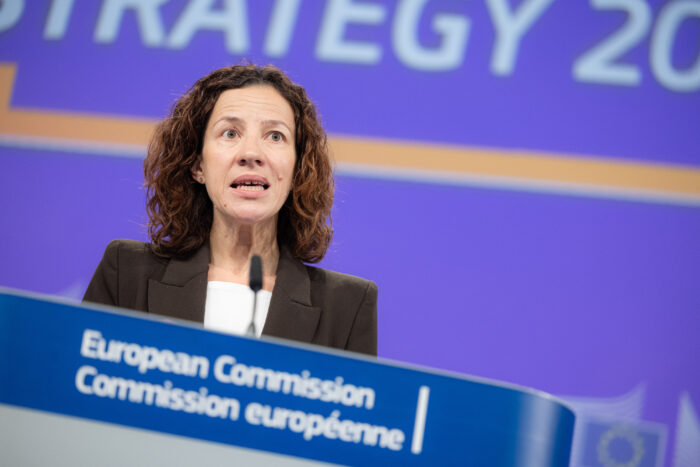
The European Commission’s Clean Industrial Deal

By David Rinaldi, Chloé Deffet and Anna Kolesnichenko


“What VP Teresa Ribera presented is an ambitious plan that makes the case for Europe as a hub for clean manufacturing and investment.” Read more.

FEPS reaction to the European Commission’s Clean Industrial Deal
FEPS reaction to the Roadmap on Women’s Rights

FEPS COMMENTARY

The European Commission’s Roadmap on Women’s Rights

By Laeticia Thissen


“At a time when anti-feminist movements are gaining influence, the EU must put all its political weight behind a truly committed Union of Equality because a union that does not defend all women and girls, with particular attention to the most vulnerable, simply cannot become a stronger Union.” Read more.

Podcast

FEPS TALKS PODCAST

Becoming less dependent on Big Tech 

With Cecilia Rikap and Gerard Rinse Oosterwijk


🎧  Spotify | Apple Podcast | Website | Youtube

Listen to the podcast

80% of the technology in Europe is provided by foreign actors. What does it mean for Europe if tech oligarchs own the digital infrastructure that provides citizens with information? How do we get out of this situation and start building our capacity?


In this episode of FEPS Talks, Cecilia Rikap, Head of Research at the UCL Institute for Innovation and Public Purpose, explores what a Eurostack aligned with our values, the objectives of the Green Transition, and the rules governing digital services and markets could look like.

Progressive Post
Lessons to learn from a defeat

Photo montage using images from Shutterstock

EUROPEAN PROGRESSIVE OBSERVATORY

Elections in Germany

Lessons to learn from a defeat


The elections in Germany on 23 February closed a chapter with the ‘traffic-light’ coalition with a lesson: German Social Democrats must reflect on the reasons for their decade-long decline and a possible strategy that could turn things around.

PROGRESSIVE PAGE

In defence of the rule of law in Italy and in Europe


There is no democracy without rule of law and while the popular vote is an inalienable component of democracy, it doesn’t exhaust the democratic systems’ complexity.

In defence of the rule of law in Italy and in Europe

Photo credit: Shutterstock / Oleg Senkov

Yet, the rule of law is under attack in some EU member states, such as in Italy. Read more. 

Was this email forwarded to you?

Copyright © 2025 FEPS Europe, All rights reserved.

You are receiving this email because you participated in one of FEPS’ events and/or have registered for FEPS’ newsletter.

If you wish not to receive FEPS’ communications anymore, please click here: unsubscribe now


Foundation for European Progressive Studies
Avenue des Arts, 46 – 1000 Bruxelles

+32 223 46 900 – info@feps-europe.eu

Find all related Progressive Post
Progressive Post
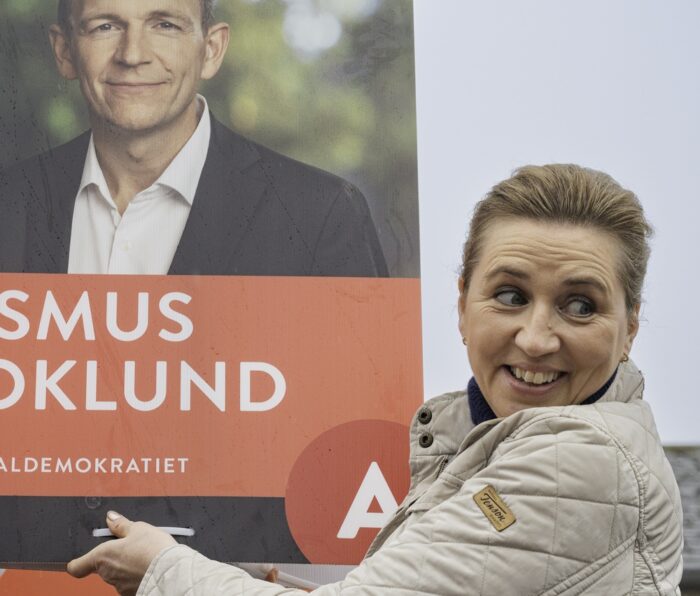
05/03/2026

Poverty is not a fatality

In 2024, more than 93 million Europeans, representing 21 per cent of the EU-population have […]
05/03/2026

Poverty is the result of political choices

On 12 February, the European Parliament voted on the report of the parliament’s committee on […]
Find all related Magazine
Magazine
  • cover book

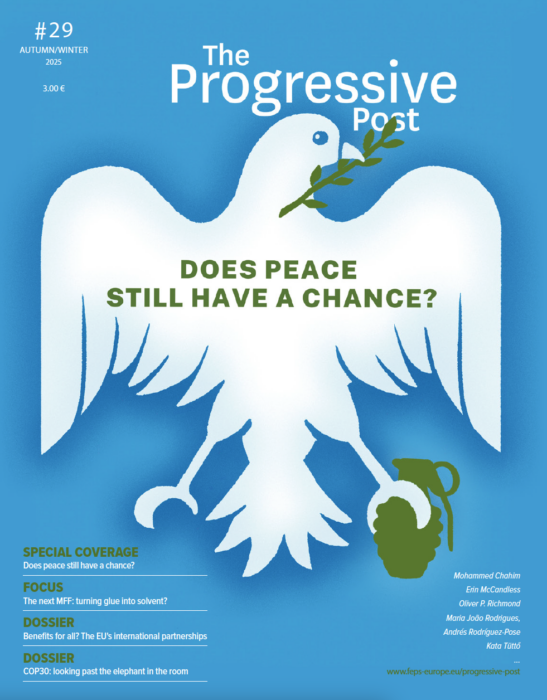
    # Issue 29 Progressive Post

# Issue 29

From the war in Ukraine to the devastation of Gaza since 2023, the words ‘war’ […]
  • cover book

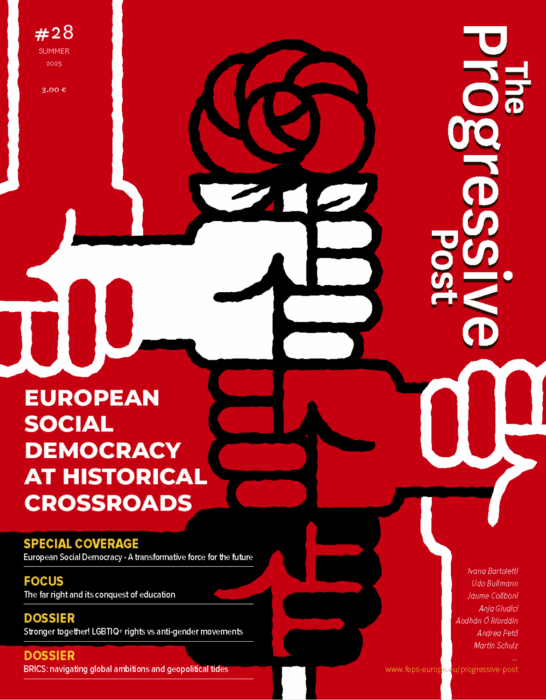
    # Issue 28 Progressive Post

# Issue 28

European Social Democracy at historical crossroads
  • cover book

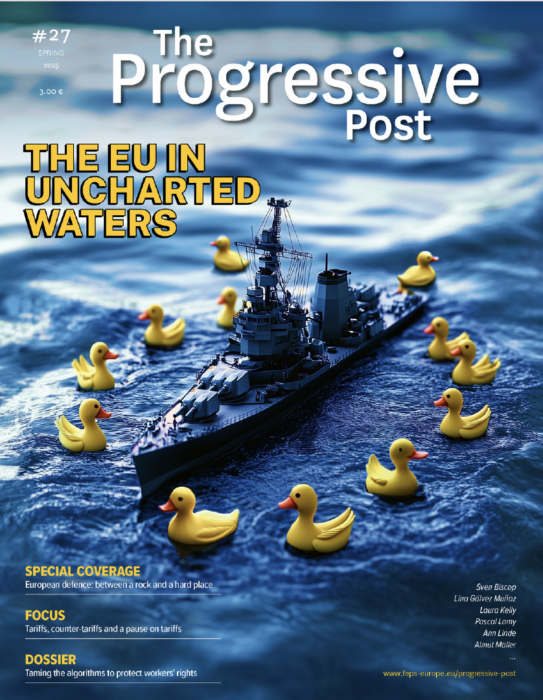
    #Issue 27 Progressive Post

#Issue 27

The EU in uncharted waters
Find all related publications
Publications
03/03/2026

Digital sovereignty and a new multilateralism for the AI era

Artificial intelligence (AI) is transforming not only economies but the very nature of global power, […]
03/03/2026

Progressive pathways for a resilient (re)construction of Ukraine: Towards a new social contract

This policy study places labour at the centre of reconstruction planning for Ukraine as the […]
03/03/2026

European sovereignty and the social dimension

Reasserting Europe’s social-democratic model in turbulent times
29/01/2026

Progressive Yearbook 2026

In an eerie manner, 2025 resembled the ‘time of monsters’, which, according to the great […]
Find all related news
News
05/03/2026

FFPPVC commentary on the new EU Gender Equality Strategy 2026-2030

Commentary by the Feminist Foreign Policy Progressive Voices Collective (FFPPVC)
03/03/2026

Wag the dog?

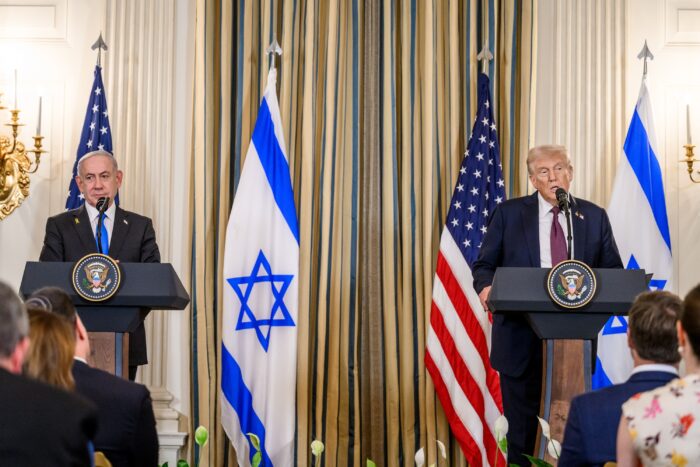
FEPS commentary on the US-Israel attack on Iran
03/03/2026

Closing ceremony of the Progressive Ukraine programme

The graduation ceremony completed the programme which was part of the Open Progressive University (OPU).
29/01/2026

Maria João Rodrigues departs from FEPS Presidency, transitions to Nicolas Schmit

After completing eight years in the role, Maria Joâo Rodrigues has departed the role of […]
Find all related in the media
In the media

Africa and Europe Must Rethink Clean Energy Partnership After COP30 Setback

by News Ghana 27/02/2026
Read this article from News Ghana on the highlights of FEPS' event "Governing the global just transition", where diverse stakeholders discussed the EU's role in supporting a just transition from fossil fuels to clean energy in Africa

EUfória podcast Andor Lászlóval: Mire képes az EU saját erejéből és mennyire van kiszolgáltatva a világnak?

by EUrologus 26/02/2026
Listen to the EUfória podcast with László Andor, Secretary General of FEPS, on what the EU can achieve on its own, how to tackle its competitiveness challenge and how the Hungarian government’s stance shapes the EU’s image.

Can the EU ever become a superpower?

by Euronews 20/02/2026
In this episode of the podcast Brussels, My Love, FEPS President Nicolas Schmit discusses the informal meeting of the Antwerp European Industrial Summit and the Munich Security Council.

España los forma, Europa los contrata: así es el mapa de la nueva fuga de cerebros

by El Confidencial 10/02/2026
Spain trains them, Europe hires them: the map of the new brain drain: László Andor, FEPS Secretary-General, discusses the 'brain drain' as a result of the EU’s single market and highlights the need for a fairer mobility and retention strategy across the EU.