The re-shaping of the political discourse in times of crises

In this FEPS Covid Response Paper #9, the authors build on the recent book “Changing […]

Policy Brief

16/10/2020

In this FEPS Covid Response Paper #9, the authors build on the recent book “Changing political discourse in the aftermath of the 2008 crisis: the case of Italy” published by FEPS and Fondazione Gramsci, to outline the reasons for which Italy can be considered a laboratory for the rest of Europe in terms of political discourse. The southern-European country offers a unique angle to comprehend how populist parties – chiefly Salvini’s Lega and Movimento 5 Stelle – have displayed an impressive agenda-setting power, capable of re-shaping fundamental nodes of political competition.

During the last decade, European party systems have experienced a profound overhaul. The emergence of new populist parties – in both the right and left-wing side of the political spectrum, the increasing salience of new issues and the reliance on new modes of communication have radically transformed mainstream political discourse. The Covid-19 pandemic has likewise reshuffled all previous political priorities and compelled officeholders and party leaders to calibrate their political discourse accordingly.

The authors present an appraisal of the discursive stance of Italy’s main political parties through three different lenses: i) representative institutions, ii) notions of citizenship and iii) foreign policy.

Crucially, this FEPS Covid Response Paper elucidates how the Covid-19 pandemic has profoundly disrupted the sovereignist and nationalist discourse of populist forces in Italy at a time when issues of health and the strengthening of the state have gained prominent importance.

The paper yields findings useful for the management of political communication by progressive forces across Europe. It offers recommendations on what Italy’s main progressive party, the Partito Democratico, should do in order to increase its ability to determine Italy’s political agenda: a better use of digital platforms, replacing neutral language with political-charged vocabulary, and the embracement of consistent frames and narratives.

Read the FEPS Covid Response paper N.9

Network
Fondazione Gramsci
Find all related publications
Publications
09/11/2026

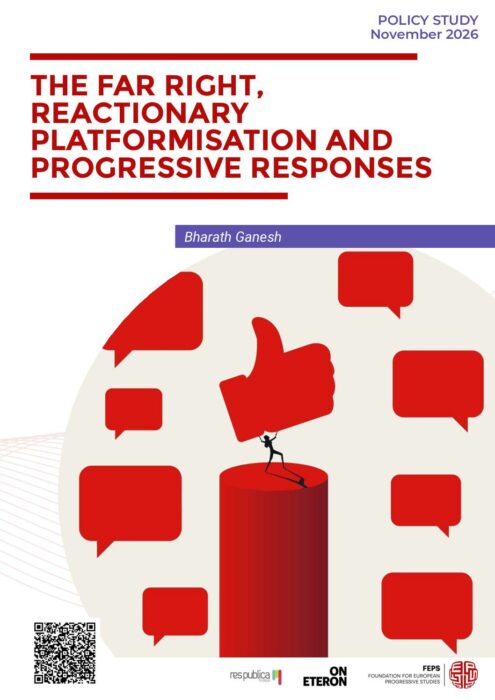
The far right, reactionary platformisation and progressive responses

The far right is thriving on social media, and this is no accident. This policy […]
28/08/2026

How can Europe’s missing middle be financed

Translating Chinese lessons for scaling industrial innovation
22/07/2026

How (not) to fight the far right

FEPS YAN papers 9th cycle
20/07/2026

Avoiding renovictions in European cities

FEPS YAN papers 9th cycle
Find all related Progressive Post
Progressive Post
10/11/2026

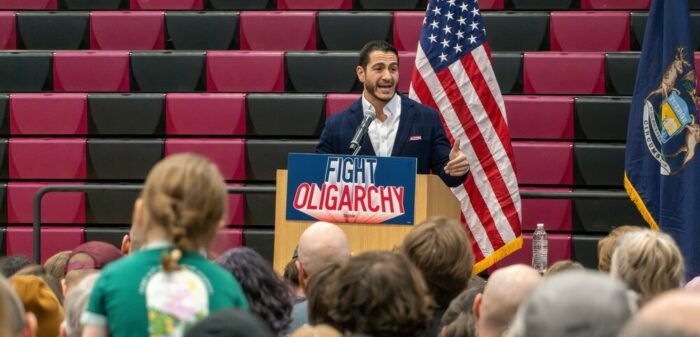
A blue wave that might crush soon

Americans have elected a new Congress: going into 2027, both chambers will be under Democratic […]
03/11/2026

Mobilisation without realignment

Israel's elections and the limits of Social Democracy
28/10/2026

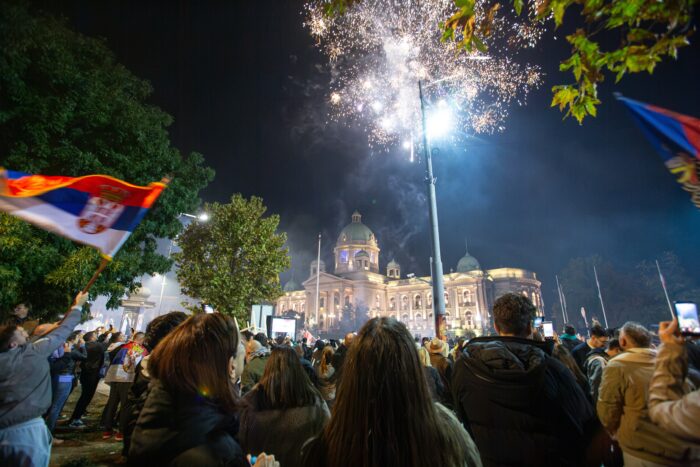
Serbia’s students defeat the machine

A mandate to dismantle the captured state
Find all related events
Events
27 NOV 2026

Housing in Practice – France

Paris, France (Expert Meeting)
01 DEC 2026

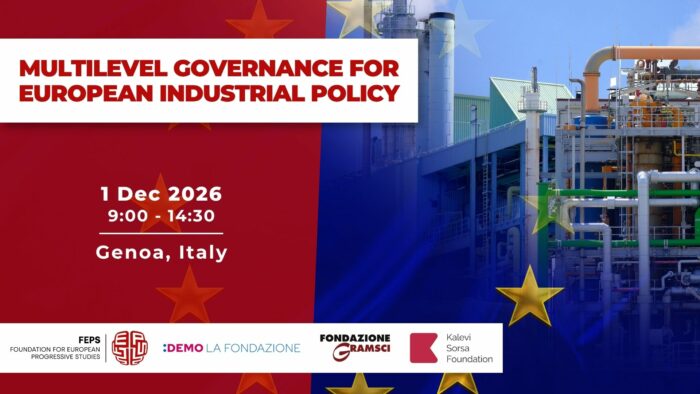
Multilevel governance for European industrial policy

Genoa, Italy
Find all related Audiovisual
Audiovisual
06/11/2026

🇪🇺 How Europe survives? with Catherine De Vries and Alexandros Kentikelenis

Half of 🇪🇺 Europe is in upheaval today. Professors Catherine De Vries and Alexandros Kentikelenis […]
06/11/2026

🇪🇺 How Europe survives? with Catherine De Vries and Alexandros Kentikelenis

Half of 🇪🇺 Europe is in upheaval today. Professors Catherine De Vries and Alexandros Kentikelenis […]
28/08/2026

Translating Chinese lessons for scaling EU industrial innovation with Cornel Ban

Europe is good at creating new technologies and innovative ideas, but too often European companies […]
28/08/2026

Translating Chinese lessons for scaling EU industrial innovation with Cornel Ban

Europe is good at creating new technologies and innovative ideas, but too often European companies […]
Find all related news
News
16/09/2026

FEPS Reacts: State of the European Union 2026

The 2026 State of the Union felt more like ‘von der Leyen I’ than ‘von […]
23/07/2026

FEPS Reacts: European Commission communication on the Action Plan on the European Pillar of Social Rights

By Laszlo Andor, FEPS Secretary-General & François Balate, Policy Analyst on Social The communication on the […]
29/01/2026

Marianna Mazzucato awarded FEPS ‘Progressive Person of the Year’

FEPS Progressive Person of the Year 2025-2026
16/12/2025

FEPS commentary on the EU Affordable Housing Plan

The announcement of the EU Affordable Housing Plan by Commissioner Dan Jørgensen is a historic milestone […]
Find all related in the media
In the media

Frågan om jämställdhet splittrar unga svenskar

by dagens arena 29/10/2026
"The issue of gender equality divides young Swedes" - FEPS Policy Analyst on Democracy Matteo Dressler discusses the findings of the EqualiZe policy study in the Swedish context.

EU’s new cross‑border work rules favour recruitment, not workers, say critics

by EUObserver 16/09/2026
FEPS Policy Analyst on Social François Balate discusses the latest EU Labour Mobility Package under Commissioner Roxana Mînzatu zatu for the EUObserver.

Une révolution civique, pas encore une révolution sociale

by Fondation Jean-Jaurès 06/05/2026
“A civic revolution, not yet a social revolution” Interview with László Andor, FEPS Secretary General, published by Fondation Jean-Jaurès (FR), analysing the electoral defeat of Viktor Orbán, the emergence of a broad opposition movement in Hungary, and the prospects for democratic renewal, EU relations and social change following what he describes as a “civic revolution” that has yet to deliver a social transformation.