
Download
EU regulation on transparency
Policy Study
16/05/2024
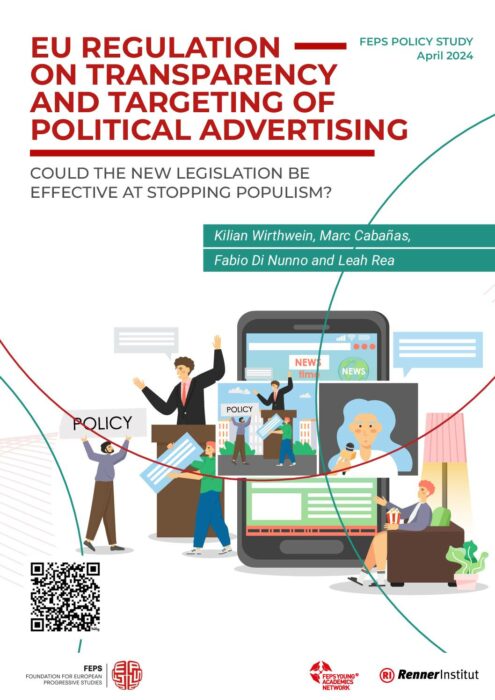
Could the new legislation be effective at stopping populism?
In the last three years, the European Commission and the European Parliament have been preparing key reforms in the space of political advertising to establish rules of the game for political campaigns that are carried out online. Different from analogue forms of political campaigning, due to its novelty, digital political campaigns represent an entry point for activities that are considered to be a threat to the proper functioning of democratic institutions. Firstly, an unregulated digital campaigning sphere is very prone to the proliferation of fake news and disinformation campaigns. Viral campaigns with the prime objective of misinforming the public, spreading hatred and non-democratic positions, have been a major challenge to Western democracies. As such, it has become usual to speak about the situation of an infodemic.
For obvious reasons, the quality of information that reaches the electorate is a key requisite for a healthy democratic order, since the electorate needs to be in a good and informed position to make critical choices that will affect policy planning. Secondly, the unregulated digital campaigning space has led to a vacuum, which has been instrumentalised by foreign actors that have sought to interfere with European elections, promoting disinformation campaigns to create democratic instability and, as a result, gain a geopolitical advantage over adversaries. This phenomenon is particularly relevant in the context of rising geopolitical tensions all across the globe. Thirdly, being linked to the previous issue of foreign interference, an unregulated digital campaigning space has opened the door for populism and populist parties, including far-right coalitions, to rise across the entire EU.
The most notable systematic misuse of personal data for campaigning purposes was the case of Cambridge Analytica; this scandal brought the issue of electoral deception through microtargeting to the attention of policymakers and the overall public, and was one of the triggers for the plan to organise a legislative response at the EU level that would set new norms on what is admissible online campaigning and which digital political advertising is contrary to clean elections and the fundamental rights of the voter.
In this context, the regulation of the European Parliament and of the Council on the transparency and targeting of political advertising seeks to establish common norms and rule out malpractice in digital campaigning that are harmful to the healthy functioning of the democratic order. This policy brief examines how this regulation has developed; what the key changes are that will be introduced and how it relates to larger debates, such as populism, democratic values and a right to receive quality information. At the same time, this policy brief offers guidelines on how progressive parties can take this legislation as a starting point for greater and deeper efforts to combat extremist populism and antidemocratic political movements in the EU.
This policy study was written as part of the FEPS Young Academic’s Network.
Network

Related publications

Find all related publications
Publications
Find all related Progressive Post
Progressive Post


Find all related events
Events
Past
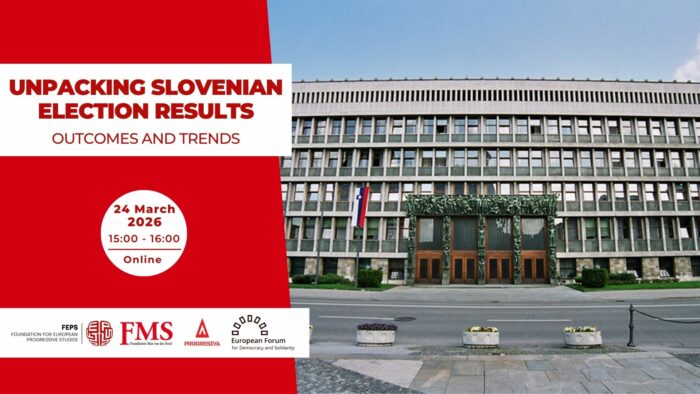
24/03/2026
Online
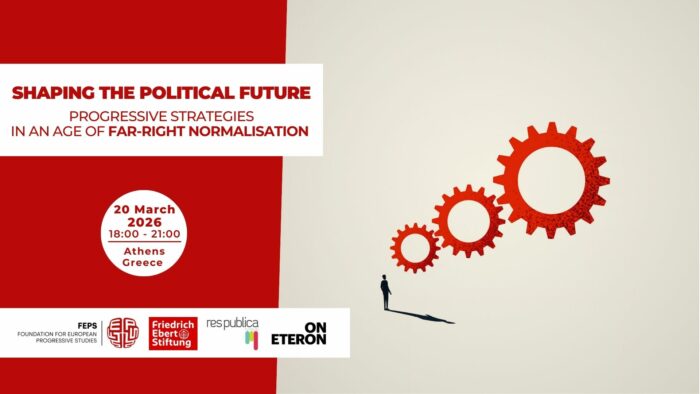
20/03/2026
Athens, Greece
23 - 25/01/2026
Zagreb, Croatia
Load more...
Find all related Audiovisual
Audiovisual
26/02/2026
26/02/2026

29/01/2026
25/07/2025
Find all related news
News



Find all related in the media
In the media
“Back to the Future: The Great Reset”
Opinion article by FEPS Vice-President, Lina Gálvez reflecting on the current global crisis marked by rising authoritarianism, digital power and extreme inequality, and tracing its roots through a historical analysis of capitalism — from the post-1945 social and geopolitical settlement led by social democratic forces, through neoliberal financialisation, to what she describes as a new phase of fascist capitalism.
Liberal democracy’s social, societal fabric under threat – Live from the EPC Annual Conference 2025
by EPC 08/12/2025
Líderes progresistas internacionales se reunieron en Buenos Aires para ponerle un freno al avance de la extrema derecha
by Mi Valle 23/09/2025
En Europe, les partis sociaux-démocrates se sont contentés d’une approche technocratique
by Le Point 04/07/2025