
Reinventing a social democratic Europe: What can we learn from the weakness of ‘Social Europe’?

The purpose of this new paper in the FEPS YAN series is thus to take […]

Policy Study

09/10/2014

The purpose of this new paper in the FEPS YAN series is thus to take a step back and develop a critical understanding of the concept of ‘Social Europe’. The paper is divided into four sections, which look at ‘Social Europe’ in all its guises: as a historical process; as a political slogan; as a (failed) attempt to translate it into public policy; and as a complex topic in the public realm.

Introduction

In the context of the current economic and political crisis, centre-left parties face the difficult task of reinventing a social democratic vision of European integration. Since the 1970s, and more prominently since the 1990s, the concept of ‘Social Europe’ has epitomised the social democratic vision of the European Union (EU), serving as a counterweight to the neoliberal bias of market building. It came to be both a political slogan for catalysing electoral support for European integration and a policy vehicle for the advancement of social and welfare policies at EU level. But in recent years, ‘Social Europe’ has failed to garner public support or recognition.

This slipping away of the vague “Social Europe” slogan comes at a time when the debt crisis and related austerity policies are hurting European citizens. The European Union is becoming an increasingly salient issue within domestic politics, with populists and sceptics increasingly making hay at its expense, and economic cleavages between Northern and Southern Europe opening up. The ‘permissive consensus’ for European integration is fast becoming a historical footnote. The implication is that it is imperative for centre-left parties to put forward a positive case for European integration and work on building coalitions for Europe, communicating Europe, and a new social democratic vision of Europe which builds over the weaknesses of the ‘Social Europe’ experience.

The purpose of this paper is thus to take a step back and develop a critical understanding of the concept of ‘Social Europe’. The paper is divided into four sections, which look at ‘Social Europe’ in all its guises: as a historical process; as a political slogan; as a (failed) attempt to translate it into public policy; and as a complex topic in the public realm. The first section provides a brief historical overview of the development of ‘Social Europe’ in the EU treaties since the late 1980s. The second section analyses how ‘Social Europe’ was used as a political slogan in election manifestos of several social democratic parties during the 2004 and 2009 European elections, thereby demonstrating how broad a concept ‘Social Europe’ has become. The third section investigates ‘Social Europe’ as a policy vehicle within the context of the regulation of services of general interest. The final section presents public opinion data, which allows us to understand the changing patterns of support for ‘Social Europe’ amongst the European electorate. In the concluding section we pull together our findings and provide some suggestions for the future success of the ‘Social Europe’ agenda of the centre-left.

Background about the FEPS Young Academics Network

The four authors of this study are : Laura BALLARÍN CEREZA, Amandine CRESPY, Marc ESTEVE DEL VALLE and Michael McTERNAN

They are members of the Young Academics Network (YAN) which was established in March 2009 by the Foundation of European Progressive Studies (FEPS) with the support of the Renner Institut to gather progressive PhD candidates and young PhD researchers, who are ready to use their academic experience in a debate about the Next Europe. The founding group was composed of awardees of the “Call for Paper” entitled “Next Europe, Next Left” – whose articles also help initiating the FEPS Scientific Magazine “Queries”. Quickly after, with the help of the FEPS member foundations, the group enlarged presently incorporating around 30 outstanding and promising young academics.

FEPS YAN meets in the Viennese premises of Renner Institut, which offers great facilities for both reflections on the content and also on the process of building the network as such. Both elements constitute mutually enhancing factors, which due to innovative methods applied makes this Network also a very unique project. Additionally, the groups work has been supervised by the Chair of the Next Left Research Programme, Dr. Alfred Gusenbauer who at multiple occasions joined the sessions of the FEPS YAN, offering his feedback and guidance.

This paper is one of the results of the second cycle of FEPS YAN, (the first one ended with three papers in June 2011), in which 5 key themes were identified and are being currently researched by FEPS YAN working groups. These topics encompass: “Education, Labour and Skills”, “Economic governance in the EU”, “Migration and Reassessment of integration models”, “Youth unemployment” and “Social Europe and public opinion”. Each of the meetings is an opportunity for the FEPS YAN to discuss the current state of their research, presenting their findings and questions both in the plenary, as also in the respective working groups. The added value of their work is the pan-European, innovative, interdisciplinary character not to mention, that it is by principle that FEPS wishes to offer a prominent place to this generation of academics, seeing in it a potential to construct alternative that can attract young people to progressivism again. Though the process is very advanced already, the FEPS YAN remains a Network and hence is ready to welcome new participants.

FEPS YAN plays also an important role within FEPS structure as a whole. The FEPS YAN members are asked to join different events (from large Conferences, such as FEPS “Call to Europe” or “Renaissance for Europe” and PES Convention to smaller High Level Seminars and Focus Group Meetings) and encouraged to provide inputs for publications (i.e. for FEPS Scientific Magazine “Queries”). Enhanced participation of the FEPS YAN Members in the overall FEPS life and increase of its visibility remains one of the strategic goals of the Network for 2013.

See the first paper – The European Youth Guarantee: a reality check

See the second paper – How Eurobonds Relate to European Integration

See the third paper – Fixing the Broken Promise of Higher Education in Europe

Network
Karl Renner Institut
Find all related publications
Publications
12/09/2025

EU-AU migration governance

Progressive Migration Group series
24/06/2025

Serbia’s civic awakening: the 2024-2025 student protests in focus

Friends of the Western Balkans series
22/04/2025

Trade, trust, and transition: Shaping the next transatlantic chapter

Essays series by FEPS and Center for American Progress (CAP)
28/02/2025

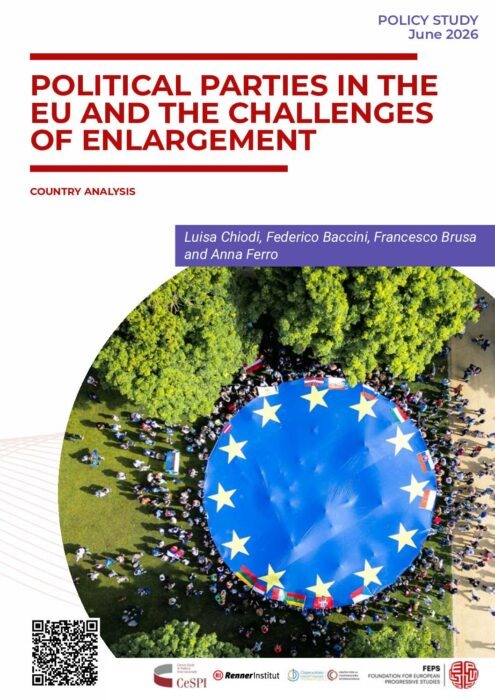
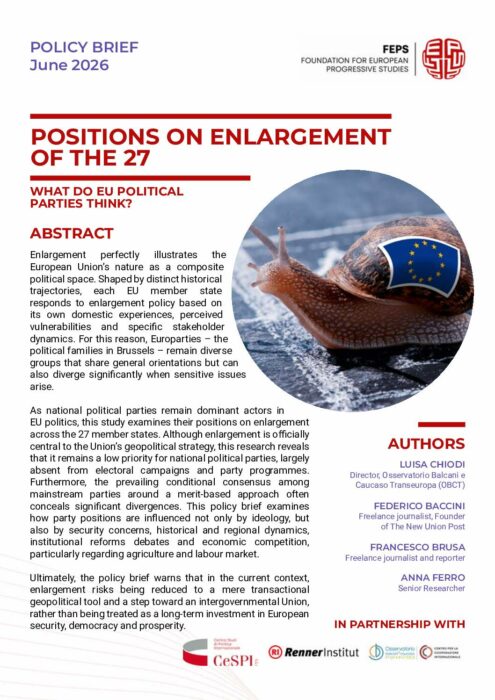
Political parties in the EU and the challenges of EU enlargement

Balkan Focus Series
Find all related Progressive Post
Progressive Post

18/09/2025

Submission is not a strategy: Von der Leyen’s missed moment

The world is sliding into a new order where the strong impose their rule and […]
10/07/2025

Schengen anniversary: a Dorian Gray effect?

The 40th anniversary of the Schengen area this year places the EU in an uncomfortable […]
08/05/2025

The European miracle

Why Europe's future is built on the ruins of the past – and what is at stake today
Find all related events
Events
Past

20 - 22/11/2025
Belgrade, Serbia

How the new EU budget will shape a wider Union

Friends of the Western Balkans Conference
26/09/2025
Rome, Italy (Hybrid)

Progressive Migration Group – Rome

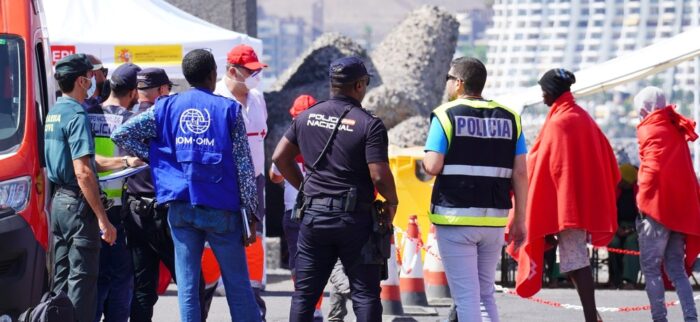
From the obsession with irregularity to legal pathways
14 - 15/07/2025
Brussels, Belgium

The EU-UK Progressive Forum

A new chapter
Load more...
Find all related Audiovisual
Audiovisual
16/05/2025

‘Friends of the Western Balkans – Ljubljana’ Flickr album

Photo album of the ‘Friends of the Western Balkans‘ event in Ljubljana the Friends of the […]
12/05/2025

Europe Day 2025

10/04/2025

‘A common new chapter for EU Enlargement’ Flickr album

Photo album of the ”A common new chapter for EU Enlargement‘ in Brussels. The European […]
05/03/2025

The European progressive way in the face of Trump’s and the far-right agenda

FEPS organised a roundtable Presidents and representatives from FEPS’ Member Foundations to address global challenges […]
Find all related news
News
10/09/2025

Von der Leyen – walking the walk at last?

FEPS reaction to The State of the European Union 2025
16/05/2025

Joint statement by the Friends of the Western Balkans (FoWB)

Ljubljana, 16th May 2025 We, the Friends of the Western Balkans (FoWB) – representatives of […]
27/02/2025

European roundtable of Progressive think tanks

The European progressive way in the face of Trump's and the far-right agenda
25/02/2025

New grand coalition in Germany with historic tasks

Commentary by FEPS Secretary General László Andor on the German elections
Find all related in the media
In the media

Migranti: Amato a FEPS — “Socialisti e populisti fomentano ossessione”

by Avanti! 29/09/2025
“Migrants: Amato to FEPS — ‘Socialists and populists fuel obsession’” News article in Avanti! where Hedwig Giusto, FEPS Head of International Affairs, critiques how both populist and some socialist political forces are stoking fear around migration. Giusto calls for balanced migration policies that respect human rights, reinforce solidarity among member states, and reject securitarian obsessions.

‘Bruselas, ¿te Quiero?’ Tras un verano cruel, Von der Leyen pide a Europa que “luche”

by Euronews 16/09/2025
After a harsh summer, Von der Leyen calls on Europe to ‘fight’” Episode of Euronews’ Brussels, my Love? featuring Beatriz Abellán, FEPS Policy Analyst on International Relations, discussing Von der Leyen’s State of the Union speech, the EU’s trade deal with the United States, and the future of multilateralism. She also stresses that the EU’s credibility is at stake due to its delayed response to the genocide in Palestine.

Ласло Андор: България не губи нищо от присъединяването си към еврозоната

by BNR 15/07/2025
"Bulgaria has nothing to lose by joining the eurozone” Interview with FEPS Secretary General László Andor on Bulgarian National Radio, where he explains that Bulgaria has already borne the costs of financial stability and will benefit from eurozone accession.

En Europe, les partis sociaux-démocrates se sont contentés d’une approche technocratique

by Le Point 04/07/2025
“In Europe, social democratic parties have relied too heavily on a technocratic approach” Interview with FEPS Secretary General László Andor in Le Point (FR), reflecting on the decline of social democracy in Europe and the need to renew its political vision in the face of nationalist challenges.