Governance and security in the Sahel: tackling mobility, demography and climate change

With Istituto Affari Internazionali

This research project will firstly analyze the factors underpinning good governance in the Sahel, and secondly will consider how the quality of governance is influenced by and can affect the management of demographic changes, climate change and mobility.

After an overview of good governance practices in the Sahel, the first part of the project will investigate these dynamics through specific case studies and approaches. The first will analyze governance, climate change and security challenges in the Lake Chad Basin area. The second case study will focus on assessing the impact of climate change, mobility and demographic change on women and girls in the region. Then, the last working stream will investigate on demographic changes and mobility in Niger. Finally, the second part of the project will focus on the role of the EU and the foreign powers in the region.

The project foresees a number of activities including the publication of a volume, and the organisation of a series of outreach and dissemination activities. An international conference in Burkina Faso will develop policy recommendations addressed to different international actors. Further promotional activities will aim at the dissemination of these policy recommendations.

19/12/2018

With Istituto Affari Internazionali

This research project will firstly analyze the factors underpinning good governance in the Sahel, and secondly will consider how the quality of governance is influenced by and can affect the management of demographic changes, climate change and mobility.

After an overview of good governance practices in the Sahel, the first part of the project will investigate these dynamics through specific case studies and approaches. The first will analyze governance, climate change and security challenges in the Lake Chad Basin area. The second case study will focus on assessing the impact of climate change, mobility and demographic change on women and girls in the region. Then, the last working stream will investigate on demographic changes and mobility in Niger. Finally, the second part of the project will focus on the role of the EU and the foreign powers in the region.

The project foresees a number of activities including the publication of a volume, and the organisation of a series of outreach and dissemination activities. An international conference in Burkina Faso will develop policy recommendations addressed to different international actors. Further promotional activities will aim at the dissemination of these policy recommendations.

Find all related Progressive Post
Progressive Post

10/11/2026

A blue wave that might crush soon

Americans have elected a new Congress: going into 2027, both chambers will be under Democratic […]
05/11/2026

If you want peace, prepare for equality

I have always been struck by how little attention we pay to patriarchal culture when […]
05/11/2026

The Women, Peace and Security agenda amid shifting geopolitics

While the current conflictual and geopolitical environment makes the Women, Peace and Security agenda ever […]
Find all related Magazine
Magazine
  • cover book

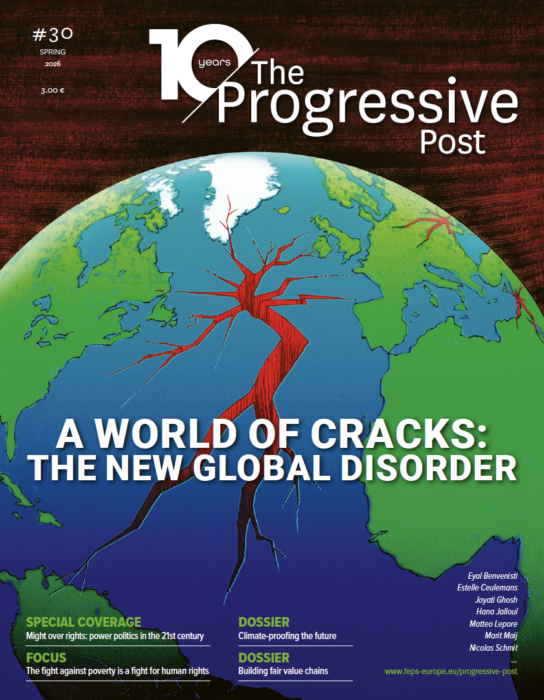
    Issue #30 Progressive Post

Issue #30

A world of cracks: the new global disorder
  • cover book

    Issue #29 Progressive Post

Issue #29

Does peace still have a chance?
Find all related publications
Publications
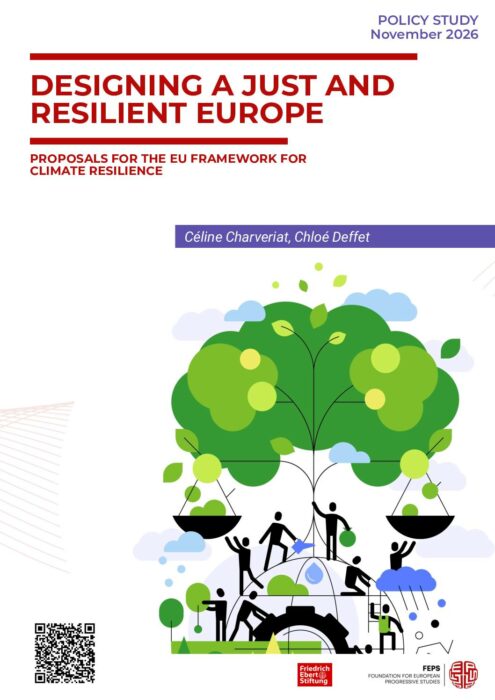
16/11/2026

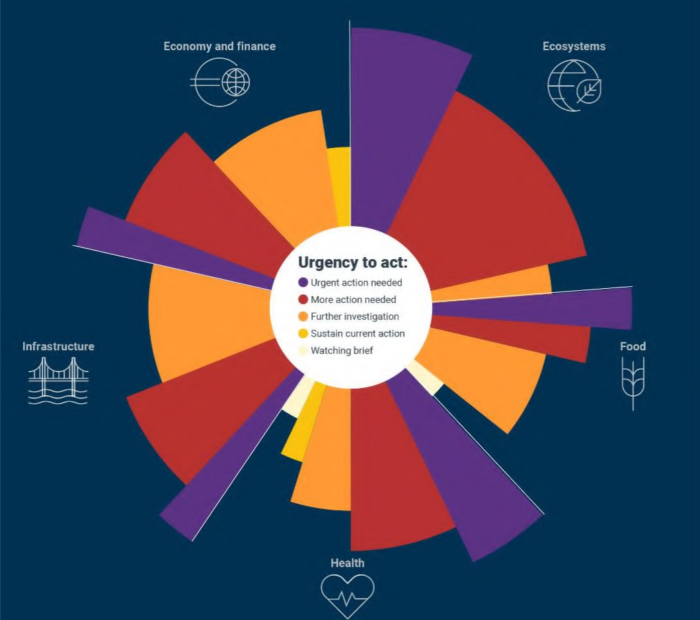
Designing a just and resilient Europe

Proposals for the EU Framework for Climate Resilience
09/11/2026

The far right, reactionary platformisation and progressive responses

The far right is thriving on social media, and this is no accident. This policy […]
04/11/2026

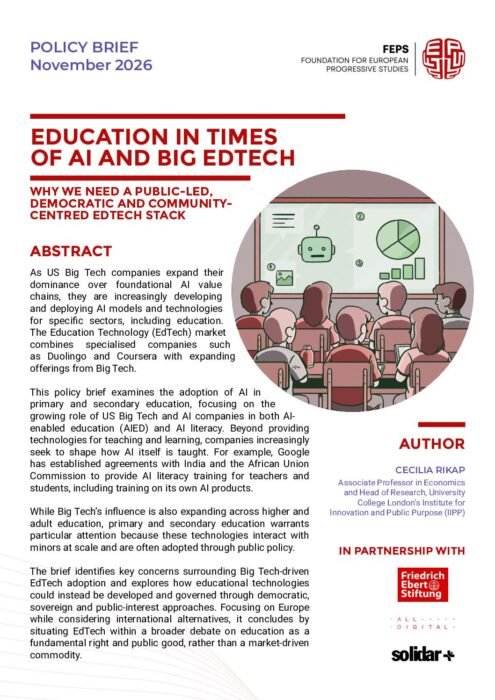
Education in times of AI and Big EdTech

Why we need a public-led, democratic and community-centred EdTech stack
04/11/2026

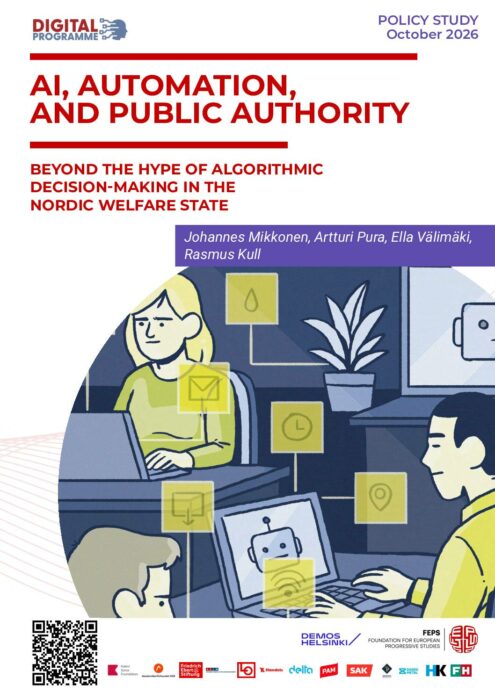
AI, automation, and public authority

Beyond the hype of algorithmic decision-making in the Nordic Welfare State
Find all related news
News
30/10/2026

FEPS Reacts: The new EU Framework for Climate Resilience

Necessary foundations but little action
23/10/2026

Notice of vacancy – Policy Analyst on Gender Equality

Apply before 23 November 2026
16/09/2026

FEPS Reacts: State of the European Union 2026

The 2026 State of the Union felt more like ‘von der Leyen I’ than ‘von […]
23/07/2026

FEPS Reacts: European Commission communication on the Action Plan on the European Pillar of Social Rights

By Laszlo Andor, FEPS Secretary-General & François Balate, Policy Analyst on Social The communication on the […]
Find all related in the media
In the media

Frågan om jämställdhet splittrar unga svenskar

by dagens arena 29/10/2026
"The issue of gender equality divides young Swedes" - FEPS Policy Analyst on Democracy Matteo Dressler discusses the findings of the EqualiZe policy study in the Swedish context.

Brazil’s Lula survives Bolsonaro scare, safeguarding EU democratic ally on climate and trade

by EUobserver 26/10/2026
Read EUobserver's analysis of what comes next after Brazil's elections, which includes comments from Thainá Leite, Project Coordinator at FEPS

Франција е Франција – но Франција е и Европа

by Racin.mk 21/10/2026
“France is France – but France is also Europe.” In an opinion piece for Racin.mk, László Andor, Secretary General of FEPS, argues that France’s youth protests, set against a latent budget crisis and growing precarity (schools, housing), risk benefiting Marine Le Pen, and that France, despite bending the EU’s fiscal rules, has also propped up European growth.

La Regina, il problema dei divari territoriali è una questione europea

by Regione Basilicata 22/09/2026
“La Regina: territorial disparities are a European issue” News article published by ANSA (IT), featuring Raffaele La Regina, participant in the FEPS Young Academics Network, discussing territorial and social inequalities across Europe, the need to reconcile competitiveness and cohesion, and the role of European cohesion policy, industrial policy and investment in ensuring that no region is left behind.