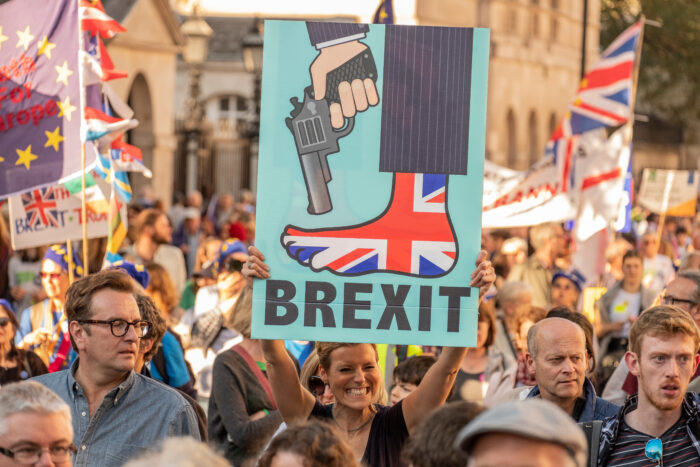
FEPS Newsletter 17 May 2024 – 🎓 FEPS Young Academic Network

New Policy Studies by FEPS YAN scholars – If you have problems displaying this email, […]

17/05/2024
New Policy Studies by FEPS YAN scholars –

If you have problems displaying this email, follow this link


Facebook Twitter LinkedIn Instagram FlickR Link
FEPS YAN website
 

The FEPS Young Academic Network (YAN) 8th cycle has successfully concluded, marking yet another great chapter of an initiative established jointly by FEPS and Karl-Renner-Institut in 2009. 


These incredibly motivated 43 PhD candidates and postdocs worked throughout the almost two-year cycle with mentors and experts, including Members of the European Parliament, and produced six policy papers on themes such as: social inequalities, fiscal policy, geopolitics, eco socialism, migration and digitalisation


The FEPS YAN 9th cycle is about to kick off. The new scholars will soon participate in the first in-person session in Vienna in July 2024.


More information about this programme at the FEPS YAN website.

Tightening welfare belts again?

By Jan Bogusławski, Matilde Ceron, Robin Huguenot-Noël, Alessandro Liscai and Severin Rapp – In collaboration with the Karl-Renner-Institut


To what extent do EU fiscal rules constrain governments’ social and labour market spending? Exploring the critical cases of France and Italy, this policy study gathers evidence from two decades of interactions between national welfare priorities and EU fiscal rules and, through this comparison, sheds light on the mechanisms underlying recent recalibrations and what it means for the Social Pillar implementation.

By Unai Gómez-Hernández, Alberto Bortolotti, Dennis Gottschlich and Maja Gergorić – In collaboration with the Karl-Renner-Institut


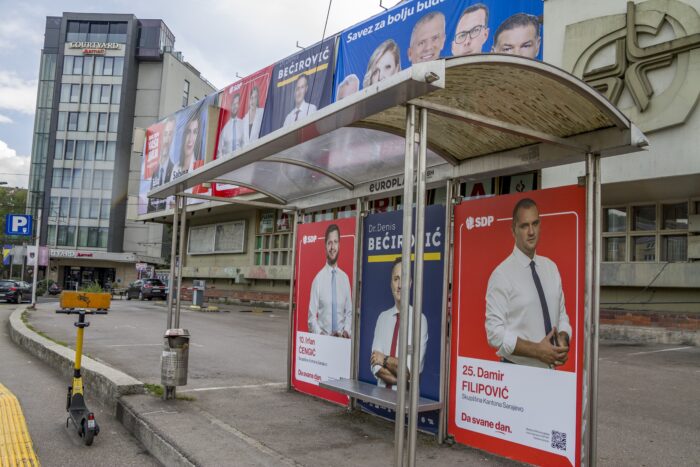
In recent years, European citizens have witnessed a rise in inequality, especially socio-economic, alongside an increase in vote share for radical right populist parties. By examining case studies from Italy, Hungary, and Spain (with the comparative case of Germany), this policy study argues that the rise of populism is not only linked to economic trends but also to other constitutional changes and institutional settings characterising European countries with a focus on economic inequality as the explanatory variable for political participation.

Inequality and populism
Toward a progressive geopolitical EU

By Mathieu Blondeel, Cleo Davies, Daniel Muth and Marene Elgershuizen – In collaboration with the Karl-Renner-Institut


In the face of a rapidly evolving geopolitical landscape, marked by global tensions and environmental challenges, this report outlines the evolution of the EU towards a geopolitical union. With the 2024 European elections approaching, the report proposes principles, which, taken together, provide for a dynamic, applicable framework that serves as a basis for practical engagement and policy formulation in fostering a progressive EU geopolitics.

By Tin Kampl, Dmytro Mamaiev, JiMin Nam, Tomás Vieira Silva and Elena Zacharenko – In collaboration with the Karl-Renner-Institut


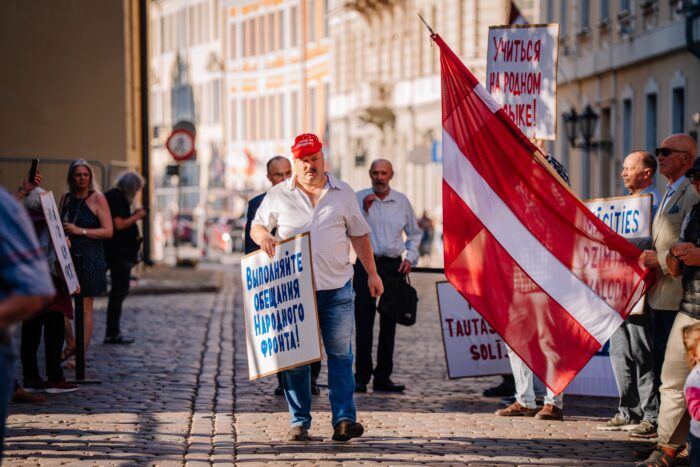
EU enlargement is once again becoming a priority for European decision makers and is seen as an effective foreign policy tool in challenging geopolitical times. However, it is imperative to recognise EU accession as a multifaceted process that can also exacerbate socio-economic disparities within and beyond the EU. This policy study analyses this phenomenon in light of two specific issues: the application of visa liberalisation policies under EU accession negotiations; and the negative effects of high levels of migration from the semi-periphery to the core of the EU induced by access to free movement.

Labour migration from the European periphery to the EU’s core
Ecosocial food policies – proposal for a new social-democratic approach

By Lena Siepker and Halliki Kreinin – In collaboration with the Karl-Renner-Institut


In the run-up to the European elections in 2024, this policy study delves into the essential question of why we need to transform the EU food system and how to do it – adopting an ecosocialist perspective that serves as a basis for a new, progressive, social- democratic and ecological food policy. 

 
Read more

By Kilian Wirthwein, Marc Cabañas, Fabio Di Nunno and Leah Rea – In collaboration with the Karl-Renner-Institut


This policy study delves into the evolution of the regulation of the European Parliament and of the Council on the transparency and targeting of political advertising, exploring upcoming key changes and their connection to broader discussions on populism, democratic values, and access to quality information. Additionally, it provides guidelines for progressive parties on leveraging this legislation to initiate comprehensive strategies to combat extremist populism and antidemocratic movements within the EU.

EU regulation on transparency and targeting of political advertising?
News
Training of trainers second session

In collaboration with Foundation Max van der Stoel and Karl-Renner-Institut


Take part in this exciting opportunity to enhance your skills and engage in knowledge exchange with trainers from across Europe. Each participant will contribute their unique experiences, styles, and ideas, fostering a rich environment for collaborative learning.

Our upcoming session is scheduled to be held in Vienna on 21-23 June. Join us and become an integral member of the pan-European Progressive Network, connecting with educators, instructors, and facilitators across the continent! 

 
More info
 

Do you have expertise in international relations? Have you worked in areas such as multilateralism, EU foreign, security, peace, development and cooperation policies?

 
Apply here

The ideal candidate will steer and implement a coherent portfolio of FEPS (co-)funded projects (including its development and consolidation) aimed at impacting policies, political debates and/or public awareness related to the EU’s approach to, and position in the world whilst building on the social democratic tradition of international cooperation and development. Apply before 24 June!

 
Apply here

Was this email forwarded to you?

Copyright © 2024 FEPS Europe, All rights reserved.

You are receiving this email because you participated in one of FEPS’ events and/or have registered for FEPS’ newsletter.

If you wish not to receive FEPS’ communications anymore, please click here: unsubscribe now


Foundation for European Progressive Studies
Avenue des Arts, 46 – 1000 Bruxelles

+32 223 46 900 – info@feps-europe.eu

Find all related Progressive Post
Progressive Post
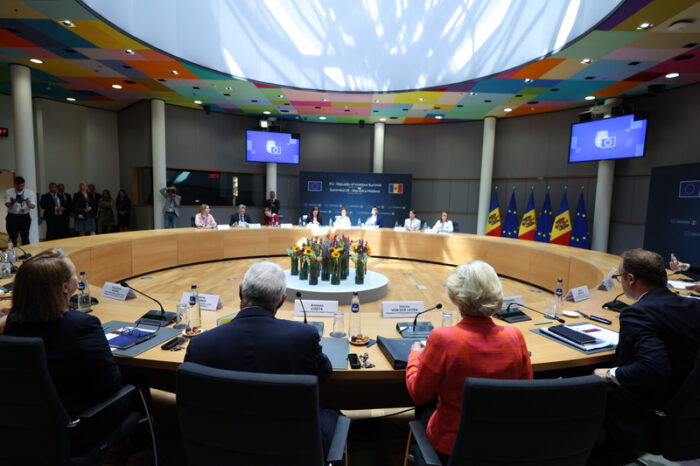
05/03/2026

Poverty is not a fatality

In 2024, more than 93 million Europeans, representing 21 per cent of the EU-population have […]
05/03/2026

Poverty is the result of political choices

On 12 February, the European Parliament voted on the report of the parliament’s committee on […]
Find all related Magazine
Magazine
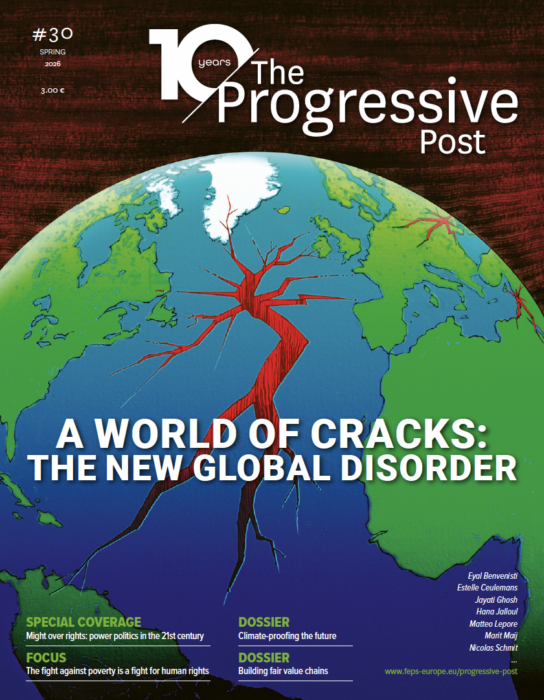
  • cover book

    # Issue 29 Progressive Post

# Issue 29

From the war in Ukraine to the devastation of Gaza since 2023, the words ‘war’ […]
  • cover book

    # Issue 28 Progressive Post

# Issue 28

European Social Democracy at historical crossroads
  • cover book

    #Issue 27 Progressive Post

#Issue 27

The EU in uncharted waters
Find all related publications
Publications
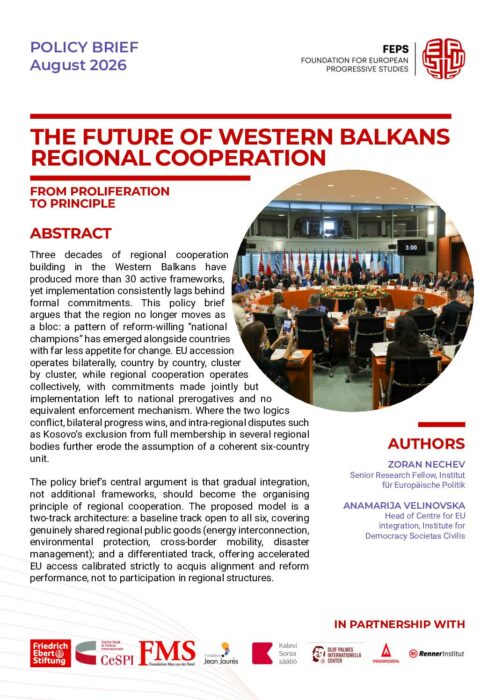
03/03/2026

Digital sovereignty and a new multilateralism for the AI era

Artificial intelligence (AI) is transforming not only economies but the very nature of global power, […]
03/03/2026

Progressive pathways for a resilient (re)construction of Ukraine: Towards a new social contract

This policy study places labour at the centre of reconstruction planning for Ukraine as the […]
03/03/2026

European sovereignty and the social dimension

Reasserting Europe’s social-democratic model in turbulent times
29/01/2026

Progressive Yearbook 2026

In an eerie manner, 2025 resembled the ‘time of monsters’, which, according to the great […]
Find all related news
News
05/03/2026

FFPPVC commentary on the new EU Gender Equality Strategy 2026-2030

Commentary by the Feminist Foreign Policy Progressive Voices Collective (FFPPVC)
03/03/2026

Wag the dog?

FEPS commentary on the US-Israel attack on Iran
03/03/2026

Closing ceremony of the Progressive Ukraine programme

The graduation ceremony completed the programme which was part of the Open Progressive University (OPU).
29/01/2026

Maria João Rodrigues departs from FEPS Presidency, transitions to Nicolas Schmit

After completing eight years in the role, Maria Joâo Rodrigues has departed the role of […]
Find all related in the media
In the media

Africa and Europe Must Rethink Clean Energy Partnership After COP30 Setback

by News Ghana 27/02/2026
Read this article from News Ghana on the highlights of FEPS' event "Governing the global just transition", where diverse stakeholders discussed the EU's role in supporting a just transition from fossil fuels to clean energy in Africa

EUfória podcast Andor Lászlóval: Mire képes az EU saját erejéből és mennyire van kiszolgáltatva a világnak?

by EUrologus 26/02/2026
Listen to the EUfória podcast with László Andor, Secretary General of FEPS, on what the EU can achieve on its own, how to tackle its competitiveness challenge and how the Hungarian government’s stance shapes the EU’s image.

Can the EU ever become a superpower?

by Euronews 20/02/2026
In this episode of the podcast Brussels, My Love, FEPS President Nicolas Schmit discusses the informal meeting of the Antwerp European Industrial Summit and the Munich Security Council.

España los forma, Europa los contrata: así es el mapa de la nueva fuga de cerebros

by El Confidencial 10/02/2026
Spain trains them, Europe hires them: the map of the new brain drain: László Andor, FEPS Secretary-General, discusses the 'brain drain' as a result of the EU’s single market and highlights the need for a fairer mobility and retention strategy across the EU.