
FEPS Next Left Working Group, National Round Table and National Congress of the European Studies at Warsaw University

The FEPS Next Left Working Group (NL WG) on Europarties and eurodemocracy will be gathering […]
Speakers

17 - 21/09/2014
00:00:00 - 00:00:00
Warsaw Warsaw
FEPS Next Left Working Group, National Round Table and National Congress of the European Studies at Warsaw University
56026
159-feps-next-left-working-group-national-round-table-and-national-congress-of-the-european-studies-at-warsaw-university
0

In order to give you access to our events, FEPS processes your personal data together with any other organiser of this event mentioned in the description of the event and in accordance with 'FEPS’ data protection policy.

The FEPS Next Left Working Group (NL WG) on Europarties and eurodemocracy will be gathering for its’ second session this year, aiming at fulfilling three objectives: proceeding with the reasearch (by offering each other peer review of the first drafts of their respective research papers), engaging in a conversation with the Polish stakeholders (politicians, experts and representatives of trade unions and NGOs), as also taking part in the first ever National Congress of European Studies held at Warsaw University https://www.kongreseuropeistyki.uw.edu.pl/ 

The core activity hosted by the Foundation Amicus Europae https://fae.pl/ with the support of Renner Institut https://www.renner-institut.at/ will feature an intensive programme. To begin with, the members of the NL WG will return to the themes that they have chosen to research this year and have modified in terms of research aenues, following the joint discussion on the outcomes of the recent EU elections and the ongoing process of setting the new legislative mandate within the EU. Furthermore, focused on Poland, the event will enable the members to enter into exchange with Polish scholars, at which opportunity the NL WG will promote the publications accomplished within this group so far (for example the vol. 7 of the FEPS Next Left books https://www.renner-institut.at/). To that extent, also panels with the representatives of SLD, Zieloni, OPZZ, Daszynski Center and Homo Homini (to name a few) are designed in a way to facilitate grasping an unsderstanding of the Polish social, economic and political specificity – offering the answers on the state of social democracy in this country and alongside this line also within the Central and Eastern European region.

The event will finish with a high level dinner, which will be opened by Aleksander Kwasniewski, former President of Poland and Dr. Alfred Gusenbauer, Chair of the FEPS Next Left Research Programme and the former Chancellor of Austria.

In case of further queries regarding FEPS NL WG or the event itself, please do not hesitate to contact Dr. A. Skrzypek, FEPS Senior Research Fellow at ania.skrzypek@feps-europe.eu

Network
Amicus Europæ
Karl Renner Institut
Find all related publications
Publications
15/01/2026

Financing enlargement via the 2028-2034 MFF

This brief intends to explain how the European Commission’s proposal for the 2028-2034 Multiannual Financial […]
19/12/2025

Moving beyond neoliberalism in EU trade policy

European Union trade policy finds itself at a crossroads. After three decades of neoliberal dominance in the […]
15/12/2025

The great unravelling

“The great unravelling” examines the challenges that the new era of globalisation poses for progressive […]
09/12/2025

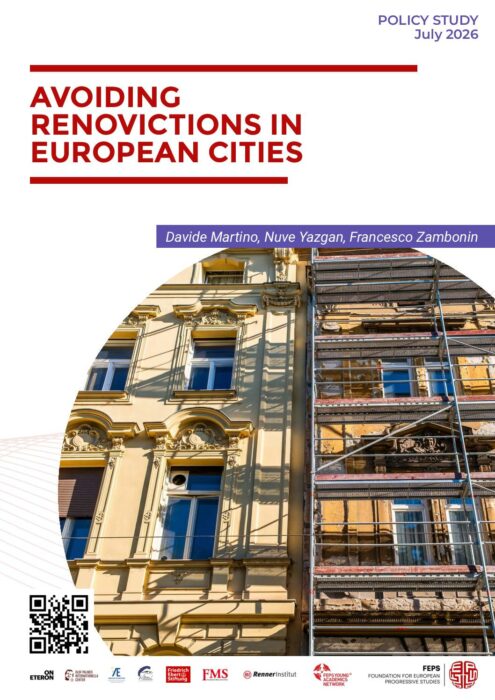
Tackling the housing crisis in Europe

Progressive ideas for affordable and sustainable housing policies
Find all related Audiovisual
Audiovisual
15/12/2025

FEPS Extraordinary General Assembly 2025

10/12/2025

‘Tackling the housing crisis in Europe’ Flickr album

Photo album of the ‘Tackling the housing crisis in Europe‘ event at the European Parliament […]
17/11/2025

New own resources in the MFF proposal

Photo album of the ‘New own resources in the MFF proposal‘ event at FEPS HQ, […]
15/11/2025

‘Africa Day 2025’ Flickr album

Photo album of the ‘Africa Day 2025‘ event in Amsterdam, Netherlands. Africa Day has been […]
Find all related news
News
06/01/2026

Venezuela is not about drugs: Trump’s Regional Expansionism and Europe’s Test

FEPS Commentary on US military intervention in Venezuela
16/12/2025

FEPS commentary on the EU Affordable Housing Plan

The announcement of the EU Affordable Housing Plan by Commissioner Dan Jørgensen is a historic milestone […]
15/12/2025

FEPS President Maria João Rodrigues at Digital UNGA in New York

From 15 to 17 December, the Digital UNGA took place in New York, bringing together […]
12/12/2025

FEPS elects Nicolas Schmit as new President

After eight years in the role, outgoing President Maria João Rodrigues requested to be replaced, considering her mission accomplished. 
Find all related in the media
In the media

“Talking with the enemy” – POLITICO Brussels Playbook, January 13

by POLITICO 13/01/2026
Read Nicolas Schmit, FEPS President-elect, in the 'POLITICO Brussels Playbook'. He calls for stronger European solidarity and a more assertive EU stance to defend its digital rules - particularly in the face of US sanctions.

Liberal democracy’s social, societal fabric under threat – Live from the EPC Annual Conference 2025

by EPC 08/12/2025
In a podcast by the European Policy Centre (EPC), FEPS Secretary General, László Andor, discusses how liberal democracy in Europe is being challenged not only at the institutional level but also through the erosion of social rights and what Europe must do to defend its social foundations.

« La souveraineté numérique européenne est un défi d’ordre civilisationnel »

by Le Monde 15/11/2025
"European digital sovereignty is a challenge for civilisation as a whole". In an opinion piece in the newspaper Le Monde, FEPS President Maria João Rodrigues shares her concerns about European digital dependence on American and Asian giants

When Algorithms Undermine Democracy: Europe’s Wake-Up Call

by Social Europe 11/11/2025
Maja Fjaestad and Simon Vinge, co-editors of FEPS book "Algorithmic rule", wrote this op-ed on the power of algorithms and how they threaten the foundations of democratic oversight