FEPS Newsletter 10 Feb 2023 – Climate mainstreaming, Fit for 55 package and more!

📅 FEPS Newsletter: Climate mainstreaming, Fit for 55 package and more! Share Tweet Share Share […]

10/02/2023
📅 FEPS Newsletter: Climate mainstreaming, Fit for 55 package and more!
Fit for 55 policy study, Progressive Post & recap of event in FEPS HQ
 ‌ ‌ ‌ ‌ ‌ ‌ ‌ ‌ ‌ ‌ ‌ ‌ ‌ ‌ ‌ ‌ ‌ ‌ ‌ ‌ ‌ ‌ ‌ ‌ ‌ ‌ ‌ ‌ ‌ ‌ ‌ ‌ ‌ ‌ ‌ ‌ ‌ ‌ ‌ ‌ ‌ ‌ ‌ ‌ ‌ ‌ ‌ ‌ ‌ ‌ ‌ ‌ ‌ ‌ ‌ ‌ ‌ ‌ ‌ ‌ ‌ ‌ ‌ ‌ ‌ ‌ ‌ ‌ ‌ ‌ ‌ ‌ ‌ ‌ ‌ ‌ ‌ ‌ ‌ ‌ ‌ ‌ ‌ ‌ ‌ ‌ ‌ ‌ ‌ ‌ ‌ ‌ ‌ ‌ ‌ ‌ ‌ ‌ ‌ ‌ ‌ ‌ ‌ ‌ ‌ ‌ ‌ ‌ ‌ ‌ ‌ ‌ ‌ ‌ ‌ ‌ ‌ ‌ ‌ ‌ ‌ ‌ ‌ ‌ ‌ ‌
Upcoming Events
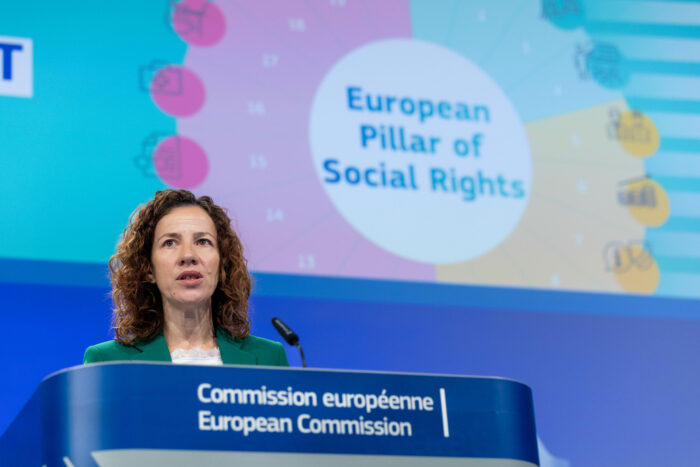
There cannot be climate justice without social justice! This week, we focus on the inclusion of social issues in climate policies and on climate mainstreaming in gender, health and digital policies. We also discuss NextGenerationEU, the EU single market and more.
Climate change is a systemic issue that cannot be addressed by siloed thinking. The transition to a political, social and economic model needs a holistic understanding to address the planetary emergencies and to implement the commitments of the EU Climate Law. Transforming societies and economies while respecting sustainability principles means mainstreaming environmental concerns whenever we design policies for all other areas.

The ‘Climate mainstreaming: Breaking down the silos’ series comprises four policy briefs that disentangle these interlinkages by connecting climate matters with different disciplinary backgrounds. The objective is to assist progressive policymakers who want to adopt environmentally sustainable policies that can remedy rather than exacerbate existing inequalities.
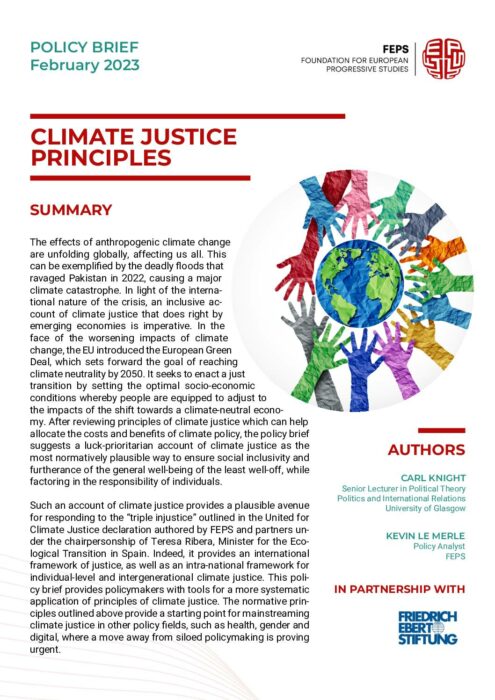
By Carl Knight and Kevin Le Merle

This policy brief provides policymakers with tools for a more systematic application of principles of climate justice. The normative principles explored provide a starting point for mainstreaming climate justice in other policy fields, such as health, gender and digital, where a move away from siloed policymaking is proving urgent. Read more.
By Gill Allwood

Gender equality and climate change should both be mainstreamed throughout all EU internal and external activities. This policy brief argues that the synergies between them should be fully explored in order to achieve the greatest co-benefits. Together, they will contribute to the systemic transformative change which is essential to both gender and climate justice. Read more.
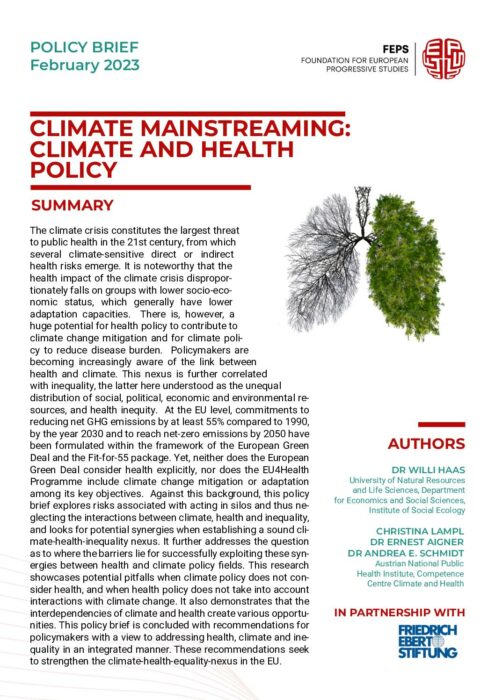
By Willi Haas, Christina Lampl, Andrea Schmidt and Ernest Aigner

There is a huge potential for health policy to contribute to climate change mitigation and for climate policy to reduce disease burden. This policy brief also looks for potential synergies when establishing a sound climate-health-inequality nexus. Read more.
By Kerstin Hotte

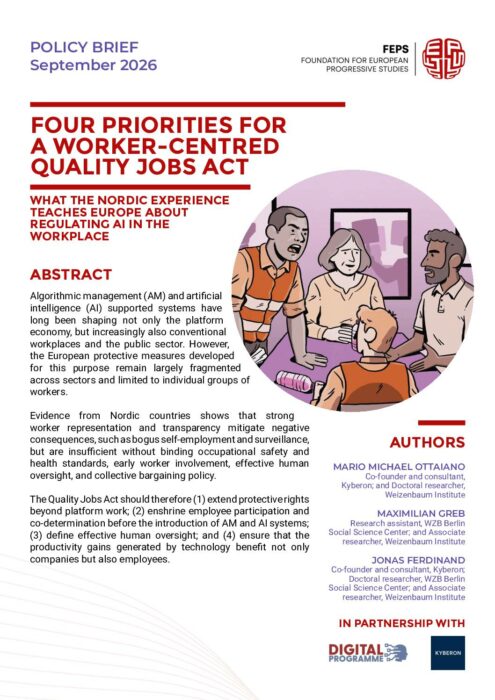
What are the positive and negative interactions across the processes of technological advances involved in climate change mitigation and digitalisation? This policy brief shows how current EU policy strategies take account of these interactions. It proceeds by outlining 15 principles around which policies for climate change mitigation, adaptation, and compensation should be designed to ensure justice and to leverage the greatest synergies with the ongoing process of digitalisation. Read more.
By Sanna Markkanen, Krisztina Zálnoky and Francesco Giannelli

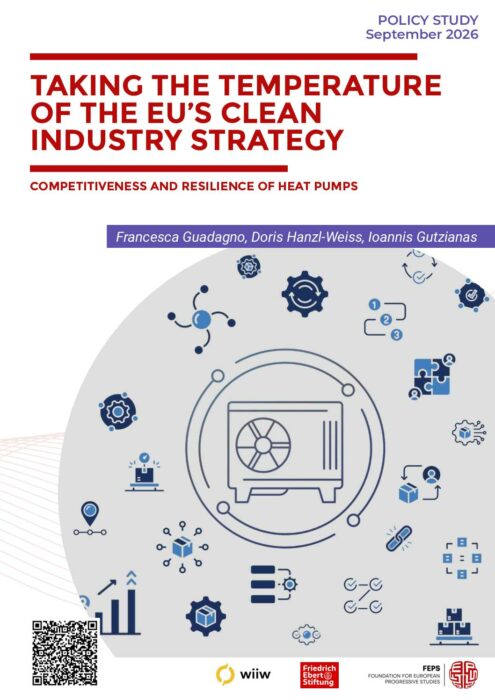
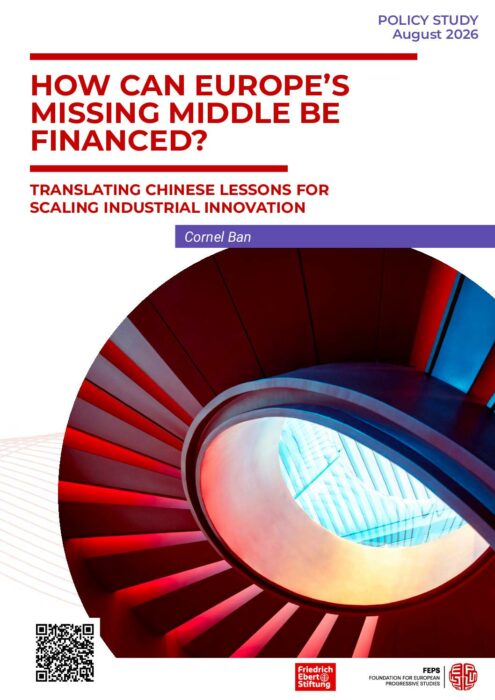
New climate policies could exacerbate existing inequalities if the costs and benefits of the transition are not equitably distributed. This policy study by FEPS, University of Cambridge Institute for Sustainability Leadership (CISL) and Friedrich-Ebert-Stiftung (FES) examines how the social elements of the Fit for 55 package evolved in the context of the climate, energy, and cost-of-living crises. Read more.
PAST EVENT
7 February – FEPS HQ, Brussels

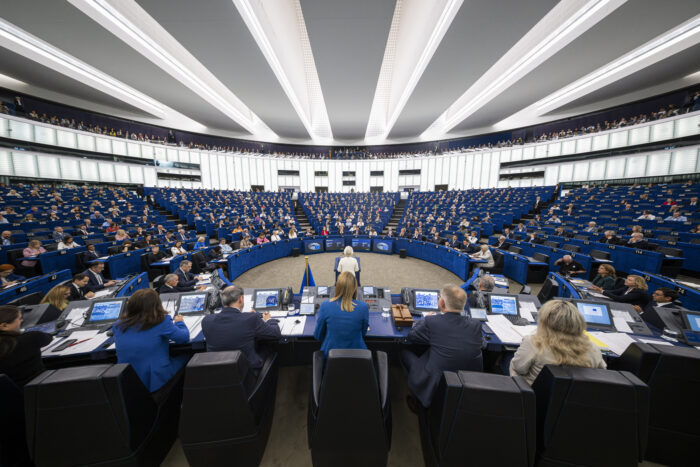
How can we better negotiate and implement the Fit for 55 package in a fair and inclusive way? Fostering a dialogue between members of different political groups, researchers and policy experts, we aimed to provide crucial inputs on the role of the EU Parliament in shaping the meaning of the social dimension of climate policy through concrete policy interventions.

Participants were invited to share their views on how the meaning of the social aspects in the Fit for 55 Package is evolving in the changing (geo)political context.

The new report from FEPS, CISL and FES, explores the ways social issues have been included in climate policies by the EU Commission. The research results, based on qualitative interviews and frequency counting of selected key terms relating to social considerations, found progress towards inclusive economic transition, but there is also an urgent need for further improvements in two key areas: the development of clear definitions for crucial terms and explicit reference to the most severely affected social groups. Read more.
Events
UPCOMING EVENT
23 February – Online

This event will mark the first anniversary of the Russian invasion of Ukraine. Paying tribute to the defenders of Ukrainian independence, we will highlight the EU solidarity efforts and preparations for reconstruction.

It will also be an opportunity to take stock of FEPS work since February 2022 and outline forthcoming action. Among the participants, László Andor, FEPS Secretary General and Uwe Optenhoegel, FEPS Vice-President, editors of the soon-to-be-published FEPS-London Publishing Partnership book on the ongoing war in Ukraine, and many more.
Events
By Marie Charrel

László Andor, FEPS Secretary General, share his views in Le Monde, on the analysis of the last thirty years since the implementation of the single market in Europe. Read more.

Photo credits: Shutterstock/BalkansCat
By Ernst Hillebrand

The Eastern member states of the EU have seen impressive economic growth since joining the European Union. This is especially true for the Visegrád countries (Czech Republic, Slovakia, Poland and Hungary), but also, for example, for Slovenia, Romania or Lithuania. In almost all of the ‘accession countries’, the economic development was far better than predicted (or feared) at the time of EU accession. Read more.
Photo credits: Shutterstock/VizUalni
By Luca Jahier

After more than 15 years of crises – from the rejection of the Constitutional Treaty, over the financial crisis, to Brexit – Brussels no longer seems a place of opportunities and solidarity, but it is seen as synonymous with austerity, inequality and growing divergences, in the face of divisive sovereignty. However, the 2019 European elections and the resulting Von der Leyen Commission represented a turning point that reversed the prospects. One could say that, after years of deadlocked defence, the EU has gone on the attack. Read more.

A slightly different version of this article was originally published in Italian on cespi.it within the framework of the Forum ‘Verso una nuova fase dell’Unione europea‘.
Photo credits: Shutterstock/PPPhotos
Twitter
Facebook
Linkedin
Instagram
Youtube
Website


Copyright © 2023 FEPS Europe, All rights reserved.
You are receiving this email because you participated in one of FEPS’ events and/or have registered for FEPS’ newsletter.
If you wish not to receive FEPS’ communications anymore, please click here: unsubscribe now


Email Marketing by ActiveCampaign
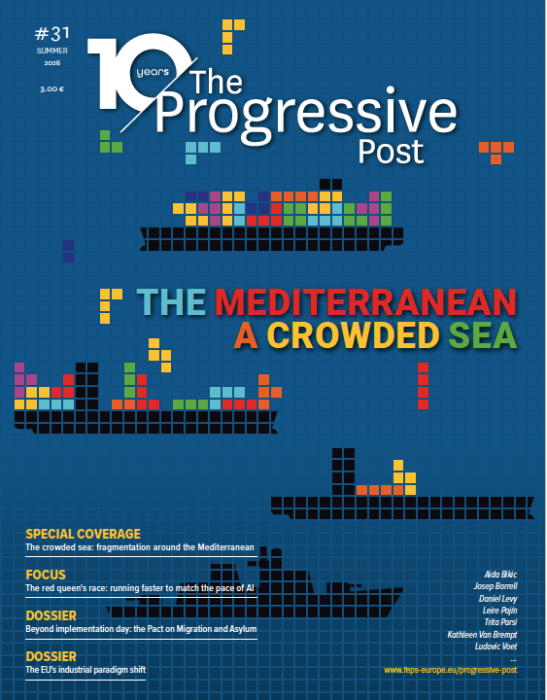
Find all related Progressive Post
Progressive Post
07/05/2026

Competitiveness is nothing without social rights

Five years after the Porto Social Summit, European leaders must remember that deregulation will only […]
06/05/2026

From attention to attachment

AI is rewiring childhood
06/05/2026

Innovating peace processes in the digital age: the role of AI

How are digital technologies – and AI in particular – changing diplomacy and peace? Whereas […]
Find all related Magazine
Magazine
  • cover book

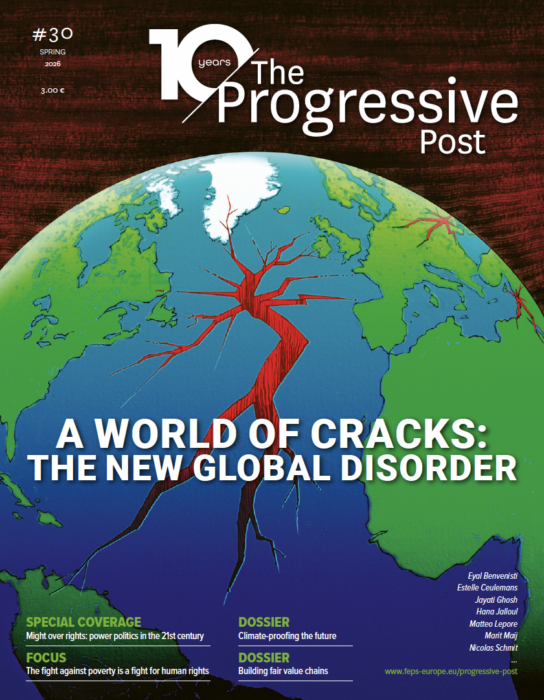
    Issue #30 Progressive Post

Issue #30

In geopolitics, 2026 is challenging our certainties: from the abduction of the Venezuelan president, over […]
  • cover book

    # Issue 29 Progressive Post

# Issue 29

From the war in Ukraine to the devastation of Gaza since 2023, the words ‘war’ […]
  • cover book

    # Issue 28 Progressive Post

# Issue 28

European Social Democracy at historical crossroads
Find all related publications
Publications
17/04/2026

The open future and its enemies

How we can protect free society from AI dictatorship
17/04/2026

EqualiZe

Gender differences in political opinion and voting among Generation Z
27/03/2026

Laboratories of counter-hegemony

Orbán, Trump and the transatlantic far-right ecosystem
25/03/2026

The European Green Deal tracker

Assessing the implementation of the Green Deal in member states
Find all related news
News
13/04/2026

Hungary’s civic revolution

FEPS' commentary on the outcomes of the Hungarian election
05/03/2026

The new EU Gender Equality Strategy 2026-2030

Commentary by the Feminist Foreign Policy Progressive Voices Collective (FFPPVC)
03/03/2026

Wag the dog?

FEPS commentary on the US-Israel attack on Iran
03/03/2026

Closing ceremony of the Progressive Ukraine programme

The graduation ceremony completed the programme which was part of the Open Progressive University (OPU).
Find all related in the media
In the media

Ue, la competitività non è nulla senza i diritti sociali

by La Repubblica 06/05/2026
"In the EU, competitiveness is nothing without social rights" In this article published in La Repubblica, former European Commissioners Nicolas Schmit (FEPS President), László Andor (FEPS SecGen) and Anna Diamantopoúlou (part of FEPS' Bureau) remind European leaders that deregulation will only make Europe poorer and that only social sovereignty will make it stronger

Une révolution civique, pas encore une révolution sociale

by Fondation Jean-Jaurès 06/05/2026
“A civic revolution, not yet a social revolution” Interview with László Andor, FEPS Secretary General, published by Fondation Jean-Jaurès (FR), analysing the electoral defeat of Viktor Orbán, the emergence of a broad opposition movement in Hungary, and the prospects for democratic renewal, EU relations and social change following what he describes as a “civic revolution” that has yet to deliver a social transformation.

Anna Diamantopoúlou, Nicolas Schmit und László Andor über eine Wettbewerbsfähigkeit, die ohne soziale Rechte wertlos ist

by Tageblatt 06/05/2026
"Competitiveness is nothing without social rights" In this article published in Tageblatt, Former European Commissioners Nicolas Schmit (FEPS President), László Andor (FEPS SecGen), and Anna Diamantopoulou (FEPS Bureau member) warn EU leaders that deregulation is a path to economic decline. They argue that Europe’s true strength lies not in cutting rules, but in achieving social sovereignty

Jön a pénz! Magyar Péter beváltja az ígéretét?

by KlikkTV 04/05/2026
“Money is coming! Will Péter Magyar deliver on his promise?” Video Interview published on KlikkTV (HU), featuring László Andor, FEPS Secretary General, discussing EU funds to Hungary, their political conditionality, and the importance of fair distribution, rule of law and social investment within the European Union.