Media in Europe: Subsidiarity should be reconsidered

The Hungarian media law symbolises the need for the European Union to assume its responsibilities […]

Policy Study

09/10/2014

The Hungarian media law symbolises the need for the European Union to assume its responsibilities to defend media freedom. Interpretations of this law diverge, however. In Hungary, it is seen as the straw that broke the camel’s back, coming on top of a series of laws aiming to strengthen the current government’s powers. In Europe, following the Italian, Romanian and Bulgarian cases, it has become a symbol of debate on a European media law.

The question of whether an EU directive is necessary and would be more effective is a valid one. What added value would a directive contribute? And, most importantly, considering cultural, linguistic and legal differences is it conceivable?

As the recent cases show, the Commission’s approach of legislating in the field of the media in order to complete the single market does not constitute an absolute guarantee. There is no direct correlation between a larger number of players on the market, greater competition and greater media independence. Despite this approach, and despite the fact that the laws comply with EU legislation, the Hungarian law still includes ambiguous articles with respect to the appointment of officials and media control. Concentration problems are not always solved satisfactorily in Italy and a homogenising effect can be seen in the programmes of private and public channels. The purpose of an EU regulation would not be to impose detailed rules like those at national level. However, as the cases mentioned above suggest, national legislation no longer suffices.

It fails to offer adequate guarantees in an increasingly interconnected world. Consequently, a European media framework law determining the bases and guiding principles for the functioning of this sector seems essential to effective protection of media freedom.

Article 5 of the Treaty on the European Union, the ‘subsidiarity principle’, is often evoked as a ground to object to a media law. Existing legislation is nevertheless inconsistent, does not cover all aspects and shows a number of major weaknesses.

Media freedom is an essential foundation of our democracies, however, since it enables us to take informed decisions during local, national and European elections. So there is a European dimension that calls into question the principle of subsidiarity. Furthermore, based on Articles 2 and 6 of the Treaty on European Union, a policy in support of media freedom could be seen as a sort of implicit competence.

In spite of the entry into force of the Lisbon Treaty, which includes the European Union’s Charter of Fundamental Rights, the Commission still does not have the capacity to act in cases of violations of human rights in general. However, it seems that the current Commission does not intend in any case to evoke more fundamental human rights principles in this connection, but on the contrary to keep to the technical aspects, as seen in the criticisms Neelie Kroes sent to the Hungarian government. More positively, the joint resolution tabled in the European Parliament by members of the S&D, ALDE and Greens-EFA groups constitutes a more courageous approach.

Will the situation change once the European Union becomes a party to the European Convention on Human Rights (ECHR)? It is still hard to say whether this change will have additional effects that could convince the Commission to adopt a more explicit approach to these problems and similar questions.

The Foundation for European Progressive Studies (FEPS) and its legal experts will work to advance a progressive European approach to the media, based on respect for democratic values and fundamental rights, and will propose progressive alternatives aimed at more coherent and effective European media legislation.

Find all related publications
Publications
23/09/2025

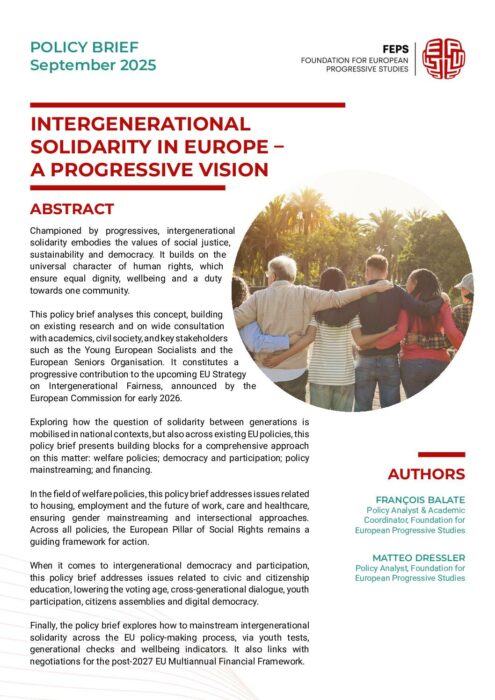
Intergenerational solidarity in Europe

A progressive vision
20/05/2025

Demonetisation of anti-democratic and extreme content

The proposed European Democracy Shield (EUDS) aims to fortify the EU’s democratic systems against disinformation, […]
29/01/2025

Progressive Yearbook 2025

2024 was announced as a ‘super election’ year. In fact, about half of the world’s […]
11/12/2024

From posts to polls

Understanding youth engagement in the 2024 European elections
Find all related Progressive Post
Progressive Post

12/11/2025

How Progressives win when democracy is on the line

Across democracies, the threat to liberal institutions no longer comes from the margins. It sits […]
18/09/2025

Submission is not a strategy: Von der Leyen’s missed moment

The world is sliding into a new order where the strong impose their rule and […]
13/06/2025

Trump vs Harvard: strike one to educate one hundred

The conflict between Harvard University and the Trump administration has become the latest battle in […]
Find all related events
Events
Past
01 - 03/12/2025
FEPS HQ, Brussels

FEPS Annual Autumn Academy 2025

For a Europe of peace, prosperity and progress
13 - 15/11/2025
Vienna, Austria (Expert Meeting)

FEPS Young Academics Seminar

4th seminar of the 9th cycle
09/10/2025
FEPS HQ (Expert meeting)

The Gen Z Gender Divide in Political Behavior

Project EqualiZe launch
Load more...
Find all related Audiovisual
Audiovisual
25/07/2025

The new American way with James K. Galbraith

Spotify – Apple Podcast Prof. James K. Galbraith shares his views about the dramatic changes […]
17/06/2025

Democracy today and tomorrow with former Greek Prime Minister George Papandreou

In this episode of FEPS Talks, Secretary General László Andor talks with the former prime […]
17/12/2024

Right turns and Left leans: A New gender divide in young voters? with Gefjon Off

🔊📺 Available on Spotify, YouTube, and Apple Podcasts In this episode of FEPS Talk, Policy […]
17/12/2024

Right turns and Left leans: A New gender divide in young voters? with Gefjon Off

🔊📺 Available on Spotify, YouTube, and Apple Podcasts In this episode of FEPS Talk, Policy […]
Find all related news
News
21/10/2025

Maria João Rodrigues at PES Congress 2025

🇳🇱 🌹 FEPS attended the Party of European Socialists (PES) Congress in Amsterdam, which included […]
18/10/2025

FEPS at PES Congress 2025

🇳🇱 🌹Within PES Congress, there were full rooms on insightful discussion on a range of […]
10/09/2025

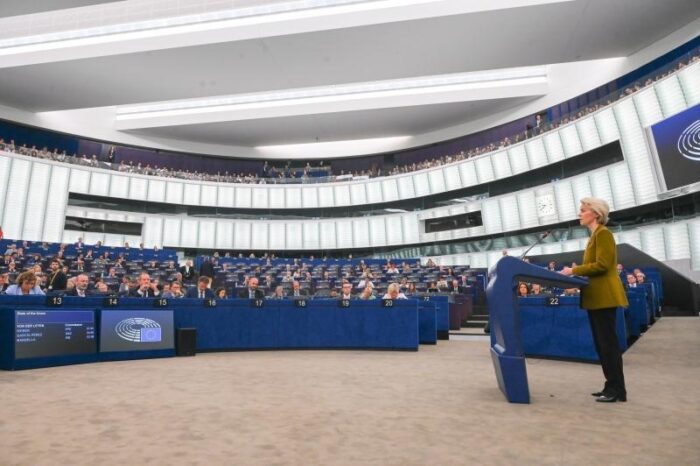
Von der Leyen – walking the walk at last?

FEPS reaction to The State of the European Union 2025
10/02/2025

FEPS joins BlueSky – follow our new account! 

When misinformation and disinformation run rampant, we resist attempts to bully users off certain platforms. […]
Find all related in the media
In the media

Liberal democracy’s social, societal fabric under threat – Live from the EPC Annual Conference 2025

by EPC 08/12/2025
In a podcast by the European Policy Centre (EPC), FEPS Secretary General, László Andor, discusses how liberal democracy in Europe is being challenged not only at the institutional level but also through the erosion of social rights and what Europe must do to defend its social foundations.

Líderes progresistas internacionales se reunieron en Buenos Aires para ponerle un freno al avance de la extrema derecha

by Mi Valle 23/09/2025
“International progressive leaders met in Buenos Aires to push back against the rise of the far right” News article in Mi Valle reporting on the meeting of progressive leaders from Europe and Latin America in Buenos Aires, where FEPS President Maria João Rodrigues took part, stressing the need to build common strategies to defend democracy and social justice against the far right.

En Europe, les partis sociaux-démocrates se sont contentés d’une approche technocratique

by Le Point 04/07/2025
“In Europe, social democratic parties have relied too heavily on a technocratic approach” Interview with FEPS Secretary General László Andor in Le Point (FR), reflecting on the decline of social democracy in Europe and the need to renew its political vision in the face of nationalist challenges.

Nem jó, hogy Magyarországon a szélsőjobb és a jobboldal versenyez

by Hírklikk 12/05/2025
“It's not good that the far-right and the right are competing in Hungary” Interview with FEPS Secretary General László Andor on KlikkTV (HU), featured in Hírklikk, discussing the rise of the far right in Hungary and the need for stronger progressive alternatives.