
Other Publication
23/04/2020
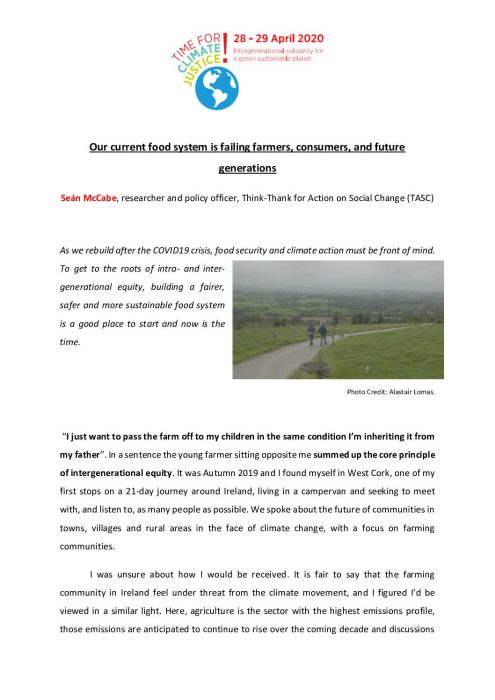
As we rebuild after the COVID19 crisis, food security and climate action must be front of mind. To get to the roots of intra- and inter-generational equity, building a fairer, safer and more sustainable food system is a good place to start and now is the time.
“I just want to pass the farm off to my children in the same condition I’m inheriting it from my father”. In a sentence the young farmer sitting opposite me summed up the core principle of intergenerational equity. It was Autumn 2019 and I found myself in West Cork, one of my first stops on a 21-day journey around Ireland, living in a campervan and seeking to meet with, and listen to, as many people as possible. We spoke about the future of communities in towns, villages and rural areas in the face of climate change, with a focus on farming communities.
I was unsure about how I would be received. It is fair to say that the farming community in Ireland feel under threat from the climate movement, and I figured I’d be viewed in a similar light. Here, agriculture is the sector with the highest emissions profile, those emissions are anticipated to continue to rise over the coming decade and discussions on reducing emissions been spun to represent a threat to farmers livelihoods. A just transition framework for agriculture is essential as we move through the climate crisis, however it remains sorely lacking.
Over the course of the trip, I was taken aback by the kindness of the reception I received. I found farmers, and farming communities wanted to talk about their future. The conversations underscored concerning issues regarding the disintegration of rural services; indebtedness, increasing overheads and unsustainable workloads due to intensification; the vulnerability of farm incomes and rural outmigration. It’s fair to say they did feel threatened by the spectre of measures to combat climate change, but mostly because they felt their livelihood was on an insecure footing and any further pressures may just put them under.
These stories echoed the concerning finding in a FEPS-TASC report earlier in 2019 that highlighted the agricultural sector as the most unequal in Ireland in terms of income. In the same year, the Irish agriculture and food development authority warned that thousands of farmers in Ireland were facing “serious poverty”.
These pressures are not unique to the Irish context. In France, agricultural incomes are among the lowest in the country and tragically, the rate of suicide among French farmers is 20% higher than the general population. The French court of auditors have criticised the unequal and negative effects of aid allocation under the Common Agricultural Policy. Late last year, newly appointed Agriculture Commissioner, Janusz Wojciechowski, highlighted that, across Europe, between 2005 and 2015, four million farms were lost – more than 1,000 a day – as farmers seek viable work elsewhere.
This story of inequality and out-migration in agriculture is set against a landscape of wastage that is both morally and environmentally untenable. In the EU, approximately 88 million tons of food is wasted every year, at the cost of €143 billion. This waste comes with a carbon footprint of 170 million tonnes CO2-eq per year – approximately equal to the total emissions of the 39 Heavily Indebted Poor Countries, as classified by the World Bank.
Our current food system undermines both inter- and intra-generational equity, and efforts to protect future generations will not succeed if they ignore the basic needs of people living today in situations of poverty and marginalisation. Exploitation is hardwired into our globalised food supply chains. Abuse of power by supermarkets and their suppliers result in farmers receiving a fraction of the price that their produce is sold for. Many workers in the production of grapes, melons and mangos cannot afford to eat outside of harvest season. Human trafficking is so rife in the commercial agriculture and seafood industry that the International Labour Organisation estimates almost 3 million people in these sectors work under threat or coercion. Local and global challenges in our food system are deeply interrelated.
The campervan trip was part of an ongoing FEPS-TASC collaboration, exploring how local wealth building might enable a just transition for communities facing pressures from the existing economic model. By the end of the trip I was convinced of two things. Firstly, that the current food system serves to enrich a few while heaping pressure on farmers across Ireland and secondly, that a different system is possible – one which enables robust action on climate change, pay’s farmers a fair price for their produce and enables communities benefit from healthier food and long term food security. This begins by giving farmers a voice in the decisions that impact on their lives.
When viewed through a lens of intergenerational solidarity, intractable issues become solvable. However, as with any structural issue of intergenerational equity, ensuring a just transition while addressing the failings of our food system will need to address a range of multidimensional issues. Policy efforts must address these issues from both the consumer and producer’s perspective. Ultimately, consumers need to pay more for their food. Universal Basic Income, coupled with local currency initiatives, could help support thriving local food systems. A four-day work week would go some way to ease the drive for convenience and give consumers more time to shop locally. Tackling issues of poverty and housing would ensure people have the space to prepare fresh food. As we connect the dots, we recognise a just transition encompasses all facets of life.
Ultimately, significant work is needed to address the asymmetries of power between farmers and agri-business. Farmers must be given greater share in the value of their produce. They must be enabled and empowered to organise. We must also explore how climate action can be good for farmers. It is now being recognised that climate action can provide a significant economic stimulus in the wake of COVID-19. We must make sure that this stimulus sticks within communities. We do this by ensuring farmers and rural communities have ownership over decision making so that funding improves rural communities and secures rural jobs. Local wealth building approaches to climate action that enable farmers to diversify their incomes, combined with much needed CAP reform and complemented by ambitious EU Farm to Fork and Biodiversity strategies, can deliver transformative change that both secures the wellbeing of our agricultural sector for future generations and creates the space for fairer, less exploitative global food system based on localised production and consumption.
Seán McCabe is working as a researcher and policy officer with the Think-tank for Action on Social Change (TASC) in Dublin. The focus of his work is creating the enabling environment for a just transition. Previously, Seán worked with the Mary Robinson Foundation – Climate Justice to advance human rights, gender equality and intergenerational equity in climate action through the UNFCCC, the HRC and other multilateral processes.
Network
Find all related publications
Publications
Find all related Progressive Post
Progressive Post

Find all related events
Events
Upcoming

Past
Find all related Audiovisual
Audiovisual

25/03/2026

04/02/2026
29/01/2026
29/01/2026
Find all related news
News


Find all related in the media
In the media
España los forma, Europa los contrata: así es el mapa de la nueva fuga de cerebros
by El Confidencial 10/02/2026
“Back to the Future: The Great Reset”
Opinion article by FEPS Vice-President, Lina Gálvez reflecting on the current global crisis marked by rising authoritarianism, digital power and extreme inequality, and tracing its roots through a historical analysis of capitalism — from the post-1945 social and geopolitical settlement led by social democratic forces, through neoliberal financialisation, to what she describes as a new phase of fascist capitalism.
“What will the EU develop from now on?”
Analysis by FEPS Secretary General László Andor in Portfolio (HU), highlighting the new MFF’s shift toward increasing EU own-resources, boosting funding for strategic domains like defense, stabilisation and competitiveness, and calling for a flexible crisis-response mechanism such as the proposed Emergency Crisis Response Mechanism
“A new EU budget cycle begins”
Article by FEPS Secretary General László Andor in Novi Vremena (BG), highlighting that while Europe must strengthen fiscal capacity to support balanced growth and strategic autonomy, priorities such as cohesion, defense, and social investment must be built into the next multiannual financial framework.