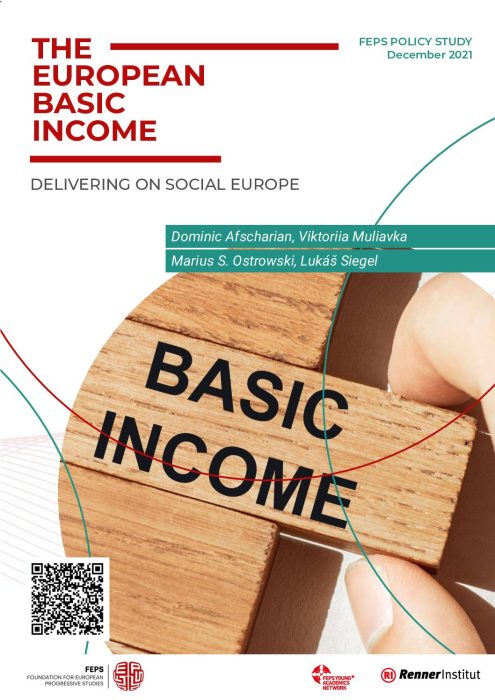
The European Basic Income – Delivering on Social Europe

Policy Study by FEPS Young Academic Network (FEPS YAN) Across the political spectrum, there is […]

Policy Study

25/01/2022
Policy Study by FEPS Young Academic Network (FEPS YAN)

Across the political spectrum, there is widespread agreement that the European Union (EU) needs a palpable social dimension. In this FEPS YAN policy study, the authors provide a research-driven policy proposal on how this social dimension can be achieved in the light of the diversity of national welfare systems in the EU.

They argue that a Universal Basic Income (UBI) could be a conceptually appealing policy to be implemented at EU level, complementing national welfare states. Due to the Covid-19 pandemic, the policy is receiving unprecedented and ever-increasing attention, and enjoys widespread public popularity, but is viewed with scepticism by major political parties.

This paper is a unified source of information for progressive policymakers, advocates, consultants, and researchers who are interested in (a) how a European UBI could be concretely designed and (b) the reasoning and justifications behind its concrete design decisions. In order to formulate a policy proposal that could potentially foster cross- partisan compromises and move public policy preferences and political reality closer together, the authors conducted a comprehensive review of historical and contemporary UBI debates, gathered the key arguments presented in academic, popular, political, and organisational sources, and reflected on them from logical, normative, and empirical perspectives.

Based on the most plausible arguments for and against a UBI, they designed a concrete policy proposal for a UBI at the EU level that responds to broadly progressive ideals from different partisan backgrounds. The result is an ambitious yet feasible proposal that bridges political divides and, if implemented, would be the most substantial leap for Social Europe yet.

Read the Policy Study

Find all related publications
Publications
11/05/2026

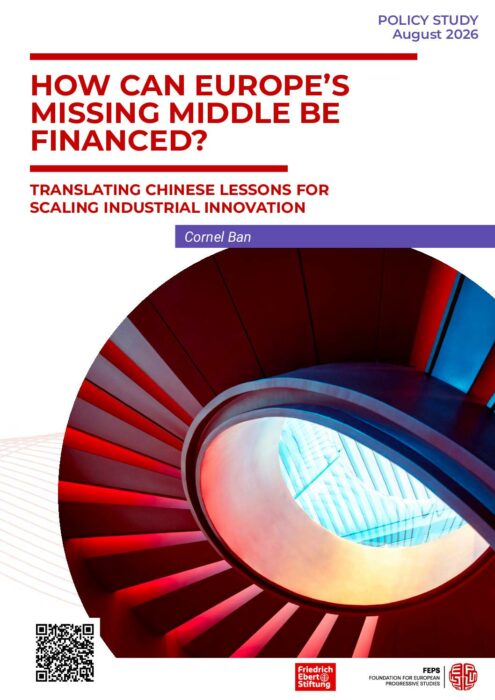
Place-based industrial policy

Places, people and power in European industrial policy
18/03/2026

New own resources for the EU budget

As part of its proposals for the Multiannual Financial Framework (MFF) for 2028 to 2034 […]
03/03/2026

European sovereignty and the social dimension

Reasserting Europe’s social-democratic model in turbulent times
29/01/2026

Progressive Yearbook 2026

In an eerie manner, 2025 resembled the ‘time of monsters’, which, according to the great […]
Find all related Progressive Post
Progressive Post

07/05/2026

Competitiveness is nothing without social rights

Five years after the Porto Social Summit, European leaders must remember that deregulation will only […]
06/05/2026

From attention to attachment

AI is rewiring childhood
06/05/2026

The AI bubble is already here

But it is rather like boulder that rolls, changing societies in its wake
Find all related events
Events
Upcoming
19/06/2026
Porto, Portugal

Social Europe is our target

High-level conference in Porto
Past
09/04/2026
FEPS HQ

Innovation financing scale-up

What can the EU learn from China
03 - 04/02/2026
FEPS HQ

Go Beyond: Zero deaths at work

Brussels visit
Load more...
Find all related Audiovisual
Audiovisual
09/04/2026

‘Innovation financing scale-up’ Flickr album

Photo album of ‘Innovation financing scale-up” event at FEPS HQ. In this event, Professor Cornel […]
26/02/2026

“Those who have A LOT, must PAY MORE” Nicolas Schmit | FEPS Talks Podcast

🎧 Listen to the latest episode of FEPS Talks with FEPS President Nicolas Schmit! 🇪🇺 […]
26/02/2026

“Those who have A LOT, must PAY MORE” Nicolas Schmit | FEPS Talks Podcast

🎧 Listen to the latest episode of FEPS Talks with FEPS President Nicolas Schmit! 🇪🇺 […]
02/02/2026

‘An EU social agenda for a geopolitical age’ Flickr album

Photo album of the ‘An EU social agenda for a geopolitical age‘ event in FEPS […]
Find all related news
News
29/01/2026

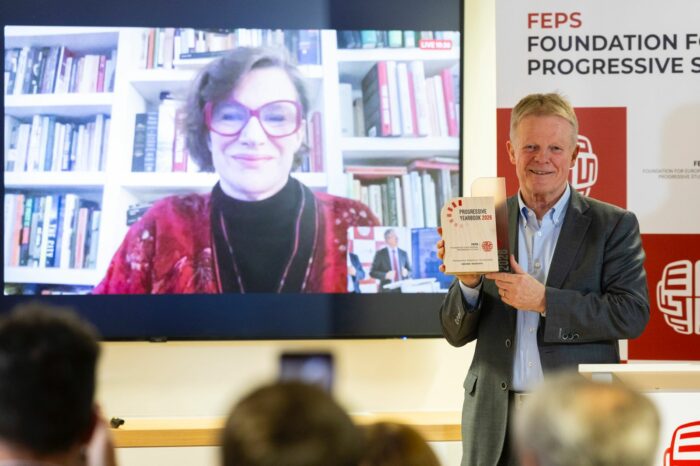
Marianna Mazzucato awarded FEPS ‘Progressive Person of the Year’

FEPS Progressive Person of the Year 2025-2026
16/12/2025

FEPS commentary on the EU Affordable Housing Plan

The announcement of the EU Affordable Housing Plan by Commissioner Dan Jørgensen is a historic milestone […]
04/12/2025

It is high time that the goal is set on “Quality”

FEPS commentary on the Quality Jobs Roadmap
21/10/2025

Maria João Rodrigues at PES Congress 2025

🇳🇱 🌹 FEPS attended the Party of European Socialists (PES) Congress in Amsterdam, which included […]
Find all related in the media
In the media

Jön a pénz! Magyar Péter beváltja az ígéretét?

by KlikkTV 04/05/2026
“Money is coming! Will Péter Magyar deliver on his promise?” Video Interview published on KlikkTV (HU), featuring László Andor, FEPS Secretary General, discussing EU funds to Hungary, their political conditionality, and the importance of fair distribution, rule of law and social investment within the European Union.

España los forma, Europa los contrata: así es el mapa de la nueva fuga de cerebros

by El Confidencial 10/02/2026
Spain trains them, Europe hires them: the map of the new brain drain: László Andor, FEPS Secretary-General, discusses the 'brain drain' as a result of the EU’s single market and highlights the need for a fairer mobility and retention strategy across the EU.

‘Regreso al futuro. El gran reseteo’ by Lina Gálvez

by Tinta Libre 02/02/2026
“Back to the Future: The Great Reset” Opinion article by FEPS Vice-President, Lina Gálvez reflecting on the current global crisis marked by rising authoritarianism, digital power and extreme inequality, and tracing its roots through a historical analysis of capitalism — from the post-1945 social and geopolitical settlement led by social democratic forces, through neoliberal financialisation, to what she describes as a new phase of fascist capitalism.

Liberal democracy’s social, societal fabric under threat – Live from the EPC Annual Conference 2025

by EPC 08/12/2025
In a podcast by the European Policy Centre (EPC), FEPS Secretary General, László Andor, discusses how liberal democracy in Europe is being challenged not only at the institutional level but also through the erosion of social rights and what Europe must do to defend its social foundations.