
Download
COVID 19 crisis- implications and lessons for European social democracy- ENG
COVID 19 crisis- implications and lessons for European social democracy- GER
COVID 19 crisis - France - ENG
COVID 19 crisis - France - GER
COVID 19 crisis - Sweden - ENG
COVID 19 crisis - Sweden - GER
COVID 19 crisis - Spain - ENG
COVID 19 crisis - Spain - GER
COVID 19 crisis - Poland - ENG
COVID 19 crisis - Poland - GER
COVID 19 crisis - Italy - ENG
COVID 19 crisis - Italy - GER
COVID 19 crisis - Germany - ENG
COVID 19 crisis - Germany - GER
Policy Study
16/12/2022
The study ‘Covid-19 crisis: implications and lessons for European social democracy‘ is the summary of the outcomes of a two-year-long joint project, which FEPS and Friedrich-Ebert-Stiftung (FES) conducted with the initial support of Istituto Cattaneo in Bologna, and then successfully concluded with the invaluable help of Kieskompas in Amsterdam.
In late spring 2020, we wanted to investigate the change in attitudes of the citizens within 6 EU member states during and after the COVID pandemic. To do so, there were two waves of surveys that captured the opinions of European citizens in two respective moments (December 2020/January 2021 and October/November 2021). The questionnaires used in both waves contained largely overlapping questions, allowing for an over-time comparison of public opinion on various socioeconomic issues.
The two waves of surveys saw over 6000 people participating in six countries: France, Germany, Italy, Poland, Spain, and Sweden. The results were then analysed accordingly to 13 sociodemographic categories and 63 thematic questions. Thanks to cross-tabulations and analyses of the overlap of the vote propensity, it was possible to extract very specific answers regarding the trends among diverse groups.
The subsequently drafted conclusions were evaluated by FES regional offices, as well as by some of FEPS’ member foundations: Centrum im. Ignacego Daszynskiego, Olaf Palme Center, Fundación Pablo Iglesias and Fundació Rafael Campalans.
The results of the surveys were further discussed at round tables involving 250 politicians, academics and civil society actors. This jointly makes the robust material of 7 reports unique in its richness and representativity. The study is also available in German.
Covid-19 crisis: Implications and lessons for European social democracy – France
In France, the data indicates many different and often polarised opinions. The French public is growing increasingly critical of their government, has a relatively low degree of institutional trust, is divided regarding their country’s membership in the EU, believes that immigrants are a benefit to society and are concerned about climate change
You can read this policy study in German here.
Covid-19 crisis: Implications and lessons for European social democracy – Germany
In Germany, the data indicates that even though there are many different and often polarised opinions among the German electorate, the majority of German citizens are politically moderate, have relatively high confidence in their government, have a high degree of institutional trust, support their country’s membership in the EU, believe that immigrants are a benefit to society and are concerned about climate change
You can read this policy study in German here.
Covid-19 crisis: Implications and lessons for European social democracy – Italy
In Italy, the data indicates many different, often polarised, opinions. The Italian public is largely supportive of the pandemic mitigation measures. However, Italians have a relatively low degree of institutional trust, and less than half of Italian citizens consider their country’s EU membership to be a good thing. Nevertheless, most respondents, especially younger generation cohorts, believe immigrants are a benefit to society and are concerned about climate change.
You can read this policy study in German here.
Covid-19 crisis: Implications and lessons for European social democracy – Poland
In Poland, the data indicate many different, often polarised, opinions. The country is more polarised than other European states: the government and opposition supporters hold diametrically opposed views and values. Nevertheless, when it comes to issues such as climate change and immigration, respondents are more concerned and permissive than is often reported in the news.
You can read this policy study in German here.
Covid-19 crisis: Implications and lessons for European social democracy – Spain
The Spanish dataset points out that even though there are many different, often polarised, opinions, the majority of Spanish citizens are politically moderate, have relatively high confidence in their government, have a high degree of institutional trust, support their country’s membership in the EU, believe that immigrants are a benefit to society and are concerned about climate change
You can read this policy study in German here.
Covid-19 crisis: Implications and lessons for European social democracy – Sweden
In Sweden, the data indicates that even though there are many different and often polarised opinions, the majority of Swedish citizens are politically moderate, have relatively high confidence in their government, have a high degree of institutional trust, believe that immigrants are a benefit to society and are concerned about climate change. Nevertheless, a substantial group of respondents is opposed to the country’s membership in the EU.
You can read this policy study in German here.
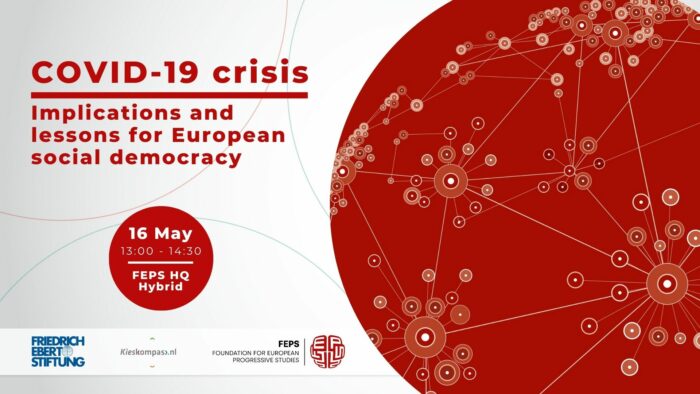
We presented these studies on 16 May during a round table at FEPS HQ.
Network
Related events
Find all related publications
Publications
Find all related Progressive Post
Progressive Post


Find all related events
Events
Past
24/03/2026
Online
20/03/2026
Athens, Greece
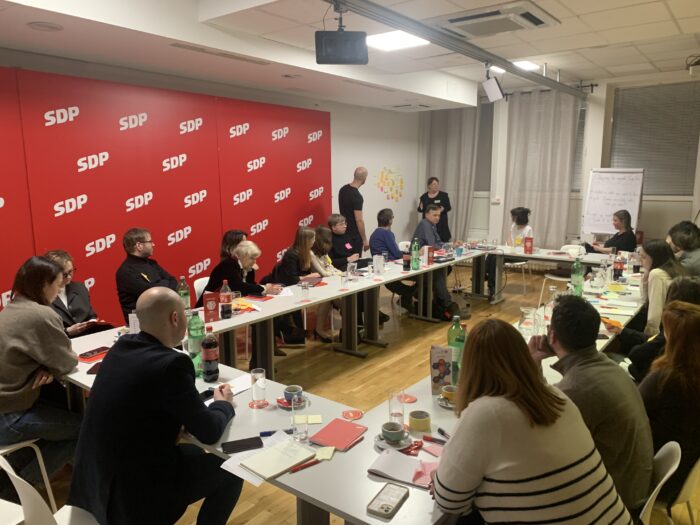
23 - 25/01/2026
Zagreb, Croatia
Load more...
Find all related Audiovisual
Audiovisual
26/02/2026
26/02/2026

29/01/2026
13/10/2025
Find all related news
News


Find all related in the media
In the media
“Back to the Future: The Great Reset”
Opinion article by FEPS Vice-President, Lina Gálvez reflecting on the current global crisis marked by rising authoritarianism, digital power and extreme inequality, and tracing its roots through a historical analysis of capitalism — from the post-1945 social and geopolitical settlement led by social democratic forces, through neoliberal financialisation, to what she describes as a new phase of fascist capitalism.
Liberal democracy’s social, societal fabric under threat – Live from the EPC Annual Conference 2025
by EPC 08/12/2025
Líderes progresistas internacionales se reunieron en Buenos Aires para ponerle un freno al avance de la extrema derecha
by Mi Valle 23/09/2025
En Europe, les partis sociaux-démocrates se sont contentés d’une approche technocratique
by Le Point 04/07/2025