Policy Brief

27/01/2025

As we enter a new EU legislative term, the stakes are high for Europe to step up and secure a strong and resilient economy that is able to deliver an inclusive and sustainable future. This publication, born out of a collaboration between progressive organisations, trade unions and the social-democratic movement, lays out essential policy insights to inform and inspire the emerging EU agenda for socio-economic development. It builds on background briefings to the Progressive Economic Policy Conference that FEPS and FES, in cooperation with the ETUC and the S&D Group, organised in Brussels on 25 and 26 September 2024.

We identify and discuss progressive policy recommendations for three priority areas:

(1) strengthening Europe’s socio- economic model, focusing on the European Social Agenda and the future of the EU’s finances;

(2) industrial policy for full-capacity Europe, focusing on the tools to deliver on the climate and digital transition and the need to foster territorial cohesion;

(3) global and sustainable Europe, focusing on new role of trade policy and international partnerships for sustainable supply chains and competitiveness.

The challenge will be to translate of progressives’ priorities into real policy change as possible, by making the most of the limited but nonetheless considerable resources and opportunities available to progressives in the new legislature. We encourage policymakers, stakeholders and citizens interested in a progressive Europe to engage with the ideas presented herein and find ways of turning them into reality in the challenging policymaking context we face over the next years.

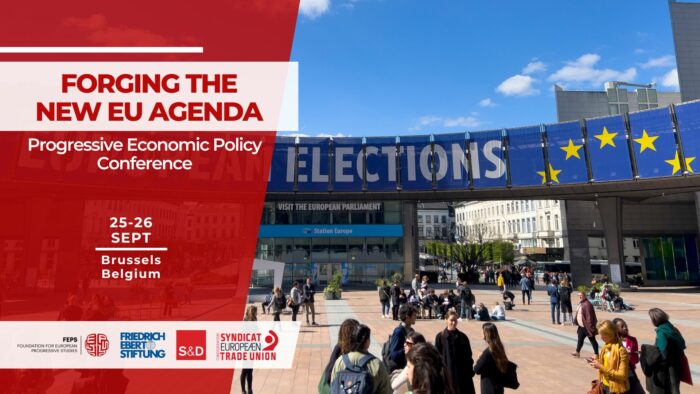
Some of these ideas were presented at the ‘Forging the new EU agenda‘ event.

Network
Friedrich-Ebert-Stiftung
Related events
25 - 26/09/2024
Brussels, Belgium (Expert meeting)

Forging the new EU agenda

Progressive Economic Policy Conference
Find all related publications
Publications
06/10/2025

Governing the global just transition from fossil fuels to clean energy

Litmus tests and proposals for COP30
26/06/2025

Strengthening and mainstreaming Just Transition goals in the EU Budget

The EU’s legally binding commitment to achieve climate neutrality by 2050 demands a far-reaching socio-economic […]
22/04/2025

Trade, trust, and transition: Shaping the next transatlantic chapter

Essays series by FEPS and Center for American Progress (CAP)
28/02/2025

Moving towards an inclusive green agenda in the Western Balkans

Balkan Focus Series
Find all related Progressive Post
Progressive Post

27/11/2025

COP30 shows that it is hard to lead when isolated

Set against the Amazon, guided by the idea of mutirão, and backed by a broad […]
27/11/2025

COP30: towards a coalition of the willing for a just transition?

Ten years after the Paris Agreement, over 80 countries are finally ready to discuss a […]
27/11/2025

Ocean action is climate action

Homework for Europe after COP30
Find all related events
Events
Past
08/11/2025
Santa Marta, Colombia

EU-LAC dialogue on Just Transition and trade

Despite the EU’s growing emphasis on sustainability, its trade and investment policies remain largely disconnected […]
13/11/2025
FEPS HQ (Expert meeting)

Evolutionary leap of the European trade policy

Progressive Economic Network 2025
15/10/2025
Brasilia, Brazil

EU and Brazilian perspectives on a Just Transition match-making platform for COP30

From dialogue to bankable pipelines
Load more...
Find all related Audiovisual
Audiovisual
13/11/2025

‘EU-LAC dialogue on Just Transition and trade’ Flickr album

Photo album of the ‘EU-LAC dialogue on Just Transition and trade’ at Santa Marta, Colombia. […]
13/11/2025

‘Evolutionary leap of the European trade policy’ Flickr album

Photo album of the ‘Evolutionary leap of the European trade policy‘ event at FEPS HQ, […]
07/07/2025

How to STOP INFLATION 💸 with Ben Tippet and Anna Kolesnichenko

We are often told that inflation “happens”, as if it is an unstoppable natural phenomenon. […]
07/07/2025

How to STOP INFLATION 💸 with Ben Tippet and Anna Kolesnichenko

We are often told that inflation “happens”, as if it is an unstoppable natural phenomenon. […]
Find all related news
News
26/02/2025

FEPS reaction to the European Commission’s Clean Industrial Deal

What Teresa Ribera presented today is an ambitious plan that makes the case for Europe […]
22/03/2024

FEPS attends the 68th annual Commission on the Status of Women (CSW68)

The 68th annual Commission on the Status of Women (CSW68), the UN’s largest annual gathering on […]
18/03/2024

FEPS President on Euronews talk-show ‘Brussels, my love?’

NATO extension, Portuguese elections, far-right and gender equality were the topics of the debate
08/03/2024

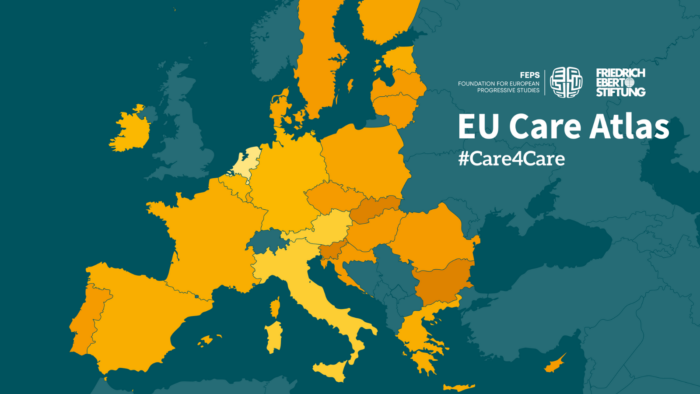
Discover the updated EU Care Atlas!

On the occasion of International Women’s Day 2024, we have updated our EU Care Atlas. […]
Find all related in the media
In the media

Tévedés azt hinni, hogy Trump után visszatérhetünk a régi kerékvágásba

by telex 24/04/2025
“It’s a mistake to think we can go back to the old normal after Trump”. Interview with FEPS Secretary General László Andor in Telex (HU), where he discusses the global trade tensions triggered by Trump-era tariffs, the shifting US-China dynamic, and the need for the EU to develop a new strategic approach in a permanently changed world order.

Nedostatak brižnosti

by Vox Feminae 04/02/2025
"Lack of care" The Croatian feminist magazine Vox Feminae highlights the chapter by Annica Kronsell in FEPS book "A new Gender Equality Contract for Europe", which is dedicated to imagining a new gender contract for the climate

Brussels, my love? Ursula von der Leyen cracks the whip on gender parity

by Euronews 07/09/2024
FEPS Director for Research and Training Ania Skrzypek participated in this episode of Euronews’ show ‘Brussels my love’.

Orbánov boj z zunanjim sovražnikom ni bil kos inflaciji

by DELO 28/05/2024
In an article in Delo, László Andor criticises Viktor Orbán government's economic policies, such as not allowing Hungary to join the euro area, which he believes would have helped curb inflation. He also criticises the government for blaming external enemies such as the President of the European Commission, to cover up its own failures.