Nine Suggested Principles to Guide EU-US Collaboration on financial regulatory reform

“We outline below broad principles for regulatory reform said Stephany Griffith-Jones and José Antonio Ocampo […]

Policy Study

09/10/2014

“We outline below broad principles for regulatory reform said Stephany Griffith-Jones and José Antonio Ocampo co-authors of this reflexion made in the framework of the cooperation between FEPS and Columbia University, New York, USA. They may need to be modified, to reflect the outcome of the current serious crisis and its management, and their impact on the structure of the financial system. Clearly managing the current crisis and limiting its negative impact on the real economy must be a clear priority in the short term. However, there is at present a window of political opportunity for designing desirable regulatory measures, which will make such terrible crises less likely in the future.”

1) Make transparency and regulation comprehensive. This means that closing existing regulatory gaps is key. The principle implies that the domain of information and regulation should be the domain of the market that needs to be regulated. For example, there should be relevant disclosure of all derivatives trading, whether on exchanges or otherwise. Ideally clearing of all high volume derivatives should go over the exchanges, to ensure that these transactions are transparent, simpler, and credit risks are supervised. A corollary of this is that opaque and unregulated OTC (over-the-counter) derivatives transactions would be minimized. Furthermore, as lender of last resort (LOLR) and bail outs are being expanded to a variety of non regulated institutions, there needs to be a corresponding expansion of disclosure and regulation, for all actors and activities that have, or may use the central banks’ LOLR and bail-outs. This will avoid moral hazard from increasing further. Also, entities whose high leverage may cause large risks, such as hedge funds, need to be regulated. One possibility would be to require relevant information from, and regulation of, all entities and activities that invest or lend on behalf of other people, especially if they use some type of leverage. There should be
equivalence between capital regulation of different actors and activities to avoid regulatory arbitrage, both nationally and internationally; this equivalence needs to consider factors such as maturity mismatches of the institution or activity, type of business, etc.

2) Regulation should try to effectively curb excessive risk taking during booms. Speed bumps could be incorporated in both liquidity and, especially, solvency requirements. To limit leverage increasing excessively in good times, and falling too much in crises, bank capital and provisions should vary in proportion to variables such as individual banks’ growth of assets, as well as macroeconomic variables, such as asset prices. Such counter-cyclical regulation for banks should be introduced as a mandatory element into Basle II and reflected in the EU Capital Adequacy Directive. Furthermore, although mark-to-market fair value accounting may continue to be used for transparency purposes, strict rules should be established to avoid asset price bubbles from feeding into the lending boom, for example by requiring that assets used as loan collaterals be valued according to some measure of long-term trends in asset values or a variable ratio of loan to assets be used linked to the variations of asset prices (with a lower ratio when prices have risen quickly).

3) Modify regulations of securitization. The originator-distributor-investor model created by securitization requires an overhaul in regulation, which should include strong incentives for more careful evaluation of risk by originators, measures to reduce the asymmetries of information between investors and originators, and require originators to maintain a significant proportion of the securitized loans on their balance sheets or compulsory provisions for bond defaults which would increase with asset prices.

4) Fiduciary investment criteria for pension funds should be designed in ways that make returns less dependent on economic cycles and possible crises, to safeguard future pensions. Information should be given to employees and their representatives about how their pensions are invested and potential risks involved.

5) Criteria should be developed for increasing the transparency and regulation of rating agencies. In particular, credit rating evaluations should be based on “broadly accepted, objective and transparent criteria”, to use the language suggested for the UN Financing for Development follow-up conference in Doha. Furthermore, there should be regulation to avoid or reduce conflicts of interest. Thus, rating agencies should not act as advisors to the financial firms whose products they are rating.

6) A system should be designed for protecting and consulting workers and their rights when private equity firms take over companies.

7) There is increased consensus, including by bodies representing banks, that remuneration linked to short term profits, contributes to boom-bust behavior of financial markets, by encouraging excessive risk-taking. Also, too much capital exits banks in good times as high compensation; this weakens banks’ solvency, and contributes in bad times to expensive bailouts, funded by taxpayers. The system of incentives (e.g., bonuses) should be modified to encourage behavior that leads to less excessive risk taking in good times. This includes regulating compensation schemes of financial institutions to ensure they favor the long term, are symmetric (for profits and losses) and transparent. Fund managers and other market actors could be paid a fixed monthly salary, and bonuses accumulated in an escrow account. These could be cashed only after a period equivalent to an average full cycle of economic activity, without losses being incurred.

8) There should be a new institutional design of regulation to reduce systemic risk and to avoid regulatory capture. This should include the establishment of an institution that look at financial stability from a systemic perspective, as well as a financial products safety commission that would evaluate the benefits and potential risks of financial products. On the basis of its evaluation, the use of particular financial products could be restricted or even prohibited, if they cause risks that are excessive and overly complex to measure, and that have limited benefits for consumers.

9) Modalities of closer collaboration between US and European regulators should be developed. Also, as has been clear during this crisis, it is essential to develop closer collaboration among European regulators. These should be seen as steps to design a global network of regulatory authorities.

Find all related publications
Publications
22/04/2025

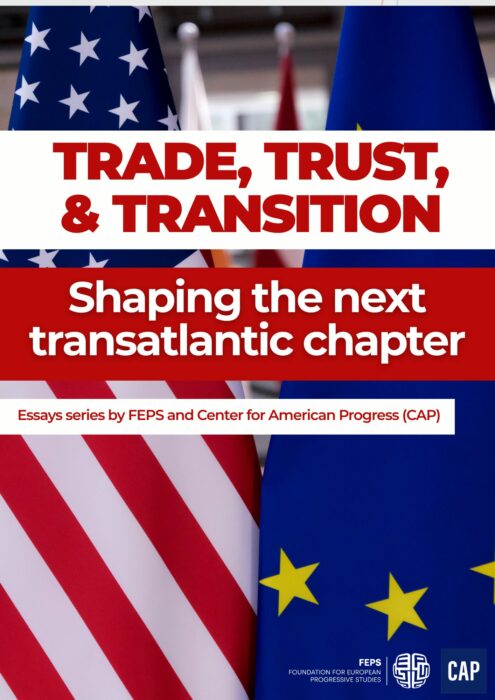
Trade, trust, and transition: Shaping the next transatlantic chapter

Essays series by FEPS and Center for American Progress (CAP)
09/12/2024

China: Dangerous rival or cooperation partner?

How can EU-China relations develop in a changing world with geopolitical conflicts?
24/01/2024

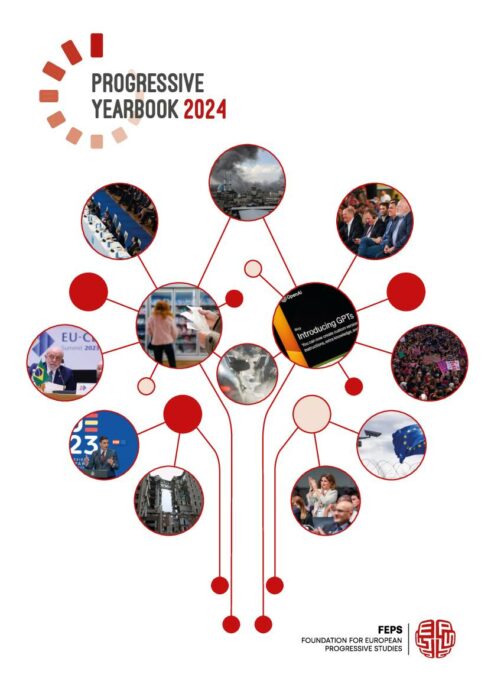
Progressive Yearbook 2024

Looking back to look ahead
06/12/2023

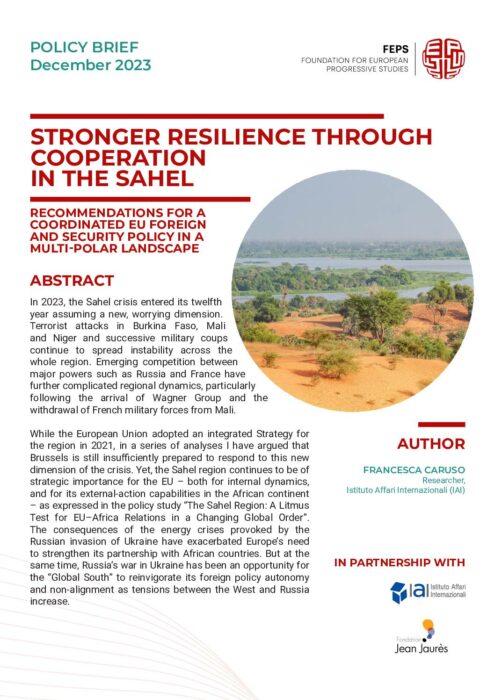
Stronger resilience through cooperation in the Sahel

'12 years of crises in the Sahel' series
Find all related Progressive Post
Progressive Post

04/09/2025

Europe’s aestas horribilis

This would have been the time for the EU to prove that ‘strategic autonomy’ is […]
15/07/2025

EU-China summit: a new start is needed

In 2025, the European Union and the People’s Republic of China mark the 50th anniversary […]
26/06/2025

BRICS 2025: Brazil’s balancing act

Brazil will host the BRICS+ summit in July this year, marking 16 years since the […]
Find all related events
Events
Past

08/11/2025
Santa Marta, Colombia

EU-LAC dialogue on Just Transition and trade

Despite the EU’s growing emphasis on sustainability, its trade and investment policies remain largely disconnected […]
16/10/2025
Brussels, Belgium

S&D Latin America Days

FEPS fringe session
07/11/2024
FEPS HQ, Brussels (Hybrid)

State of the Unions

The US election: implications for the US, the EU and global politics
Load more...
Find all related Audiovisual
Audiovisual
13/11/2025

‘EU-LAC dialogue on Just Transition and trade’ Flickr album

Photo album of the ‘EU-LAC dialogue on Just Transition and trade’ at Santa Marta, Colombia. […]
17/10/2025

‘S&D Latin America Days FEPS fringe session’ Flickr album

The S&D Latin America Days aim to foster cooperation between progressive forces in Latin America and […]
08/11/2024

‘State of the Unions 2024’ Flickr album

Photo album of the ‘State of the Unions‘ event in FEPS HQ, Brussels. As the […]
04/01/2024

Global China and European derisking

FEPS Talks #141
Find all related news
News
03/12/2024

FEPS President Maria João Rodrigues at the 2024 Understanding China Conference

FEPS President Maria João Rodrigues participated in the 2024 Understanding China Conference, “Carry through the […]
15/05/2024

Notice of vacancy – Policy analyst on international relations

This vacancy is now closed.
04/03/2024

FEPS at the ‘Africa Summit of the Future Dialogue’ in Abuja, Nigeria

FEPS delegation, including FEPS Special Advisor on Foreign Affairs Ann Linde, attended the ‘The Africa […]
15/12/2023

FEPS President mission to China

Maria Joao Rodrigues participates in the ‘2023 Understanding China Conference’
Find all related in the media
In the media

Franklin D. Roosevelt és a New Deal – Beszélgetés Andor Lászlóval

by Tilos Rádió 12/11/2022
FEPS Secretary General László Andor participates on 'Régen minden jobb volt' (Everything used to be better) backward-looking history programme on HU 'Tilos Rádió' on Franklin D. Roosevelt.

Ronald Reagan és a “Reaganomics” legendája – Beszélgetés Andor Lászlóval

by Tilos Rádió 03/09/2022
FEPS Secretary General László Andor participates on 'Régen minden jobb volt' (Everything used to be better) backward-looking history programme on HU 'Tilos Rádió' on Ronald Reagan.

EU sees strengthened partnership with US vital for global recovery – EURACTIV

26/01/2022