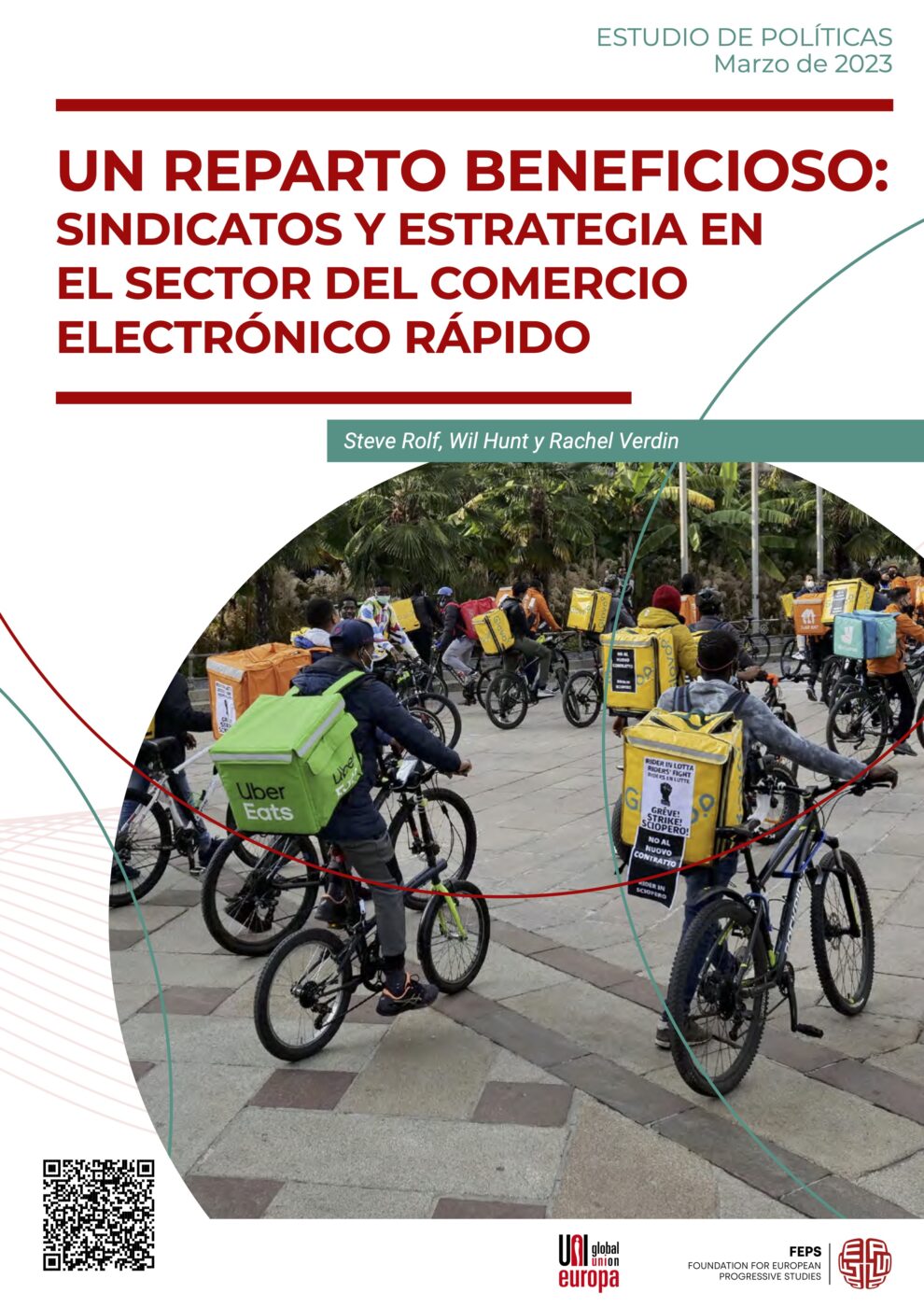
Policy Study

28/03/2023

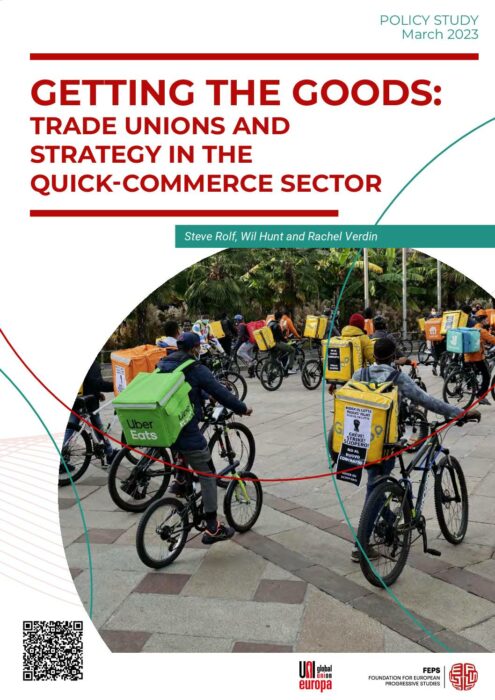
The rise of quick-commerce (q-commerce) platforms has reshaped the retail industry, posing new challenges for trade unions.

This policy study examines q-commerce, which promises super-fast delivery of groceries, often under 30 minutes, and its potential threats to established collective bargaining patterns and trade union strongholds in bricks-and-mortar retail.

Drawing on desk research and in-depth qualitative interviews with a range of experts, industry stakeholders, and q-commerce workers in four firms across three countries (Germany, Spain and the UK), this policy study contextualises the rise of q-commerce, before considering how trade unions could react to its emergence at a macro- and workplace level.

The authors outline a critical power resources approach (PRA) framework to adjudicate the potential for organising in q-commerce, given the structure of the industry and its labour markets. The study also maps out the structural, associational, institutional, and societal power resources available to q-commerce workers and unions.

Despite turbulent business dynamics, some variants of q-commerce will likely continue, and unions should devote efforts and resources to organising q-commerce for the protection of workers and to ensure q-commerce firms do not undermine the conditions of those working in adjacent retail and logistics industries.

Below, you can download the Spanish and German versions of the ‘Getting the goods’ policy study:
Network

UNI Europa
Related publications
Related events
28/03/2023
FEPS HQ (Hybrid)

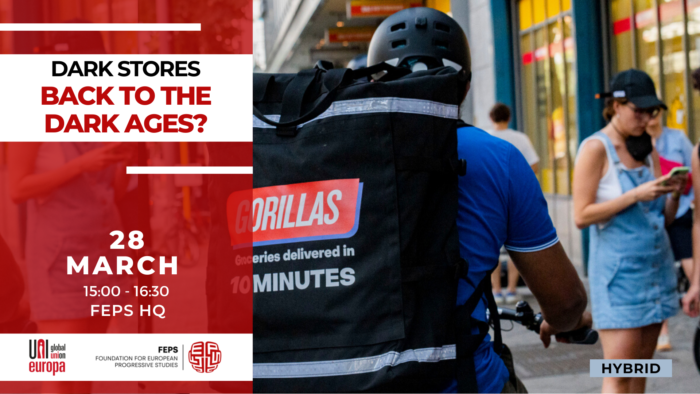
Dark stores: Back to the Dark Ages?

Launch event of policy study into the q-commerce sector
Find all related publications
Publications
18/11/2025

Public investment in the proposed 2028-2034 EU budget

Needs, gaps and options
02/09/2025

A progressive roadmap for expanding European digital sovereignty

Every economic, social and political interaction today relies on digital technologies that are disproportionately provided […]
26/06/2025

Strengthening and mainstreaming Just Transition goals in the EU Budget

The EU’s legally binding commitment to achieve climate neutrality by 2050 demands a far-reaching socio-economic […]
17/06/2025

Lessons learned from the Recovery and Resilience Facility for a future European fiscal capacity

The creation of the Recovery and Resilience Fund (RRF) as a response to the pandemic […]
Find all related Progressive Post
Progressive Post
18/09/2025

Submission is not a strategy: Von der Leyen’s missed moment

The world is sliding into a new order where the strong impose their rule and […]
10/09/2025

EU budget 2028-2034: beware of a big ugly deal!

The EU’s 2028–2034 budget proposal centralises the new ‘shiny’ priorities of the European Commission while […]
10/09/2025

Cohesion needs reform, not nationalisation

The EU’s proposed budget overhaul risks turning Cohesion Policy from a shared, democratic development tool […]
Find all related events
Events
Past
17/11/2025
FEPS HQ, Brussels (Expert meeting)

New own resources in the MFF proposal

EU Investment Capacity Group 2025
08/11/2025
Santa Marta, Colombia

EU-LAC dialogue on Just Transition and trade

Despite the EU’s growing emphasis on sustainability, its trade and investment policies remain largely disconnected […]
13/11/2025
FEPS HQ (Expert meeting)

Evolutionary leap of the European trade policy

Progressive Economic Network 2025
Load more...
Find all related Audiovisual
Audiovisual
17/11/2025

New own resources in the MFF proposal

Photo album of the ‘New own resources in the MFF proposal‘ event at FEPS HQ, […]
13/11/2025

‘Evolutionary leap of the European trade policy’ Flickr album

Photo album of the ‘Evolutionary leap of the European trade policy‘ event at FEPS HQ, […]
06/10/2025

‘The profit-price spiral: How to prevent the cost of living crises’ Flickr album

Photo album of the ‘The profit-price spiral: How to prevent the cost of living crises‘ […]
04/09/2025

‘Inflation preparedness in the EU’ Flickr album

Photo event of the ‘Inflation preparedness in the EU‘ event in Brussels. On 3 September […]
Find all related news
News
18/10/2025

FEPS at PES Congress 2025

🇳🇱 🌹Within PES Congress, there were full rooms on insightful discussion on a range of […]
10/09/2025

Von der Leyen – walking the walk at last?

FEPS reaction to The State of the European Union 2025
18/07/2025

A European Commission against the Social Contract

FEPS commentary on the MMF 2028-2034
26/02/2025

FEPS reaction to the European Commission’s Clean Industrial Deal

What Teresa Ribera presented today is an ambitious plan that makes the case for Europe […]
Find all related in the media
In the media

László Andor: Miből fejleszt az EU ezután?

by Portfolio 28/08/2025
“What will the EU develop from now on?” Analysis by FEPS Secretary General László Andor in Portfolio (HU), highlighting the new MFF’s shift toward increasing EU own-resources, boosting funding for strategic domains like defense, stabilisation and competitiveness, and calling for a flexible crisis-response mechanism such as the proposed Emergency Crisis Response Mechanism

Започва нов ЕС-бюджетен цикъл

by Novi Vremena 26/08/2025
“A new EU budget cycle begins” Article by FEPS Secretary General László Andor in Novi Vremena (BG), highlighting that while Europe must strengthen fiscal capacity to support balanced growth and strategic autonomy, priorities such as cohesion, defense, and social investment must be built into the next multiannual financial framework.

Ласло Андор: България не губи нищо от присъединяването си към еврозоната

by BNR 15/07/2025
"Bulgaria has nothing to lose by joining the eurozone” Interview with FEPS Secretary General László Andor on Bulgarian National Radio, where he explains that Bulgaria has already borne the costs of financial stability and will benefit from eurozone accession.

Tévedés azt hinni, hogy Trump után visszatérhetünk a régi kerékvágásba

by telex 24/04/2025
“It’s a mistake to think we can go back to the old normal after Trump”. Interview with FEPS Secretary General László Andor in Telex (HU), where he discusses the global trade tensions triggered by Trump-era tariffs, the shifting US-China dynamic, and the need for the EU to develop a new strategic approach in a permanently changed world order.