FEPS Newsletter 24 Nov 2026 – 🌍 Africa & the EU: Time for a new cooperation model

For a partnership based on equality – If you have problems displaying this email, follow […]

24/11/2026
For a partnership based on equality –

If you have problems displaying this email, follow this link

Why does the EU continue to engage with Global South partners in outdated ways in a multipolar world? Europe’s geopolitical relevance and economic interests – from climate to AI – depend on building coalitions with Global South countries.


Yet the EU continues to unilaterally design policies that affect its partners, neglecting its own demands. The ongoing negotiations on the next EU budget offer an opportunity to update the EU’s approach towards the Global South.

Africa
An EU social agenda for a geopolitical age

21 NOV – AMSTERDAM, NETHERLANDS

Africa Day 2026

FEPS fringe events 

By FEPS, in collaboration with PRO International. 


FEPS was in Amsterdam for the 2026 edition of Afriakdag, with two panels on the FEPS Global Stage, discussing what the future of the EU-Africa Cooperation Alliance is beyond aid, and the defining issue of the Just Transition in EU-Africa relations.


Read the publications launched at the FEPS panels:

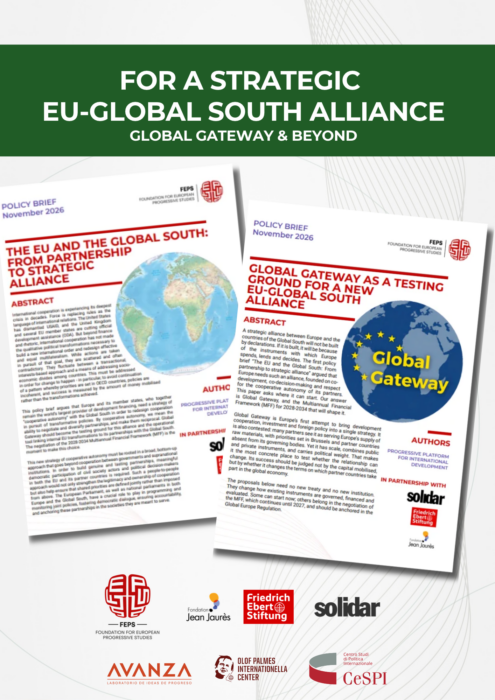
For a strategic EU-Global South Alliance: Global Gateways and beyond

A new model of cooperation is needed, capable of bringing European and African capabilities around jointly defined priorities. Rather than creating new models of cooperation, improving existing instruments, such as the Global Gateway, can evolve relations to deliver a mutually beneficial EU-Africa cooperation alliance.

For a strategic EU-Global South Alliance

Find out more about how the existing tools for EU-Global South relations can be improved.

Written by the Progressive Platform for International Development – By FEPS, in collaboration with Friedrich-Ebert-Stiftung (FES), Solidar and Fondation Jean-Jaurès.

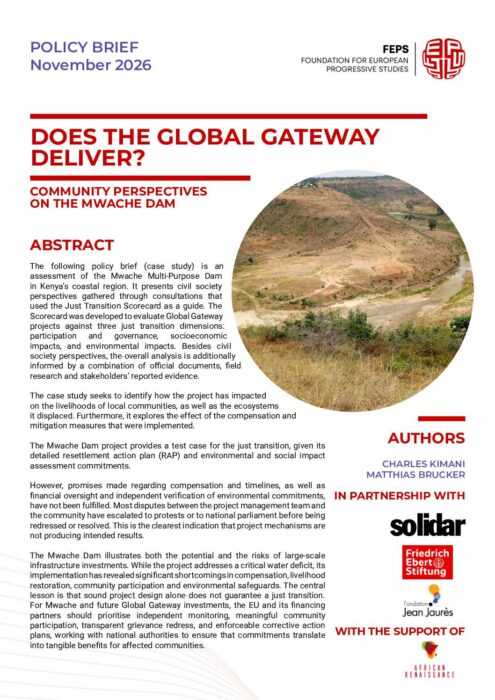
Does the Global Gateway deliver?

Does the Global Gateway deliver?

The case study examines the Mwache Multi-Purpose Dam in Kenya’s coastal region using the Just Transition scorecard.


The study presents civil society perspectives gathered through consultations that used the Just Transition Scorecard as a guide. The Scorecard was developed to evaluate Global Gateway projects against three just transition dimensions: participation and governance, socioeconomic impacts and environmental impacts.

Written by Charles Kimani and Matthias Brucker – By FEPS, in collaboration with FES, Solidar and Fondation Jean-Jaurès.

FEPS React: EU member states’ negotiations with Rwanda on the ‘return hub’

A commentary signed by Nicolas Schmit, László Andor, Cecilia Strada, Ferruccio Pastore, Ana Catarina Mendes, Luca Cefisi and Hedwig Giusto

FEPS React: EU member states’ negotiations with Rwanda on the ‘return hub’

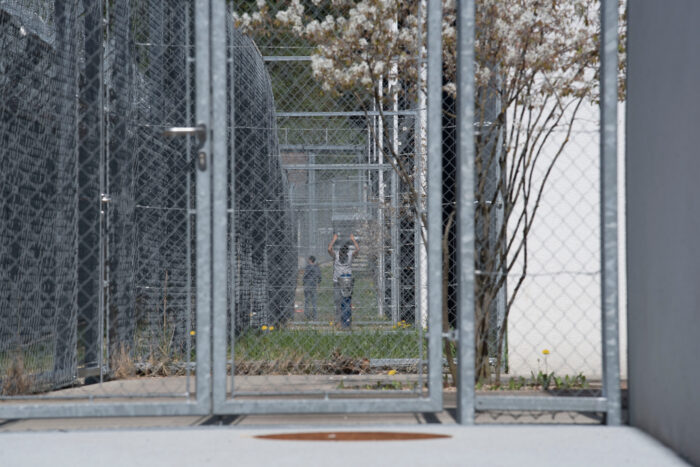
The announcement made in Vienna on 16 November of the official start of negotiations with Rwanda to establish the first ‘return hub’ by the heads of government of Austria, Denmark, Germany, Greece and the Netherlands is not new, but for Europe, it marks a historic turning point. Read the full commentary.

© Photo credit: Shutterstock / elmar gubisch

Events
Unpacking Spain’s election results: Outcomes and trends
 

📅  1 DECEMBER

💻 ONLINE

Unpacking Spain’s election results: Outcomes and trends


On 29 November, Spanish voters will head to the polls to elect a new parliament in snap election called by Prime Minister Pedro Sánchez. What factors shaped the election outcome? Can the governing Spanish Socialist Workers Party (PSOE) secure another mandate?


Beyond the above questions, this webinar will examine the dominant themes of the election campaign, assess voter turnout and the broader integrity of the electoral process, and consider the election’s implication for Spain and the EU’s future. Join the webinar live!

Multilevel governance for European industrial policy
 

📅  1 DECEMBER

📍 GENOA, ITALY

Multilevel governance for European industrial policy


Industrial policy has returned to the centre of the European agenda, but how can it be governed across multiple levels, institutions and instruments?


This event will present a multilevel architecture built around an Industrial Strategy Board linking the Commission, Member States and regions. It will pay special attention to the regional dimension of industrial policy. Register here.

Silver Rose Awards 2026
 

📅  2 DECEMBER

📍 BRUSSELS, BELGIUM

Silver Rose Awards 2026


Join us in celebrating those who are fighting for social justice and climate action. The registration for the Silver Rose Awards 2026 is open!


This year, we will celebrate Jan Eliasson, former Deputy Secretary-General of the United Nations, for a lifetime of work on peace, diplomacy and human rights and the Philippine Movement for Climate Justice, a coalition of more than 150 organisations that helped stop 18 coal-fired power plants and 8 LNG plants. Register now!

19-20 NOV – BUDAPEST, HUNGARY

2030 and beyond: A progressive agenda for the future of EU enlargement


EU enlargement has regained strategic momentum, but it is unfolding in a profoundly changed geopolitical context. The fourth progressive enlargement conference addressed the question of how to accelerate the accession process, but also how a larger and more diverse Union can function effectively, maintain its cohesion and deliver on its political, economic and social ambitions.

2030 and beyond: A progressive agenda for the future of EU enlargement

This event is organised by FEPS, in collaboration with FES, Karl-Renner-Institut, CeSPI, Olof Palme International Center, PRO International, Progresiva, Kalevi Sorsa Foundation, Fondation Jean Jaurès and with the support of Foundation for Social Democracy (Hungary) and Foundation of Political History (Hungary).

Progressive solutions for European prosperity: The Spanish blueprint

16-17 NOV – MADRID, SPAIN

Progressive solutions for European prosperity: The Spanish blueprint

Progressive Economics Network (PEN)


Spain offers practical insights into how progressive policies can foster strong growth, driven by an inclusive labour market and domestic demand. Its policy choices can therefore outline a blueprint for tackling major economic challenges, such as ensuring fair working conditions, promoting innovation and securing affordable energy, in other member states.

With rising geopolitical tensions, the EU needs to fend for itself. Increased autonomy must be underpinned by a strong economy. The discussion should move beyond short-term crisis response and contribute to building a coherent, forward-looking economic vision rooted in progressive principles.


By FEPS, in collaboration with FES, Das Progressive Zentrum and Avanza.

10 NOV – FEPS HQ

Pluralism on the left

Can red-green be a majoritarian progressive coalition for the future?


Can a red-green cooperation provide the foundations for a renewed progressive force in Europe? The meeting brought together MEPs, representatives of European political parties and institutions, civil society organisations and academic researchers to discuss the political challenges of implementing environmental policies and the future of progressive alliances.

Pluralism on the left

By FEPS, in cooperation with the Karl-Renner-Institut and ESPOL’s TransformEU Jean Monnet Centre of Excellence, within the framework of their Research Programme Next Left.

Training of Trainers (ToT) on Social Democracy 

6-8 NOV – VIENNA, AUSTRIA

Training of Trainers (ToT) on Social Democracy 


FEPS was in Vienna for a Training of Trainers, bringing together FEPS’ Pool of Trainers as part of its European Progressive Training Lab to strengthen their capacity to design and deliver engaging training on social democracy and progressive messages. The training focused on translating progressive academic research into accessible and practical learning experiences for activists and citizens.

By FEPS, in collaboration with FES, Amicus Europae, PRO International, Karl-Renner-Institut, Olof Palme International Centre, Fondazione Pietro Nenni and Eteron.

Publications

POLICY STUDY

Designing a just and resilient Europe

Proposals for the EU Framework for Climate Resilience


Summer 2026 made it clear: the EU must become more resilient to intensifying climate change impacts. As COP31 puts the urgency of climate action back in the spotlight, FEPS new policy study draws on scientific, policy and civil society expertise:

🎯 Sets out a vision for a just and resilient Europe by design

Designing a just and resilient Europe

🌱 Makes the case for the right to a habitable Europe, in line with the Parliamentary Assembly of the Council of Europe.

💡 Identifies 11 key policy recommendations for an enhanced EU Framework for Climate Resilience

Written by Céline Charveriat and Chloé Deffet – By FEPS, in collaboration with FES.


Was this email forwarded to you?

Copyright © 2026 FEPS Europe, All rights reserved.

You are receiving this email because you participated in one of FEPS’ events and/or have registered for FEPS’ newsletter.

If you wish not to receive FEPS’ communications anymore, please click here: unsubscribe now. We use tracking pixels in our newsletters to measure engagement. Manage your preferences or unsubscribe at any time.


Foundation for European Progressive Studies
Avenue des Arts, 46 – 1000 Bruxelles

+32 223 46 900 – info@feps-europe.eu

Find all related Progressive Post
Progressive Post
26/11/2026

Reducing emissions: beyond the doom and gloom

Despite the urgent need to reduce greenhouse gas emissions fast, COP31 has just ended in […]
26/11/2026

Europe has bought two years on methane – now it must use them

Europe has learned the hard way what energy insecurity costs. First came the price shock […]
26/11/2026

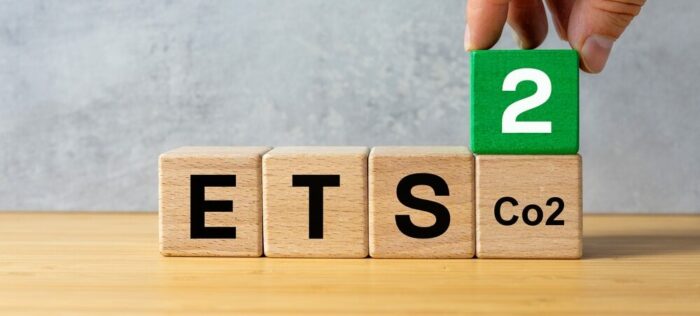
Turning Europe’s carbon market into an engine for clean investment

The ongoing reform of the EU’s emissions trading system is an opportunity to reposition this […]
Find all related Magazine
Magazine
  • cover book

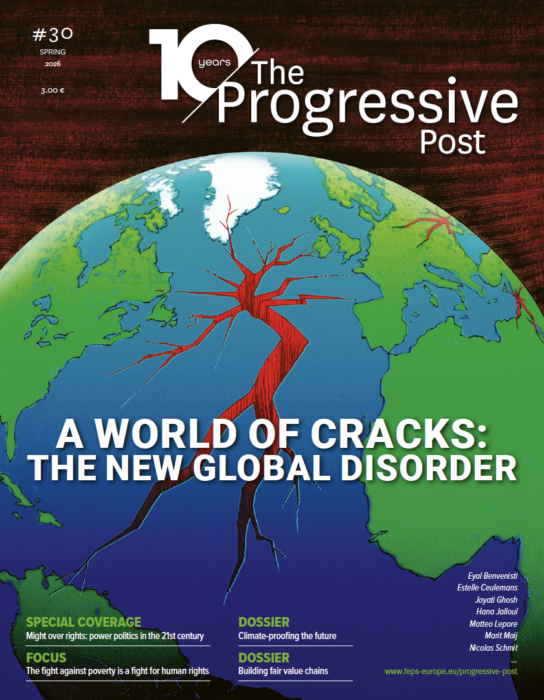
    Issue #30 Progressive Post

Issue #30

A world of cracks: the new global disorder
  • cover book

    Issue #29 Progressive Post

Issue #29

Does peace still have a chance?
Find all related publications
Publications
27/11/2026

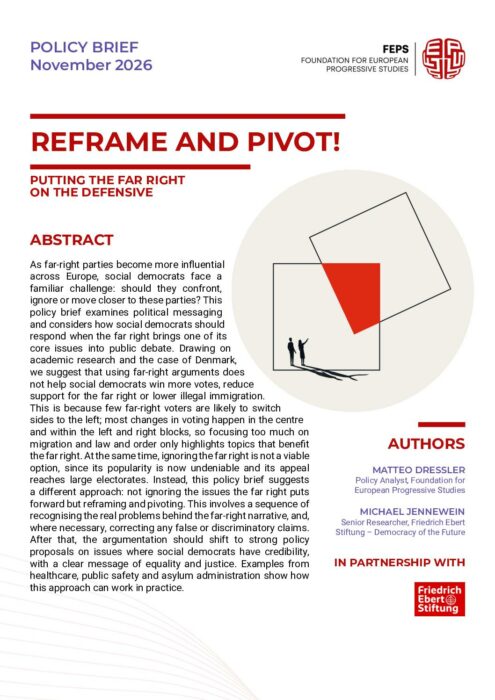
Reframe and pivot!

Putting the far right on the defensive
26/11/2026

Governance for European industrial policy

Coordination, planning and fiscal capacity
21/11/2026

Does the Global Gateway deliver?

Community perspectives on the Mwache Dam in Kenya
21/11/2026

For a strategic EU-Global South Alliance

Global Gateway & beyond
Find all related news
News
20/11/2026

FEPS React: EU member states’ negotiations with Rwanda on the ‘return hub’

The announcement by five European Union member states of the official start of negotiations with […]
30/10/2026

FEPS Reacts: The new EU Framework for Climate Resilience

Necessary foundations but little action
23/10/2026

Notice of vacancy – Policy Analyst on Gender Equality

Apply before 23 November 2026
16/09/2026

FEPS Reacts: State of the European Union 2026

The 2026 State of the Union felt more like ‘von der Leyen I’ than ‘von […]
Find all related in the media
In the media

Meno risorse, più governo: la politica industriale europea alla prova del bilancio UE

by Quotidiano Nazionale 26/11/2026
'Fewer resources, stronger governance: European industrial policy put to the test of the EU budget' Featured in Quotidiano Nazionale, an op-ed by co-author Simone Oggionni highlights the FEPS policy study "Governance for European industrial policy", which proposes a new governance model for industrial policy amid cuts to the European Competitiveness Fund (ECF)

Filipche attends Fourth Progressive Enlargement Conference in Hungary

by Медиумска информативна агенција 20/11/2026
Read the article by the Media Information Agency (MIA) about our past event : "2030 and beyond: A progressive agenda for the future of EU enlargement".

Direct democracy MP Laouris clarifies participation at event with far-right party

by en.Philenews 18/11/2026
FEPS policy brief "Countering the far right in the European Parliament" was cited by en.Philenews in its latest coverage of the far-right Europe of Sovereign Nations (ESN) group in Cyprus.

Le Conseil d’analyse économique organise le webinaire “Inégalités face au changement climatique : qui paie la fracture ?”

by Bulletin Quotidien 18/11/2026
"The Council of Economic Analysis is organizing the webinar "Inequalities in the face of climate change: who is paying the price?" Read the article by Bulletin Quotidien about our upcoming event on 26 November: "What kind of European Union in the face of empires?".