FEPS React: EU negotiation with Rwanda on the ‘return hub’

The announcement by five European Union member states of the official start of negotiations with […]

20/11/2026

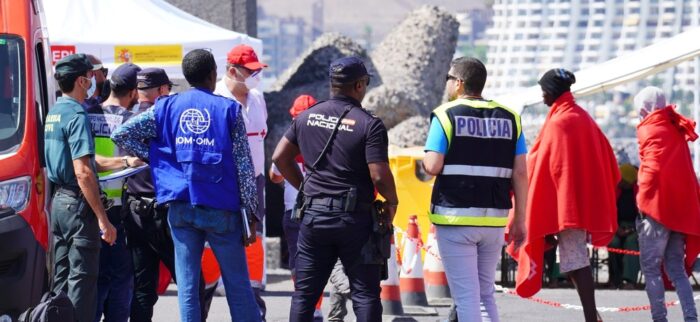
The announcement by five European Union member states of the official start of negotiations with Rwanda to establish the first ‘return hub’ is not entirely new. The first attempts in this direction, which failed due to legal obstacles, were made by the United Kingdom in 2022. In August 2026, the first seven migrants were deported from the United States to the same central African country, under an agreement negotiated by the Trump administration that was never made entirely public.

The announcement made in Vienna on 15 November by the heads of government of Austria, Denmark, Germany, Greece and the Netherlands is therefore not new, but for Europe, it marks a historic turning point. For the first time, an idea that had been floating around the European Union for some time, albeit in vague terms, is moving into the realm of concrete commitments.

In the agreement announced in Vienna, what is new is not the fact that it opens the door to the possibility of deporting people to countries where their lives or fundamental rights may be at risk. Unfortunately, this has been happening for years now, under the legal cover of an inherently ambiguous and arbitrary concept such as that of a ‘safe country’. The real novelty is that deportation is now envisaged to a country with which the people being removed have no connection whatsoever. One cannot, therefore, speak of ‘repatriation’, because Rwanda is not the country of origin of those being deported; nor is it a ‘return’, because those migrants have never set foot in Rwanda. Deportation is, in fact, the only linguistically correct term.

It is no coincidence that this aberration – linguistic, legal and ethical – manifests itself in Europe’s relations with the African continent. The government which, having signed a similar agreement with Trump’s US, is now bowing to the demands of the five European states, is, in fact, that of an African country. And not just any African country, but Rwanda – a nation prized by the West for its political stability and high rates of development, yet at the same time sanctioned by the European Union itself for its support of the M23 movement, which for years has been waging a bloody, undeclared war to seize the natural resources of neighbouring Congo.

It is no coincidence that this unscrupulous vanguard of five European states has now decided to try out this experiment on the African continent. After centuries of extractivism, during which European governments colluded with African elites to seize natural resources, we are witnessing a new form of colonial-style imposition. This time, the consent of local leaders is being bought so that they agree to turn their countries into social dumping grounds for people whom Europe wishes to rid itself of. Unable to send them back to their countries of origin – which are not necessarily African and are evidently less accommodating than Kagame’s Rwanda – the right to dump them on African soil is being purchased. On closer inspection, however, this is not entirely new either: it bears a striking resemblance to those infamous ‘penal colonies’ that European powers created at will in past centuries, from Australia to Guyana.

The details of the agreement announced in Vienna remain unclear, and there are many doubts regarding its legal feasibility. On a practical level, too, experts and academics doubt the deterrent effectiveness of this ‘solution’, touted as ‘innovative’: they question whether the threat of being sent back to a remote and, to them, unknown country can truly deter migrants whom the life-threatening risks of the journey have failed to deter.

However, beyond the legal, ethical and practical doubts, the issue is fundamentally political, and concerns Africa as a whole. Courted for its resources, Africa continues to be regarded as a second-rate partner, essentially devoid of dignity. It is hard to imagine that an agreement of this kind could be proposed to Asian or American countries. The very act of proposing it would be perceived as an insult. With Africa, it is different. Centuries of racism, evidently internalised by subordinate leaderships such as that in Kigali, make all this not only proposable, but apparently also feasible. Unless the African peoples, and the African diaspora in Europe and around the world, oppose it promptly, vocally and on a massive scale.

Signatories

Nicolas Schmit, FEPS President
László Andor, FEPS Secretary General
Cecilia Strada, MEP of the S&D Group
Ferruccio Pastore, Director of FIERI (Forum of International and European Research on Immigration, Torino)
Luca Cefisi, Member of the Board of Directors of Fondazione Socialismo

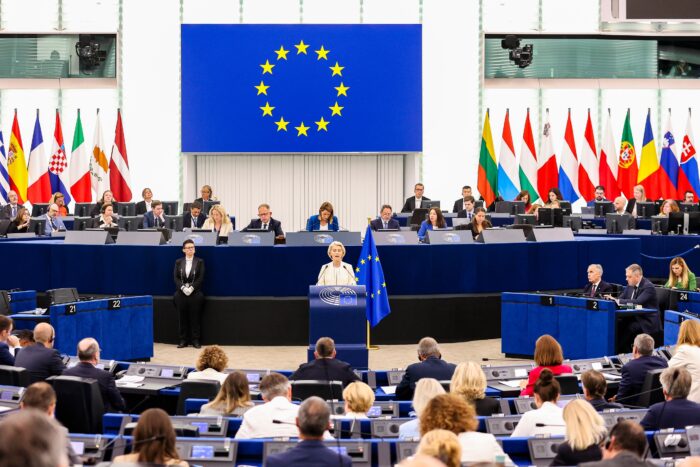
© Photo credit: Shutterstock / elmar gubisch

Find all related publications
Publications
30/06/2026

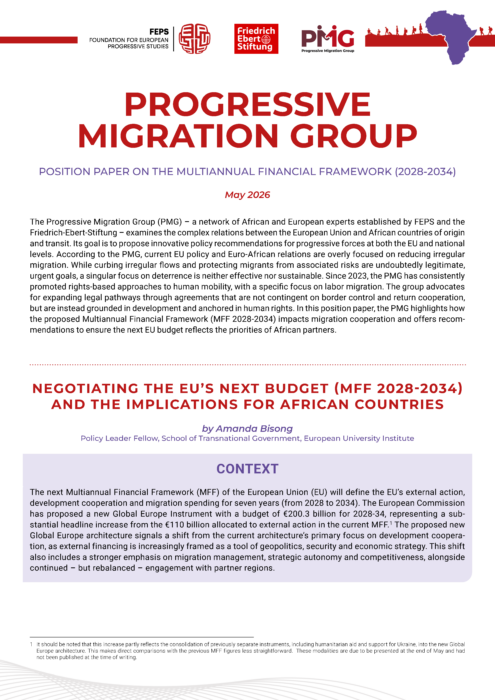
PMG position paper on the Multiannual Financial Framework (2028-2034)

Progressive Migration Group Position Paper
29/01/2026

Progressive Yearbook 2026

In an eerie manner, 2025 resembled the ‘time of monsters’, which, according to the great […]
12/09/2025

EU-AU migration governance

Progressive Migration Group series
22/04/2025

Trade, trust, and transition: Shaping the next transatlantic chapter

Essays series by FEPS and Center for American Progress (CAP)
Find all related Progressive Post
Progressive Post

21/09/2026

Can a fortress be attractive?

On the migration dimension of this year's State of the European Union speech
18/09/2026

A State of the Union bereft of coherence and clarity

The State of the Union is a very special exercise for the president of the […]
02/07/2026

A pact: what else?

The entry into force of the EU’s Pact on Migration and Asylum on 12 June […]
Find all related events
Events
24 JUN 2026

From compassion to crime

FEPS HQ
23 JUN 2026

How Progressives should think about migration

Brussels, Belgium (Hybrid)
21–22 MAY 2026

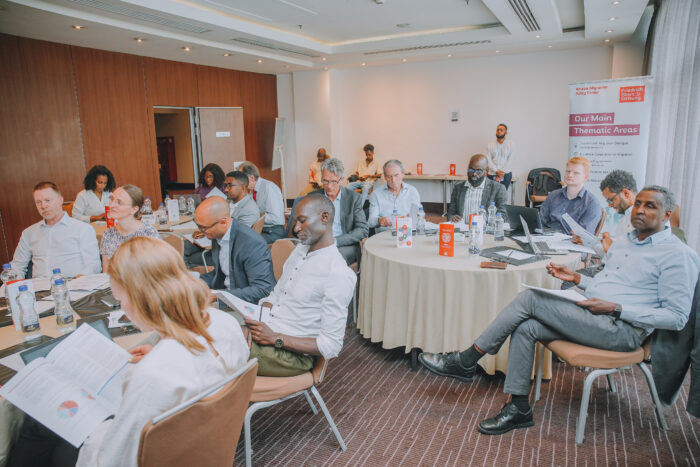
Progressive Migration Group – Addis Ababa

Addis Ababa, Ethiopia (Hybrid - Expert Meeting)
17–18 APR 2026

FEPS at the Global Progressive Mobilisation

Barcelona, Spain
Load more...
Find all related news
News
16/09/2026

FEPS Reacts: State of the European Union 2026

The 2026 State of the Union felt more like ‘von der Leyen I’ than ‘von […]
08/07/2026

Letter to Manfred Weber, Chair of the EPP Group, by FEPS President Nicolas Schmit 

Dear Mr Weber, You are European, but also German. One should be entitled to expect […]
26/01/2023

Grzegorz Pietruczuk is FEPS Progressive Person of the Year

FEPS Progressive Person of the Year 2022-2023
10/12/2022

Multiannual research project: Disinformation about migration in the EU

How to counteract disinformation effectively?
Find all related in the media
In the media

Migranti: Amato a FEPS — “Socialisti e populisti fomentano ossessione”

by Avanti! 29/09/2025
“Migrants: Amato to FEPS — ‘Socialists and populists fuel obsession’” News article in Avanti! where Hedwig Giusto, FEPS Head of International Affairs, critiques how both populist and some socialist political forces are stoking fear around migration. Giusto calls for balanced migration policies that respect human rights, reinforce solidarity among member states, and reject securitarian obsessions.

Italy’s scheme to offshore asylum claims should not be a model for the rest of Europe

by The Guardian 16/10/2024
Article from The Guardian which references the policy study "Responsibility-sharing or shifting? Implications of the New Pact for future EU cooperation with third countries" by FEPS, FES and EPC.

Is it time to turn down the volume on the migration debate?

by IPS Journal 13/11/2023
IPS Journal article about FEPS policy briefs 'Communicating on migration'