Building an equitable and sustainable society

The Foundation for European Progressive Studies and the University of Greenwich are launching the Greenwich Political […]

19 - 20/01/2016
17:00 - 21:00
London, UK
University of Greenwich, Queen Anne Building Room QA080, Old Royal Naval College, Park Row, London, SE10 9LS, (UK) University of Greenwich, Queen Anne Building Room QA080, Old Royal Naval College, Park Row, London, SE10 9LS, (UK)
Building an equitable and sustainable society
56111
244-building-an-equitable-and-sustainable-society
0

In order to give you access to our events, FEPS processes your personal data together with any other organiser of this event mentioned in the description of the event and in accordance with 'FEPS’ data protection policy.

The Foundation for European Progressive Studies and the University of Greenwich are launching the Greenwich Political Economy Research Centre (GPERC). The aim of GPECR is to encourage interdisciplinary analysis of the linkages between institutions, power structures and economic dynamics with a view to:

  • Enhance knowledge of the pressing problems of our time such as inequalities, unemployment, climate change, energy crisis, housing crisis, care deficit, aging, productivity, innovation, and technological change; and 
  • Provide independent and cutting-edge research evidence that will expand the range of evidence-informed and progressive options for policy and practice. 

GPERC brings together an innovative group of researchers who want to expand the knowledge frontier by challenging orthodoxies in economic and social science research.

PROGRAMME

WELCOME ADDRESS

Professor Javier Bonet, Deputy Vice Chancellor – Research, University of Greenwich

SPEAKERS
Dr Ernst Stetter, Foundation of European Progressive Studies
Professor Philip Arestis, University of Cambridge
Jonathan Trickett MP, Shadow Secretary of State for Communities and Local Government and Shadow Minister for the Constitutional Convention
Ann Pettifor, Policy Research in Macroeconomics, Director
Secretary General Professor
John Weeks, Emeritus Professor, SOAS, University of London
Professor Ozlem Onaran, University of Greenwich, GPERC, Director
Professor Mehmet Ugur, University of Greenwich, GPERC

CHAIR
Jonathan Sibson, Pro Vice Chancellor, Business School, University of Greenwich 

More info

Network
Greenwich Political Economy Research Centre (GPERC)
Find all related publications
Publications
18/11/2025

Public investment in the proposed 2028-2034 EU budget

Needs, gaps and options
06/10/2025

Governing the global just transition from fossil fuels to clean energy

Litmus tests and proposals for COP30
26/06/2025

Strengthening and mainstreaming Just Transition goals in the EU Budget

The EU’s legally binding commitment to achieve climate neutrality by 2050 demands a far-reaching socio-economic […]
17/06/2025

Lessons learned from the Recovery and Resilience Facility for a future European fiscal capacity

The creation of the Recovery and Resilience Fund (RRF) as a response to the pandemic […]
Find all related events
Events
Past
03/12/2025
Brussels, Belgium

Silver Rose Awards 2025

Advancing a socially just transition in the face of political challenges
17/11/2025
FEPS HQ, Brussels (Expert meeting)

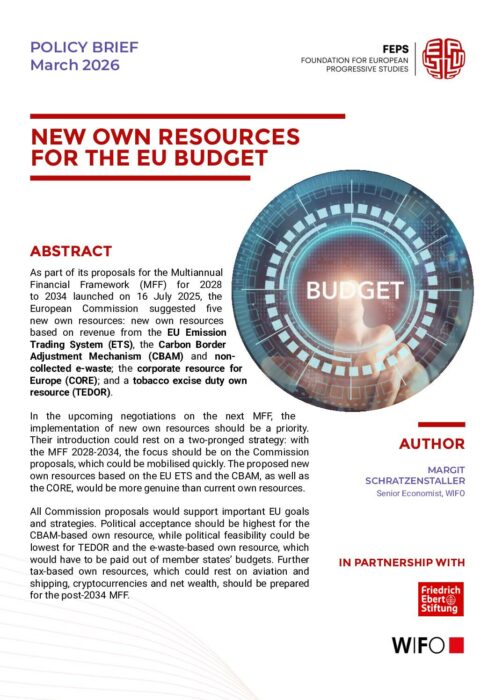
New own resources in the MFF proposal

EU Investment Capacity Group 2025
13 - 15/11/2025
Vienna, Austria (Expert Meeting)

FEPS Young Academics Seminar

4th seminar of the 9th cycle
Load more...
Find all related Audiovisual
Audiovisual
17/11/2025

New own resources in the MFF proposal

Photo album of the ‘New own resources in the MFF proposal‘ event at FEPS HQ, […]
13/11/2025

‘EU-LAC dialogue on Just Transition and trade’ Flickr album

Photo album of the ‘EU-LAC dialogue on Just Transition and trade’ at Santa Marta, Colombia. […]
13/11/2025

‘Evolutionary leap of the European trade policy’ Flickr album

Photo album of the ‘Evolutionary leap of the European trade policy‘ event at FEPS HQ, […]
06/10/2025

‘The profit-price spiral: How to prevent the cost of living crises’ Flickr album

Photo album of the ‘The profit-price spiral: How to prevent the cost of living crises‘ […]
Find all related news
News
27/11/2025

Is a bad COP outcome better than no outcome at all?

FEPS Commentary on COP30
10/09/2025

Von der Leyen – walking the walk at last?

FEPS reaction to The State of the European Union 2025
18/07/2025

A European Commission against the Social Contract

FEPS commentary on the MMF 2028-2034
26/02/2025

FEPS reaction to the European Commission’s Clean Industrial Deal

What Teresa Ribera presented today is an ambitious plan that makes the case for Europe […]
Find all related in the media
In the media

László Andor: Miből fejleszt az EU ezután?

by Portfolio 28/08/2025
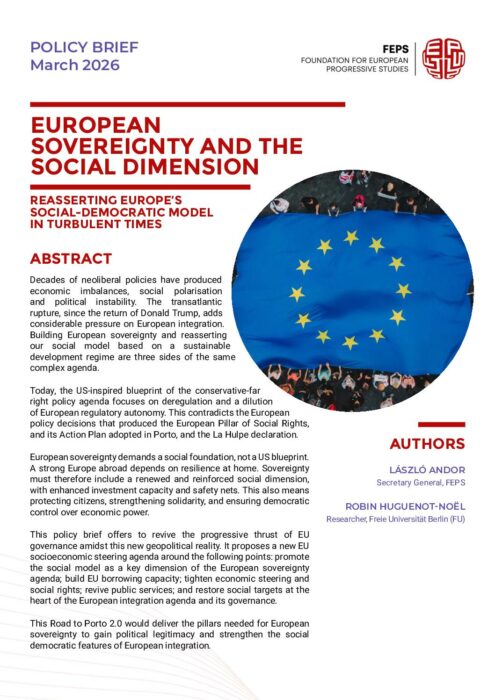
“What will the EU develop from now on?” Analysis by FEPS Secretary General László Andor in Portfolio (HU), highlighting the new MFF’s shift toward increasing EU own-resources, boosting funding for strategic domains like defense, stabilisation and competitiveness, and calling for a flexible crisis-response mechanism such as the proposed Emergency Crisis Response Mechanism

Започва нов ЕС-бюджетен цикъл

by Novi Vremena 26/08/2025
“A new EU budget cycle begins” Article by FEPS Secretary General László Andor in Novi Vremena (BG), highlighting that while Europe must strengthen fiscal capacity to support balanced growth and strategic autonomy, priorities such as cohesion, defense, and social investment must be built into the next multiannual financial framework.

Ласло Андор: България не губи нищо от присъединяването си към еврозоната

by BNR 15/07/2025
"Bulgaria has nothing to lose by joining the eurozone” Interview with FEPS Secretary General László Andor on Bulgarian National Radio, where he explains that Bulgaria has already borne the costs of financial stability and will benefit from eurozone accession.

Tévedés azt hinni, hogy Trump után visszatérhetünk a régi kerékvágásba

by telex 24/04/2025
“It’s a mistake to think we can go back to the old normal after Trump”. Interview with FEPS Secretary General László Andor in Telex (HU), where he discusses the global trade tensions triggered by Trump-era tariffs, the shifting US-China dynamic, and the need for the EU to develop a new strategic approach in a permanently changed world order.