FEPS Newsletter 31 May 2024 – 🌱 Just transition

One week until the EU elections! – If you have problems displaying this email, follow […]

31/05/2024
One week until the EU elections! –

If you have problems displaying this email, follow this link

Every vote counts! By voting in next week’s EU elections, you have the power to shape the future of the European Union. A future in which we must continue the path towards a just transition, now under threat.


In recent months, we have seen a well-coordinated effort to rewind the EU’s climate ambitions. One claim is that taking care of our environment hurts poor people and regions. But this is not true. A just transition protects both the environment and the people.


The following publications show how it is done.

Just Transition
A positive narrative for a Just Transition

By Inanna Tribukait and Kevin Le Merle – In collaboration with Solidar


This policy study analyses the reactionary backlash against the socio-ecological transition and how to counter it with political communications. Not only do the authors recommend a conscious choice of medium, but also tangible and positive examples that make a difference in peoples’ lives. On top of that, the process of policymaking, including identifying the right goals, forms part of the set of recommendations.


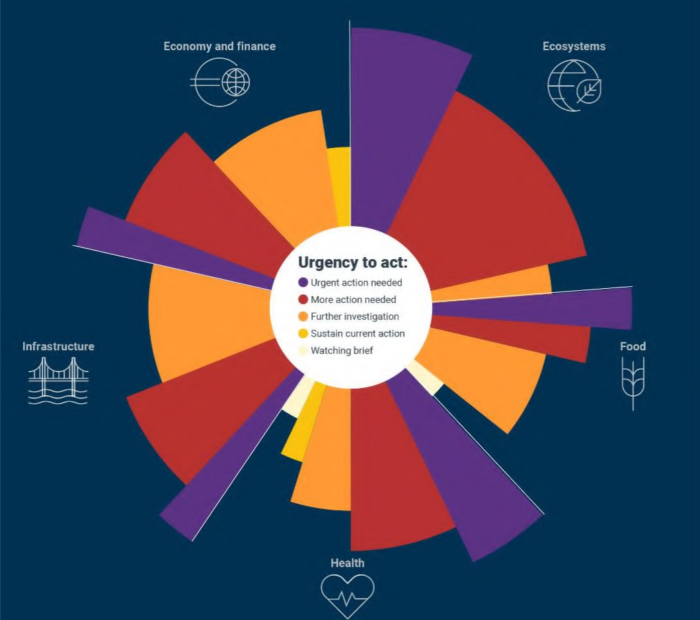
By Milan Petit, Mikhail Sirenko, Michael Obersteiner and Kevin Le Merle – In collaboration with Friedrich-Ebert-Stiftung (FES), Project SEER, Environmental Change Institute and International Institute for Applied Systems Analysis 


A research team from project SEER, assesses the effectiveness of complementing the GDIP with labour market policies in Just Transition regions, highlighting the challenges of labour shortages and structural unemployment.

Read 'Expected labour market effects of the Green Deal Industrial Plan'

The study provides insights into the structural mismatch in labour markets, emphasising the need for labour mobility, while regional case studies from Belgium, Spain, Czechia, Poland and Sweden offer in-depth perspectives on the local effects of the socio-ecological transition. The report concludes with policy recommendations, emphasising a systems approach for a balanced, effective transition.

 
Policy Study
Read 'How can RepowerEU consolidate recovery?'

By Franco Tomassoni and Tiago Santos Pereira – In collaboration with FES, Colabor and Institut Emile Vandervelde


The question “How can RepowerEU consolidate recovery?” is the focus of this policy study published within the FEPS Recovery Watch series. Analysing the case studies of the National Recovery and Resilience Plans of Denmark, Estonia, France, Portugal, and Spain, the researchers demonstrate that European energy policy still lacks significant cross-border infrastructure investments, as well as the need for further monitoring and evaluation to reach a concept of energy security that puts European resilience at the centre.

Progressive Post

PROGRESSIVE PAGE

Navigating the greenlash

Putting people at the heart of climate action in Europe

Article by Mikael Leyi, Secretary General of SOLIDAR

 
Navigating the greenlash

The Greenlash has recently gained momentum in the EU. Yet, climate action is indispensable and stay a high priority for Europeans. It is time to dispel the myth that climate action is a burden and instead highlight how well-planned and implemented sustainable policies directly improve lives and benefit all.


Any climate and environmental action should be accompanied by a socioeconomic impact assessment and by measures that aim to tackle the inequalities that are connected to it. Through a just and inclusive transition, we can ensure that Europeans grasp the immediate and long-term benefits of embracing a sustainable future. Read more.

Photo Credits: Shutterstock/IlonaLablaika

News
FEPS is in the news

MEDIA

Ahead of the EU elections and the upcoming Hungarian Presidency of the EU, FEPS Secretary General László Andor has recently conducted several interviews for different European media:

SURVEY

Shape your next FEPS event experience!


Recently attended an event at FEPS headquarters? We want to hear from you!


Your insights are very important for us as we continually strive to enhance the quality of our events and ensure they meet your expectations. By taking just a few moments to complete this brief survey, you’ll provide us with valuable information that will help us improve future events and tailor our offerings to better suit your needs.

Shape Your Next FEPS Event Experience!

Was this email forwarded to you?

Copyright © 2024 FEPS Europe, All rights reserved.

You are receiving this email because you participated in one of FEPS’ events and/or have registered for FEPS’ newsletter.

If you wish not to receive FEPS’ communications anymore, please click here: unsubscribe now


Foundation for European Progressive Studies
Avenue des Arts, 46 – 1000 Bruxelles

+32 223 46 900 – info@feps-europe.eu

Find all related Progressive Post
Progressive Post
05/11/2026

If you want peace, prepare for equality

I have always been struck by how little attention we pay to patriarchal culture when […]
05/11/2026

The Women, Peace and Security agenda amid shifting geopolitics

While the current conflictual and geopolitical environment makes the Women, Peace and Security agenda ever […]
05/11/2026

The EU’s next WPS plan must act on tech, not just mention it

The EU is drafting its next action plan on Women, Peace and Security, and technology […]
Find all related Magazine
Magazine
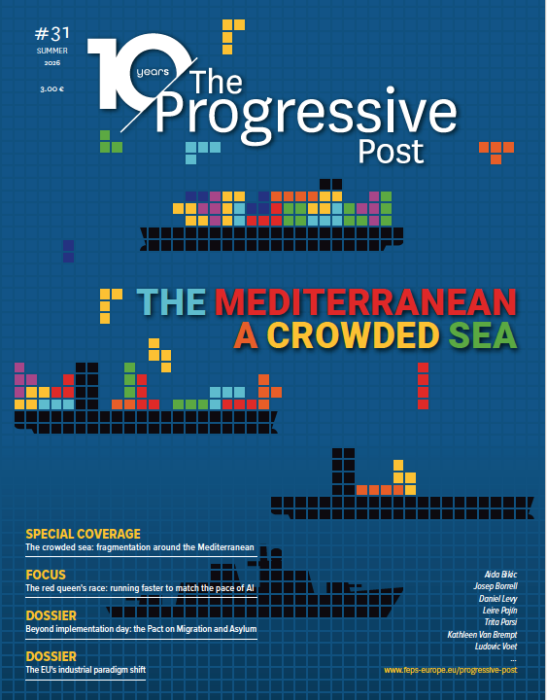
  • cover book

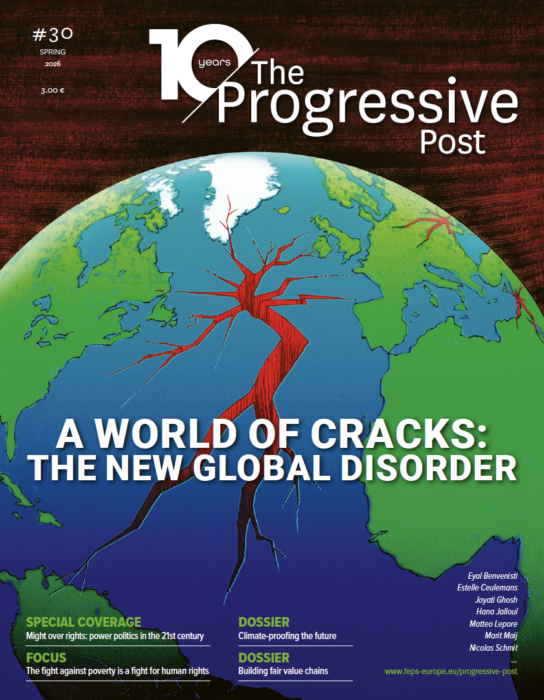
    Issue #30 Progressive Post

Issue #30

A world of cracks: the new global disorder
  • cover book

    Issue #29 Progressive Post

Issue #29

Does peace still have a chance?
Find all related publications
Publications
04/11/2026

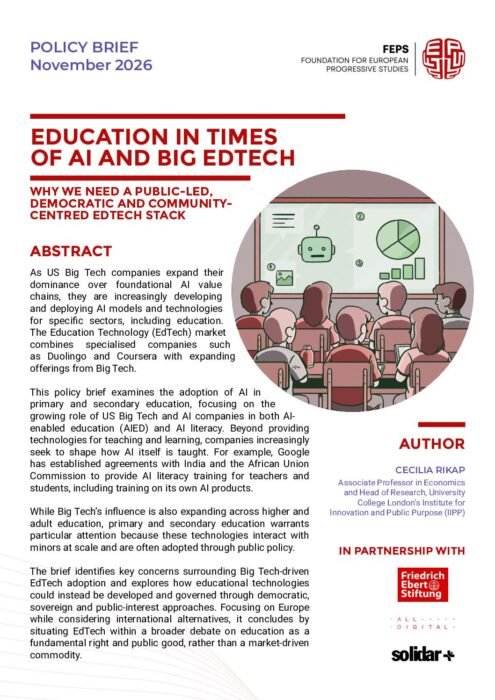
Education in times of AI and Big EdTech

Why we need a public-led, democratic and community-centred EdTech stack
04/11/2026

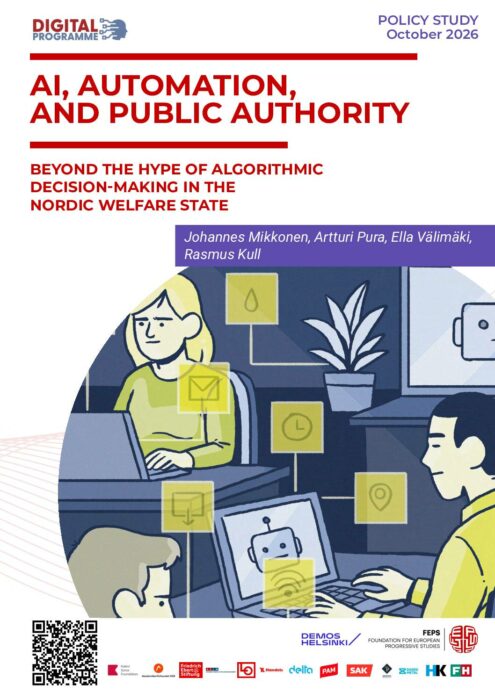
AI, automation, and public authority

Beyond the hype of algorithmic decision-making in the Nordic Welfare State
23/10/2026

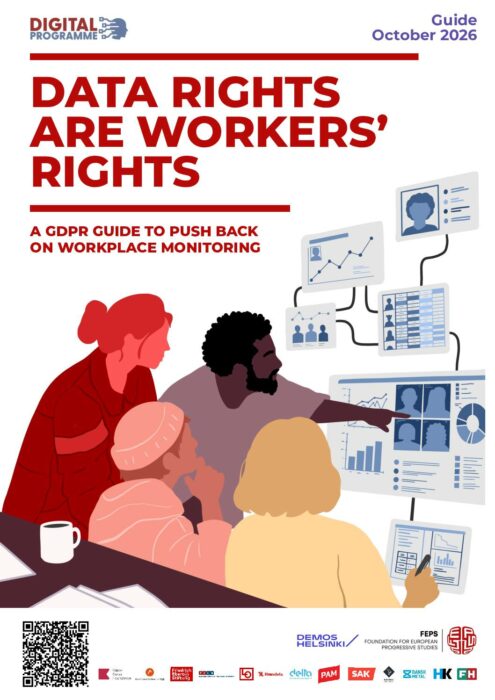
Data rights are workers’ rights

A GDPR guide to push back on workplace monitoring
23/10/2026

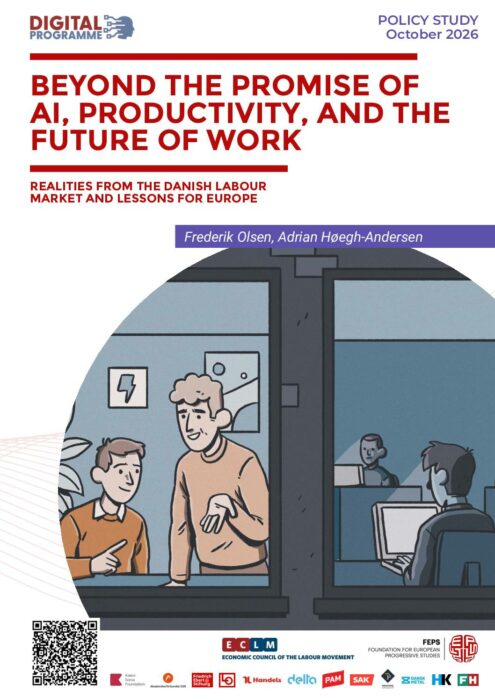
Beyond the promise of AI, productivity and the future of work

Realities from the Danish Labour Market and lessons for Europe
Find all related news
News
30/10/2026

FEPS Reacts: The new EU Framework for Climate Resilience

Necessary foundations but little action
23/10/2026

Notice of vacancy – Policy Analyst on Gender Equality

Apply before 23 November 2026
16/09/2026

FEPS Reacts: State of the European Union 2026

The 2026 State of the Union felt more like ‘von der Leyen I’ than ‘von […]
23/07/2026

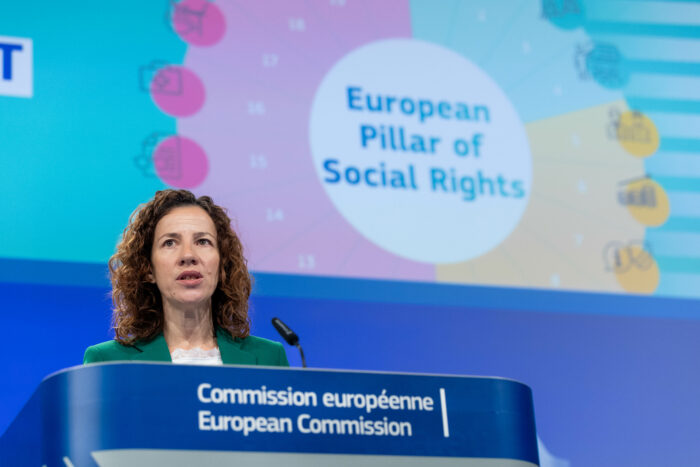
FEPS Reacts: European Commission communication on the Action Plan on the European Pillar of Social Rights

By Laszlo Andor, FEPS Secretary-General & François Balate, Policy Analyst on Social The communication on the […]
Find all related in the media
In the media

Frågan om jämställdhet splittrar unga svenskar

by dagens arena 29/10/2026
"The issue of gender equality divides young Swedes" - FEPS Policy Analyst on Democracy Matteo Dressler discusses the findings of the EqualiZe policy study in the Swedish context.

Brazil’s Lula survives Bolsonaro scare, safeguarding EU democratic ally on climate and trade

by EUobserver 26/10/2026
Read EUobserver's analysis of what comes next after Brazil's elections, which includes comments from Thainá Leite, Project Coordinator at FEPS

Франција е Франција – но Франција е и Европа

by Racin.mk 21/10/2026
“France is France – but France is also Europe.” In an opinion piece for Racin.mk, László Andor, Secretary General of FEPS, argues that France’s youth protests, set against a latent budget crisis and growing precarity (schools, housing), risk benefiting Marine Le Pen, and that France, despite bending the EU’s fiscal rules, has also propped up European growth.

La Regina, il problema dei divari territoriali è una questione europea

by Regione Basilicata 22/09/2026
“La Regina: territorial disparities are a European issue” News article published by ANSA (IT), featuring Raffaele La Regina, participant in the FEPS Young Academics Network, discussing territorial and social inequalities across Europe, the need to reconcile competitiveness and cohesion, and the role of European cohesion policy, industrial policy and investment in ensuring that no region is left behind.