Inequalities in the European Semester

Since its inception, the European Semester has attracted interest in its effects on EU’s social […]

Policy Study

07/10/2020
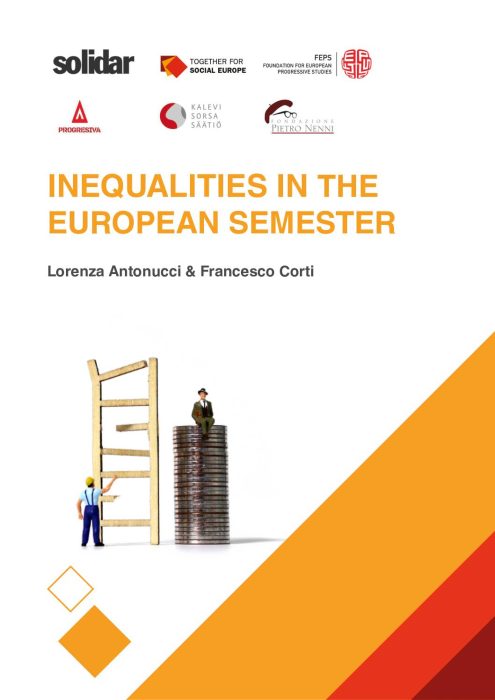
Since its inception, the European Semester has attracted interest in its effects on EU’s social outcomes. Nevertheless, the Semester is devoid of a framework to monitor socio-economic inequalities within member states.

In this study, Lorenza Antonucci and Francesco Corti propose a new framework to address the current Semester’s limitations by: considering the rising socio-economic insecurity of the European lower-middle classes; connecting the social and economic aspects of the Semester; exploiting the redistributive effects of taxation.

Read the Policy Study

As European Semester will play a key role in the implementation of such Recovery Plans, it becomes essential to push forward the revision process of this fundamental coordination tool and transform it into a useful instrument able to grasp the changes affecting vital aspects of our daily life: health, education and work.


Accordingly, they develop a set of 9 recommendations for a new Semester that truly tackles inequalities. The key recommendation is to start monitoring inequalities. Currently, there is a focus on absolute poverty and little information about the trends affecting the European middle class. The indices of the Semester must be upgraded; monitoring work precarity, households’ financial insecurities and access to key services like child and elderly care have to be part of the European toolkit for the coordination of the recovery.

Infographic

Executive summary

This study was carried out by FEPS in partnership with SOLIDAR, Kalevi Sorsa Foundation, Fondazione Pietro Nenni and Društva Progresiva.

Watch the online presentation

Network
Fondazione Pietro Nenni
Kalevi Sorsa Foundation
Progresiva
Solidar
Find all related publications
Publications
15/01/2026

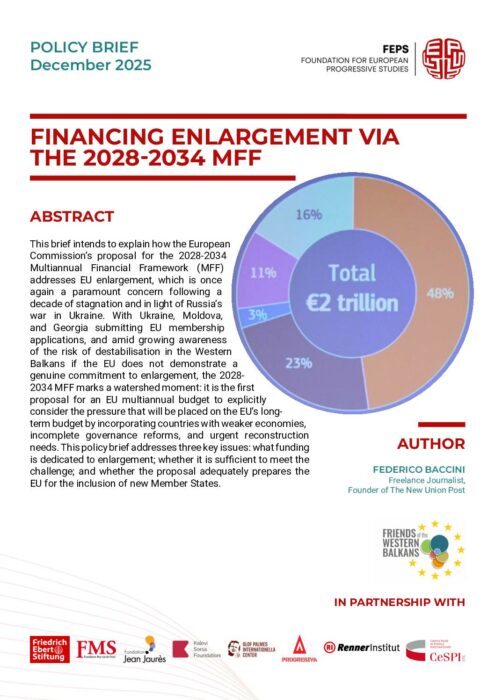
Financing enlargement via the 2028-2034 MFF

This brief intends to explain how the European Commission’s proposal for the 2028-2034 Multiannual Financial […]
19/12/2025

Moving beyond neoliberalism in EU trade policy

European Union trade policy finds itself at a crossroads. After three decades of neoliberal dominance in the […]
09/12/2025

Tackling the housing crisis in Europe

Progressive ideas for affordable and sustainable housing policies
18/11/2025

Public investment in the proposed 2028-2034 EU budget

Needs, gaps and options
Find all related Progressive Post
Progressive Post

15/01/2026

Bulgaria’s Eurozone moment

Bulgaria has joined the world’s most ambitious integration project by adopting the euro in January […]
11/12/2025

Unpacking competitiveness

Since Mario Draghi published his report on The future of European competitiveness, its recommendations have […]
18/09/2025

Submission is not a strategy: Von der Leyen’s missed moment

The world is sliding into a new order where the strong impose their rule and […]
Find all related events
Events
Upcoming
29/01/2026
FEPS HQ

FEPS’ New Year Reception & Progressive Yearbook launch

7th edition
Past
17/11/2025
FEPS HQ, Brussels (Expert meeting)

New own resources in the MFF proposal

EU Investment Capacity Group 2025
13 - 15/11/2025
Vienna, Austria (Training)

FEPS Young Academics Seminar

4th seminar of the 9th cycle
Load more...
Find all related Audiovisual
Audiovisual
10/12/2025

‘Tackling the housing crisis in Europe’ Flickr album

Photo album of the ‘Tackling the housing crisis in Europe‘ event at the European Parliament […]
17/11/2025

New own resources in the MFF proposal

Photo album of the ‘New own resources in the MFF proposal‘ event at FEPS HQ, […]
13/11/2025

‘Evolutionary leap of the European trade policy’ Flickr album

Photo album of the ‘Evolutionary leap of the European trade policy‘ event at FEPS HQ, […]
27/10/2025

🧠 “MENTAL HEALTH is not an individual issue” With Sara Bojarczuk, Aida Bikic & Jana Michailidu

📺🔊 Available on YouTube, Spotify & Apple Podcast Europe is facing a growing mental health […]
Find all related news
News
16/12/2025

FEPS commentary on the EU Affordable Housing Plan

The announcement of the EU Affordable Housing Plan by Commissioner Dan Jørgensen is a historic milestone […]
04/12/2025

It is high time that the goal is set on “Quality”

FEPS commentary on the Quality Jobs Roadmap
21/10/2025

Maria João Rodrigues at PES Congress 2025

🇳🇱 🌹 FEPS attended the Party of European Socialists (PES) Congress in Amsterdam, which included […]
18/10/2025

FEPS at PES Congress 2025

🇳🇱 🌹Within PES Congress, there were full rooms on insightful discussion on a range of […]
Find all related in the media
In the media

Liberal democracy’s social, societal fabric under threat – Live from the EPC Annual Conference 2025

by EPC 08/12/2025
In a podcast by the European Policy Centre (EPC), FEPS Secretary General, László Andor, discusses how liberal democracy in Europe is being challenged not only at the institutional level but also through the erosion of social rights and what Europe must do to defend its social foundations.

László Andor: Miből fejleszt az EU ezután?

by Portfolio 28/08/2025
“What will the EU develop from now on?” Analysis by FEPS Secretary General László Andor in Portfolio (HU), highlighting the new MFF’s shift toward increasing EU own-resources, boosting funding for strategic domains like defense, stabilisation and competitiveness, and calling for a flexible crisis-response mechanism such as the proposed Emergency Crisis Response Mechanism

Започва нов ЕС-бюджетен цикъл

by Novi Vremena 26/08/2025
“A new EU budget cycle begins” Article by FEPS Secretary General László Andor in Novi Vremena (BG), highlighting that while Europe must strengthen fiscal capacity to support balanced growth and strategic autonomy, priorities such as cohesion, defense, and social investment must be built into the next multiannual financial framework.

Ласло Андор: България не губи нищо от присъединяването си към еврозоната

by BNR 15/07/2025
"Bulgaria has nothing to lose by joining the eurozone” Interview with FEPS Secretary General László Andor on Bulgarian National Radio, where he explains that Bulgaria has already borne the costs of financial stability and will benefit from eurozone accession.