
Book
09/10/2014
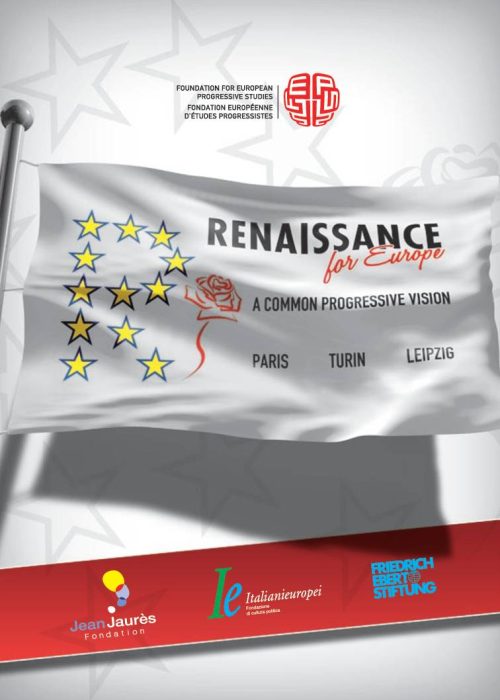
Renaissance for Europe initiative was born out of intellectual and political desire to open a new chapter of a conversation about the future of the Union. The upcoming national elections in the three founding states of the EU – France, Italy and Germany – seemed a window of opportunity to reach beyond a discourse on crisis and decline. A motivation to deliberate upon an alternative scenario and propose a progressive way forward for Europe translated. The project under the auspices of the FEPS President, Massimo D’Alema and with the support of Fondation Jean Jaurès, Italiani Europei and Friedrich Ebert Stiftung featured conferences in Paris, Turino and Leipzig. The text below was drafted as a record of provoking thoughts that these exchanges inspired.
The recent decade has witnessed a deterioration of the Europe that came together while fulfilling a promise of a post-war generation. Though memories of the cataclysm of 1939 – 1945 have been most vivid at the beginning – the real motivation was not just a fear to prevent the story repeating itself. No more wars, no more poverty and hunger, no more some against others – those notions may have brought states, societies and individuals together, however what has kept them united has been an idea that jointly they can make a new history. Altogether they could fulfil dreams of long lasting peace, overall prosperity and democracy. This vision has been meaningful and worth fighting for – always and forever, despite all the challenges, detours and predicaments.
The progressive family has always strived for a political Union that puts people first. The initial scepticism of many parties versus an initiative that was initially driven by an economic cooperation has become this political movement’s inspiration to develop an alternative proposal. Common market and tighter industrial relations would not be enough, they decided. This became a promise of a Social Europe – which would carry a promise that benefits of the Union would first and foremost serve improving working and living conditions of the citizens. They, being the members of herewith created polity, would be the ones to have a decisive say about the future of the Community and this was why the idea of establishing direct European elections was so important.
The successful achievements of the past sixty years are undeniable. But this does not stop the contemporary to ask the existential question what is the sense of Europe today. The Treaty ofMaastricht that was to empower citizens and deepen the European democracy brought on the Union an imbalanced construction. The uncompleted Monetary Union with insufficient tools for Europe to react became its liability in times of crisis. The Growth and Stability Pact imposed requirements, while not being supported with strategies that would assist all the members to comply with the expectations. Though the lisbon Strategy was a beacon of hope in terms of transforming the labour market and herewith also adapt the European Social Model, it did not live up to witness the fulfilment of the ambitious commitments that had been made then. Finally, the Constitutional Treaty, which was to voice people’s vision of Europe of the new millennium, was rejected by the citizens of the two founding member states. Though it is hard to believe that with so many brave ideas, the results can be so discouraging – the case still is that the reoccurring question across the continent seems to echo a sentiment of disbelief: “do we really need this Europe? And what for?”
The progressive response to those queries remains a decisive one. yes, we need Europe – but not this Europe. The ruling centre-right has been consequently and forcefully decomposing the communitarian sphere in order to give ways to their Europe of nations. It results in an image that the Union is not more than a loose confederation of states, among which one member assumes leadership in trying to satisfy anticipated demands of the markets. But such a Europe does not work – neither figuratively nor literally. The demand for an alternative is real and can be heard on the streets, in unemployment offices and in queues for social security assistance.
Renaissance for Europe was a response to those calls, while trying to place the answer in a political context. The circumstances gave a hope that with the changing climate there would be a chance not only to argue for a change, but also to fulfil hopes for one – while winning the elections and returning to governing. For the symbolic and historical reasons to show that a new beginning is possible at the source of already existing initiative, the focus was on the three founding member states of France, Italy and Germany. Politicians, academics and experts gathered together in Paris, Turin and leipzig with an aim to go beyond more common technical debates on Europe. The objective was to reach further than analysis of the crisis and to break out of the confinement of the existing discourse. Renaissance for Europe was about retrieving sense of solidarity in order to push together the limits of political imagination and mobilise political courage to articulate bold proposals. Here below is a record of 10 provoking thoughts that these debates inspired.
Read the 10 provoking thoughts drafted by Dr Ania Skrzypek FEPS senior Research fellow
Network
Find all related publications
Publications
Find all related Progressive Post
Progressive Post

Find all related events
Events
Past
18/09/2026
Online
10 - 12/09/2026
Vienna, Austria (Training)
01 - 04/07/2026
Warsaw, Poland (Training)
Load more...
Find all related Audiovisual
Audiovisual
26/02/2026
26/02/2026
28/06/2024
28/06/2024
Find all related news
News

Find all related in the media
In the media
“Back to the Future: The Great Reset”
Opinion article by FEPS Vice-President, Lina Gálvez reflecting on the current global crisis marked by rising authoritarianism, digital power and extreme inequality, and tracing its roots through a historical analysis of capitalism — from the post-1945 social and geopolitical settlement led by social democratic forces, through neoliberal financialisation, to what she describes as a new phase of fascist capitalism.
László Andor: «En Hongrie, malgré l’érosion de la popularité d’Orbán, la gauche peine à regagner en crédibilité»
by Le Figaro 25/08/2025