
Policy Study
15/01/2021
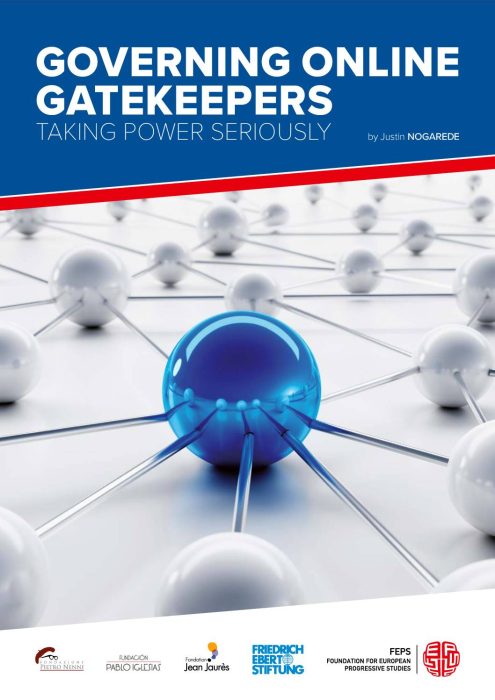
How should the EU respond to the power and control that large online platforms exercise over crucial digital services, markets, and the public sphere? This is one of the key questions confronting policy-makers at the moment. The Foundation for European Progressive Studies (FEPS), together with the Friedrich-Ebert-Stiftung, the Fondation Jean-Jaurès, the Fundación Pablo Iglesias, and the Fondazione Pietro Nenni, explore exactly that question in the policy paper “Governing online gatekeepers – Taking power seriously”. This paper is especially relevant in the context of the European Commission’s recent proposals for the Digital Services Act and the Digital Markets Act.
In the absence of public investment and legislation, the internet has evolved into an online ecosystem of powerful and private gatekeepers. The Covid-19 crisis once again underlined that large platforms function as essential social and economic infrastructure. Online retailers find it difficult to avoid Amazon, citizens find it difficult to avoid Facebook’s social media ecosystem, and everyone relies on Google to find and be found online. However, these gatekeepers regulate social activity via the technical design of their services, but in ways that are increasingly at odds with the public interest, societal well-being, and citizens’ rights.
The policy paper explores the EU’s existing policy approach to reign in large online platforms’ power and align their functioning with the public interest, and finds it has been ineffective (competition policy), overly accommodating and complex (the raft of self-regulatory initiatives on illegal content), and simply not properly enforced (notably the General Data Protection Regulation). The paper argues for public investment in digital infrastructure, and simple – but strictly enforced – public rules targeted at the biggest online gatekeepers.
Network



Find all related publications
Publications
Find all related Progressive Post
Progressive Post



Find all related events
Events
Upcoming
Past

Find all related Audiovisual
Audiovisual
26/02/2026
26/02/2026

02/02/2026
29/01/2026
Find all related news
News

Find all related in the media
In the media
España los forma, Europa los contrata: así es el mapa de la nueva fuga de cerebros
by El Confidencial 10/02/2026
“Back to the Future: The Great Reset”
Opinion article by FEPS Vice-President, Lina Gálvez reflecting on the current global crisis marked by rising authoritarianism, digital power and extreme inequality, and tracing its roots through a historical analysis of capitalism — from the post-1945 social and geopolitical settlement led by social democratic forces, through neoliberal financialisation, to what she describes as a new phase of fascist capitalism.
“What will the EU develop from now on?”
Analysis by FEPS Secretary General László Andor in Portfolio (HU), highlighting the new MFF’s shift toward increasing EU own-resources, boosting funding for strategic domains like defense, stabilisation and competitiveness, and calling for a flexible crisis-response mechanism such as the proposed Emergency Crisis Response Mechanism
“A new EU budget cycle begins”
Article by FEPS Secretary General László Andor in Novi Vremena (BG), highlighting that while Europe must strengthen fiscal capacity to support balanced growth and strategic autonomy, priorities such as cohesion, defense, and social investment must be built into the next multiannual financial framework.