

Digital footprint: Employment in platform economies

After 3 years of surveys carried out in various European countries, it has become clear […]

09/04/2019
09:00 - 15:00
Madrid, Spain
Digital footprint: Employment in platform economies
61634
digital-footprint-employment-in-platform-economies
0

In order to give you access to our events, FEPS processes your personal data together with any other organiser of this event mentioned in the description of the event and in accordance with 'FEPS’ data protection policy.

After 3 years of surveys carried out in various European countries, it has become clear that platform work is here to stay and is even growing rapidly. It has become a way to gain additional income for many people across Europe, with particularly high levels in European countries where salaries are low. 

The ‘platform dynamic’ that involves precarious work, reduced worker autonomy, and flexibility for the employer, not the worker, is gaining prominence in European labour markets.

This ‘platformisation of work’ has been measured for the first time in Spain as part of the GENERA project. The report made by Felipe González Foundation, ‘Huella Digital: El empleo en las economías de plataforma’, which focuses on the Spanish case, was presented during the CaixaForum. 

This report has been done as part of the first Europe-wide study on workers in the Gig Economy, which concerned 13 European countries. It was launched by FEPS and UNI Europa and carried out by the University of Hertfordshire and Ipsos MORI.

The presentation of the report brought together several experts, social and economic agents and included interventions by Justin Nogarede, FEPS Senior Policy Analyst on Digital; Ursula Huws, author of the report and Professor of Employment and Globalisation at the University of Hertfordshire, and the director of Foundation Felipe González, Rocío Martínez-Sampere.

The debate focused on the situation of workers in this new economy, which continues to grow at an unstoppable rate. The importance of comparative analysis with other European countries was also highlighted, as it is the only way to have a more complete vision of the situation and a better understanding of what should be done.

Network
Fundación Felipe Gonzalez
UNI Europa
Find all related publications
Publications
18/11/2025

Public investment in the proposed 2028-2034 EU budget

Needs, gaps and options
26/06/2025

Strengthening and mainstreaming Just Transition goals in the EU Budget

The EU’s legally binding commitment to achieve climate neutrality by 2050 demands a far-reaching socio-economic […]
17/06/2025

Lessons learned from the Recovery and Resilience Facility for a future European fiscal capacity

The creation of the Recovery and Resilience Fund (RRF) as a response to the pandemic […]
05/05/2025

Shaping a European budget fit for climate action and a just transition

The negotiations for the next EU Multiannual Financial Framework (MFF) – the long-term budget at […]
Find all related events
Events
Past
17/11/2025
FEPS HQ, Brussels (Expert meeting)

New own resources in the MFF proposal

EU Investment Capacity Group 2025
08/11/2025
Santa Marta, Colombia

EU-LAC dialogue on Just Transition and trade

Despite the EU’s growing emphasis on sustainability, its trade and investment policies remain largely disconnected […]
13/11/2025
FEPS HQ (Expert meeting)

Evolutionary leap of the European trade policy

Progressive Economic Network 2025
Load more...
Find all related Audiovisual
Audiovisual
17/11/2025

New own resources in the MFF proposal

Photo album of the ‘New own resources in the MFF proposal‘ event at FEPS HQ, […]
13/11/2025

‘Evolutionary leap of the European trade policy’ Flickr album

Photo album of the ‘Evolutionary leap of the European trade policy‘ event at FEPS HQ, […]
06/10/2025

‘The profit-price spiral: How to prevent the cost of living crises’ Flickr album

Photo album of the ‘The profit-price spiral: How to prevent the cost of living crises‘ […]
04/09/2025

‘Inflation preparedness in the EU’ Flickr album

Photo event of the ‘Inflation preparedness in the EU‘ event in Brussels. On 3 September […]
Find all related news
News
18/10/2025

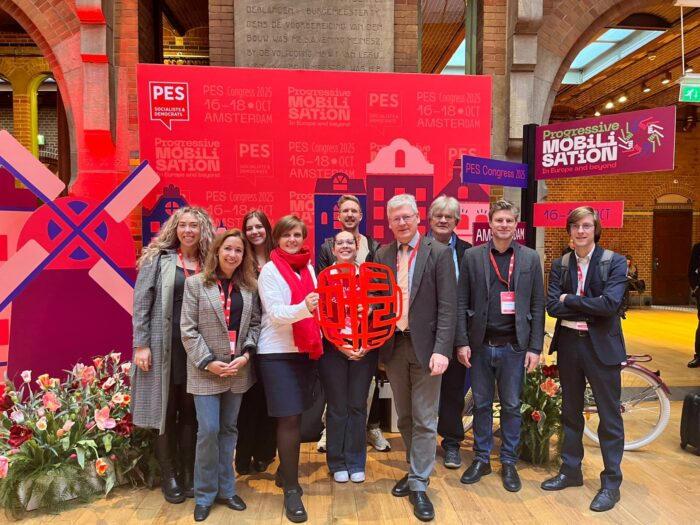
FEPS at PES Congress 2025

🇳🇱 🌹Within PES Congress, there were full rooms on insightful discussion on a range of […]
10/09/2025

Von der Leyen – walking the walk at last?

FEPS reaction to The State of the European Union 2025
18/07/2025

A European Commission against the Social Contract

FEPS commentary on the MMF 2028-2034
26/02/2025

FEPS reaction to the European Commission’s Clean Industrial Deal

What Teresa Ribera presented today is an ambitious plan that makes the case for Europe […]
Find all related in the media
In the media

László Andor: Miből fejleszt az EU ezután?

by Portfolio 28/08/2025
“What will the EU develop from now on?” Analysis by FEPS Secretary General László Andor in Portfolio (HU), highlighting the new MFF’s shift toward increasing EU own-resources, boosting funding for strategic domains like defense, stabilisation and competitiveness, and calling for a flexible crisis-response mechanism such as the proposed Emergency Crisis Response Mechanism

Започва нов ЕС-бюджетен цикъл

by Novi Vremena 26/08/2025
“A new EU budget cycle begins” Article by FEPS Secretary General László Andor in Novi Vremena (BG), highlighting that while Europe must strengthen fiscal capacity to support balanced growth and strategic autonomy, priorities such as cohesion, defense, and social investment must be built into the next multiannual financial framework.

Ласло Андор: България не губи нищо от присъединяването си към еврозоната

by BNR 15/07/2025
"Bulgaria has nothing to lose by joining the eurozone” Interview with FEPS Secretary General László Andor on Bulgarian National Radio, where he explains that Bulgaria has already borne the costs of financial stability and will benefit from eurozone accession.

Tévedés azt hinni, hogy Trump után visszatérhetünk a régi kerékvágásba

by telex 24/04/2025
“It’s a mistake to think we can go back to the old normal after Trump”. Interview with FEPS Secretary General László Andor in Telex (HU), where he discusses the global trade tensions triggered by Trump-era tariffs, the shifting US-China dynamic, and the need for the EU to develop a new strategic approach in a permanently changed world order.