
Download
Inequality and populism
Policy Study
15/05/2024
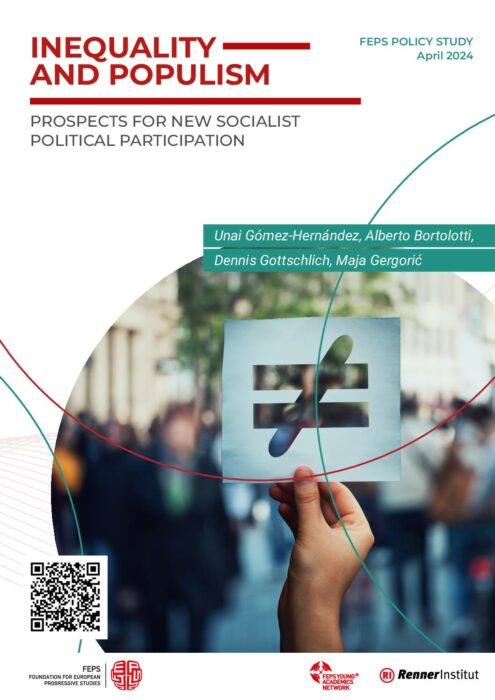
Prospects for a new socialist political participation
In recent years, European citizens have witnessed how inequality, particularly socio-economic inequality, together with the vote share that radical right populist parties have secured in elections, has increased. These parties now govern some countries, such as Italy and Hungary, and have gained a significant number of seats in others, such as Spain. That is why the present policy study aims to examine the nexus between inequality and populism, with a particular focus on the dialectics between social-democratic and radical right populist parties, as well as the territorial differences of inequality.
In fact, with respect to our research question, “how does inequality affect political participation?”, we argue that the rise of populism is not only linked to economic trends but also to other constitutional changes and institutional settings characterising European countries. We understand the current disenchantment upon which populist parties have achieved their result, as a consequence not only of the democratic dynamics but also of economic inequalities. Similarly, we acknowledge that the rise of populism also responds to the party fragmentation that has recently taken place in many European states. However, this lies beyond the scope of our research. Hence, our main focus is on economic inequality as the explanatory variable for political participation. This way, analysis of the economic realm to generate policy recommendations is justified. The research fills the gap in the literature by combining a sound theoretical foundation, a clear applied analysis, and articulated policy recommendations deriving from these. The main goal is, thus, applied.
To support the argument of the policy brief, our work is split into the following sections. The first deals with the methodology that is used in the writing. Combining a qualitative analysis of the case studies and a quantitative analysis of the data that concerns them, the study sheds light on the research question. Then three countries are presented as case studies. The quantitative analysis of the data is put forward, and finally, a set of policy recommendations, together with an open call for further research on the link between rising inequalities and populist parties‘ political consensus and participation, are proposed.
This policy study was written as part of the FEPS Young Academic’s Network.
Network

Related publications

Find all related publications
Publications
Find all related Progressive Post
Progressive Post
Find all related events
Events

Dublin, Ireland

Dublin (expert meeting)

Dublin, Ireland (Expert meeting)
Brussels, Belgium
Load more...
Find all related Audiovisual
Audiovisual

20/05/2026
26/02/2026
26/02/2026

02/02/2026
Find all related news
News
Find all related in the media
In the media
“A civic revolution, not yet a social revolution”
Interview with László Andor, FEPS Secretary General, published by Fondation Jean-Jaurès (FR), analysing the electoral defeat of Viktor Orbán, the emergence of a broad opposition movement in Hungary, and the prospects for democratic renewal, EU relations and social change following what he describes as a “civic revolution” that has yet to deliver a social transformation.
“Money is coming! Will Péter Magyar deliver on his promise?”
Video Interview published on KlikkTV (HU), featuring László Andor, FEPS Secretary General, discussing EU funds to Hungary, their political conditionality, and the importance of fair distribution, rule of law and social investment within the European Union.
“Back to the Future: The Great Reset”
Opinion article by FEPS Vice-President, Lina Gálvez reflecting on the current global crisis marked by rising authoritarianism, digital power and extreme inequality, and tracing its roots through a historical analysis of capitalism — from the post-1945 social and geopolitical settlement led by social democratic forces, through neoliberal financialisation, to what she describes as a new phase of fascist capitalism.