FEPS Newsletter 12 Nov 2026 – 🗳️ Election observatory

Winds of change? – If you have problems displaying this email, follow this link   […]

12/11/2026
Winds of change? –

If you have problems displaying this email, follow this link

Election observatory

Are we witnessing winds of change? With the good news coming from the US, Brazil and Serbia, it seems we can finally breathe a little easier.


However, we’re still holding our breath over what the coming weeks and months may bring, with key elections in Spain and France on the horizon. Whatever happens, something has begun to move, both figuratively and literally, as people take to the streets across Europe. We can only hope it keeps moving in the right direction: for people, for democracy, for solidarity and for the planet. 


FEPS will keep analysing the election results and helping progressive ideas take shape in response to Europe’s biggest challenges. In the following articles on the recent elections in Serbia, Israel, Bosnia and Herzegovina, Latvia, and the US, you will find the main findings on coalition-building processes and dynamics, campaign topics, electoral integrity and strategic takeaways for upcoming elections.

🇷🇸 SERBIA

Unpacking Serbia’s election results

Outcome and trends 


On 25 October 2026, former President of Serbia’s Alexander Vučić conceded defeat to the student-led movement in a historic election. 

An EU social agenda for a geopolitical age

This webinar, in collaboration with PRO International, looked at the key information and takeaways from the election, with a particular focus on the Serbian Student List’s performance.


📰 Read the article “Serbia’s students defeat the machine“ by Tamara Tripić for more insights into the election in Serbia. 

Mobilisation without realignment

Photo credits: Shutterstock / vladi_konov

🇮🇱 ISRAEL

Mobilisation without realignment

Article by Liel Maghen


Israel’s October 2026 elections produced a striking paradox. Prime Minister Benjamin Netanyahu’s governing bloc has lost its parliamentary majority but Likud remains the largest party. Netanyahu’s electoral performance was considerably stronger than many had anticipated. Read more.

🇧🇦 BOSNIA & HERZEGOVINA

The vote is harder to steal, but politics remains hard to change

Article by Harun Cero


Bosnia and Herzegovina’s general elections on 4 October produced an unusual result: the country has taken a significant step forward in how votes are cast and counted, without fundamentally changing who holds political power. Read more.

The vote is harder to steal, but politics remains hard to change

Photo credits:  Shutterstock / Mete H

A strong mandate amid falling participation

Photo credits: Shutterstock / shulers

🇱🇻 LATVIA

A strong mandate amid falling participation

Article by Konstantīns Čekušins 


On 3 October, Latvians elected a new parliament. Prime Minister Andris Kulbergs’ regionalist, green and conservative United List more than doubled its seats, from 15 to 41. However, The answer to the question of whether the country ‘woke up to a new reality’ after these elections is both no and yes. Read more.

🇺🇸 UNITED STATES

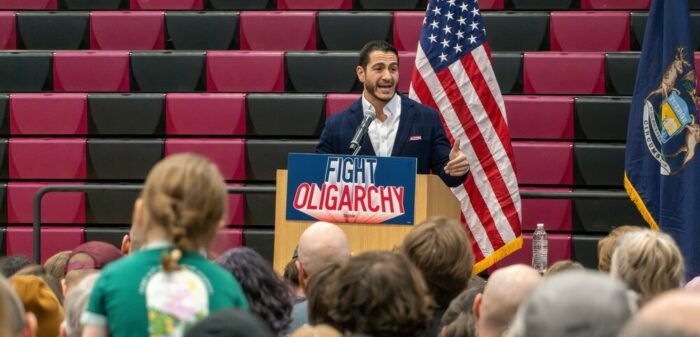
A blue wave that might crush soon

Article by Reinhard Krumm


Americans have elected a new Congress: going into 2027, both chambers will be under Democratic control. On the campaign trail, president Donald Trump had repeatedly urged voters to pretend as if he was on the ballot – and it seems they did. Read more.

A blue wave that might crush soon

Photo credits: Shutterstock /

Jonathan Thomas-Palmer

Events
Afrikadag 2026
 

📅  21 NOVEMBER

📍 AMSTERDAM, NETHERLANDS

Afrikadag 2026
The future is here!


EU partnership language with Africa often gets stuck in short-term choices, such as shrinking development cooperation budgets. The question for Europe is not whether it grants Africa a seat at the table, but whether it positions itself in time for a world that is no longer waiting. Join this new edition of Afrikadag!

Multilevel governance for European industrial policy
 

📅  1 DECEMBER

📍 GENOA, ITALY

Multilevel governance for European industrial policy


Industrial policy has returned to the centre of the European agenda, but how can it be governed across multiple levels, institutions and instruments?


This event will present a multilevel architecture built around an Industrial Strategy Board linking the Commission, Member States and regions. It will pay special attention to the regional dimension of industrial policy. Register here.

Silver Rose Awards 2026
 

📅  2 DECEMBER

📍 BRUSSELS, BELGIUM

Silver Rose Awards 2026


The registration for the Silver Rose Awards 2026, an evening to celebrate those who are fighting for social justice and climate action, is now open! 


This year, we will celebrate Jan Eliasson, former Deputy Secretary-General of the United Nations, for a lifetime of work on peace, diplomacy and human rights and the Philippine Movement for Climate Justice, a coalition of more than 150 organisations that helped stop 18 coal-fired power plants and 8 LNG plants. Register now!

3 NOV – EUROPEAN PARLIAMENT

Geofeminism and the WPS agenda

Lessons from the SWANA region


When women participate in peace processes, peace is more sustainable. Yet in 2025, women accounted for only 5% of negotiators across 57 peace processes.


As part of the European Parliament Gender Equality Week, the roundtable hosted by MEP Chloé Ridel looked at why empowering women and girls worldwide is essential to building peace and discussed alternatives to relying on military power alone.

Geofeminism and the WPS agenda

This event was organised by the Feminist Foreign Policy Progressive Voices Collective (FFPPVC), led by FEPS in collaboration with Friedrich-Ebert-Stiftung (FES) EU Office. It was held with the support of Equipop and the S&D Group.

For the impactful EU-UK partnership in the rapidly changing world

3 NOV – BRUSSELS, BELGIUM

For the impactful EU-UK partnership in the rapidly changing world

Fringe event at the EU-UK Progressive Forum


How can the EU and the UK build a deeper partnership grounded in shared democratic values and common interests? 


The event looked at how to move the relationship from transactional to strategic, what role the UK should play in Europe and how cooperation can extend beyond security into areas such as climate, digital and energy.

This fringe event was held in the context of the EU-UK Progressive Forum, organised by FEPS, in collaboration with FES EU Office and FES UK Office.

3 NOV – BRUSSELS, BELGIUM

Employee ownership: Bridging competitiveness and shared prosperity

Fringe event at the EO Days 2026 


FEPS hosted two panels focusing on the benefits of employee ownership for competitiveness and shared prosperity, with examples from France and Spain. The conversation also looked at Europe’s succession problem for millions of European businesses, and how employee ownership can save them from private equity.

Employee Ownership 2026

By FEPS, in collaboration with the Institute for Economic Democracy – IED and with the support of FEBEA, Fondazione Messina, Fundació Seira and SOCODEN.

Podcast
Listen to the podcast

FEPS TALKS PODCAST

How Europe survives?

With Catherine De Vries, Alexandros Kentikelenis and László Andor

🎧 Listen to this podcast on Spotify | Apple Podcast | Website or watch it on Youtube


In this episode, authors of their new book “How Europe survives?” Professor Catherine De Vries and Professor Alexandros Kentikelenis discuss this question in detail. They look back to previous difficult chapters, including the Eurozone crisis, Covid-19 recession, and more, to find out how the EU managed to avoid disintegration. 

Progressive Post

DOSSIER

The Women, Peace and Security agenda in times of turning tides 


Authoritarianism, anti-gender backlash and fading political support are eroding Women Peace and Security when it is most needed.

The Women, Peace and Security agenda in times of turning tides

📚 Read more.

Photo credits: UN Photo/Manuel Elías


Was this email forwarded to you?

Copyright © 2026 FEPS Europe, All rights reserved.

You are receiving this email because you participated in one of FEPS’ events and/or have registered for FEPS’ newsletter.

If you wish not to receive FEPS’ communications anymore, please click here: unsubscribe now. We use tracking pixels in our newsletters to measure engagement. Manage your preferences or unsubscribe at any time.


Foundation for European Progressive Studies
Avenue des Arts, 46 – 1000 Bruxelles

+32 223 46 900 – info@feps-europe.eu

Find all related Progressive Post
Progressive Post
19/11/2026

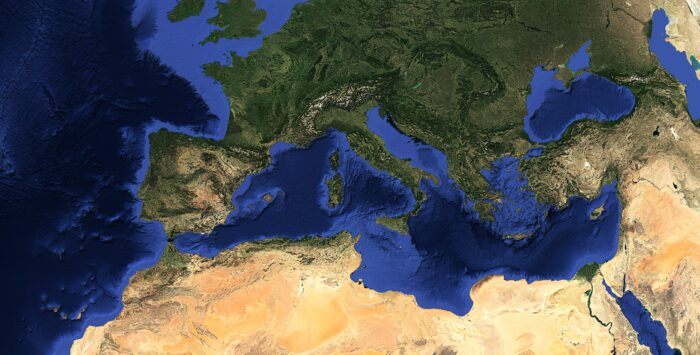
Translating Europe’s commitment to multilateralism into action in the Mediterranean

The case for doubling down on the Union for the Mediterranean
10/11/2026

A blue wave that might crush soon

Americans have elected a new Congress: going into 2027, both chambers will be under Democratic […]
05/11/2026

If you want peace, prepare for equality

I have always been struck by how little attention we pay to patriarchal culture when […]
Find all related Magazine
Magazine
  • cover book

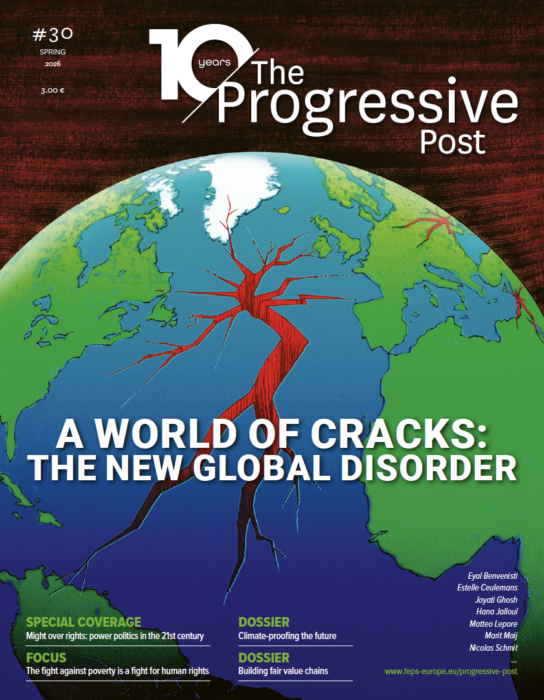
    Issue #30 Progressive Post

Issue #30

A world of cracks: the new global disorder
  • cover book

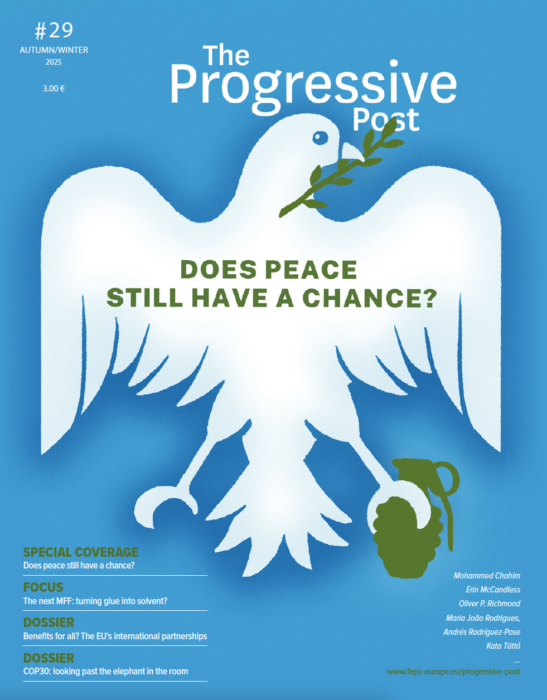
    Issue #29 Progressive Post

Issue #29

Does peace still have a chance?
Find all related publications
Publications
16/11/2026

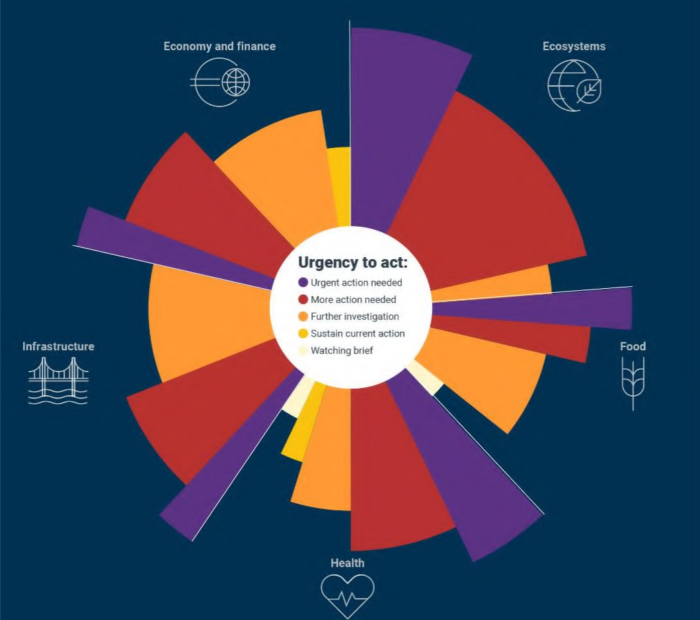
Designing a just and resilient Europe

Proposals for the EU Framework for Climate Resilience
09/11/2026

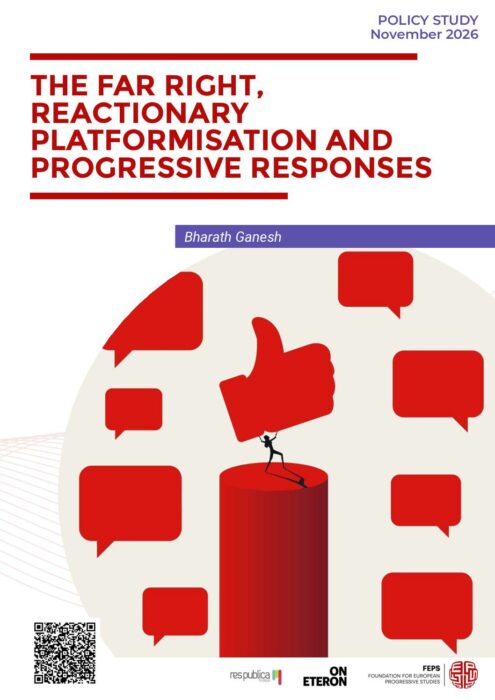
The far right, reactionary platformisation and progressive responses

The far right is thriving on social media, and this is no accident. This policy […]
04/11/2026

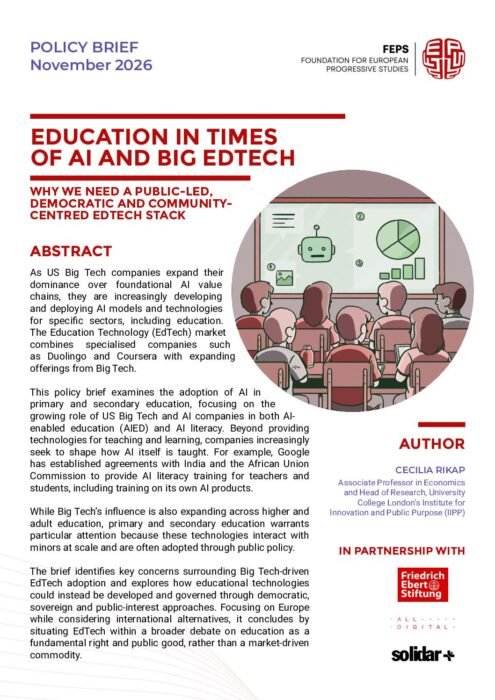
Education in times of AI and Big EdTech

Why we need a public-led, democratic and community-centred EdTech stack
04/11/2026

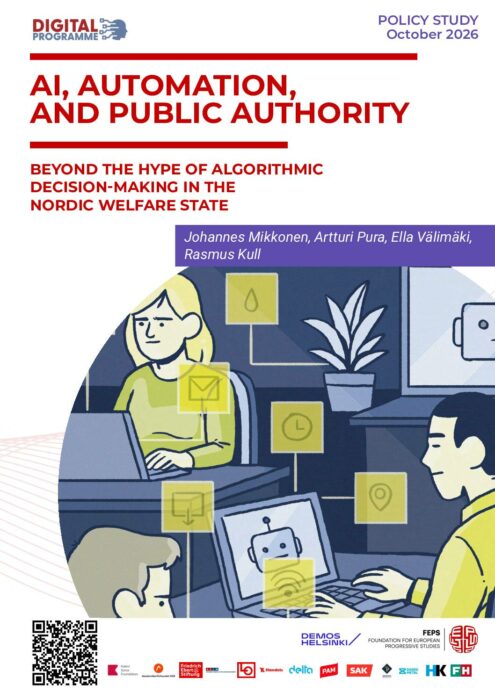
AI, automation, and public authority

Beyond the hype of algorithmic decision-making in the Nordic Welfare State
Find all related news
News
30/10/2026

FEPS Reacts: The new EU Framework for Climate Resilience

Necessary foundations but little action
23/10/2026

Notice of vacancy – Policy Analyst on Gender Equality

Apply before 23 November 2026
16/09/2026

FEPS Reacts: State of the European Union 2026

The 2026 State of the Union felt more like ‘von der Leyen I’ than ‘von […]
23/07/2026

FEPS Reacts: European Commission communication on the Action Plan on the European Pillar of Social Rights

By Laszlo Andor, FEPS Secretary-General & François Balate, Policy Analyst on Social The communication on the […]
Find all related in the media
In the media

Direct democracy MP Laouris clarifies participation at event with far-right party

by en.Philenews 18/11/2026
FEPS policy brief "Countering the far right in the European Parliament" was cited by en.Philenews in its latest coverage of the far-right Europe of Sovereign Nations (ESN) group in Cyprus.

Le Conseil d’analyse économique organise le webinaire “Inégalités face au changement climatique : qui paie la fracture ?”

by Bulletin Quotidien 18/11/2026
"The Council of Economic Analysis is organizing the webinar "Inequalities in the face of climate change: who is paying the price?" Read the article by Bulletin Quotidien about our upcoming event on 26 November: "What kind of European Union in the face of empires?".

Bharat Summit: Accountability key to restoring public trust in democracy

by UNI India 14/11/2026
Read UNI India’s article on the Bharat Summit, where Christian Salm, FEPS Head of Democracy and Participation Programmes, joined a political panel on democratic accountability and political reform.

Perustuslaki halutaan avata, jotta tekoälyä voidaan käyttää vielä enemmän – Ei, sanoo vasemmiston Honkasalo

by Helsingin Sanomat 06/11/2026
“The Constitution could be reopened to allow greater use of AI – No, says Left Alliance MP Honkasalo” News article by Veera Paananen published in Helsingin Sanomat (FI), referring to the FEPS and Demos Helsinki policy study on AI, automation and public authority in Nordic welfare states. The article draws on the study's findings to highlight the risks of delegating decision-making to AI in public services, including the loss of human judgement and accountability, and features Finnish MP Veronika Honkasalo's opposition to expanding AI-driven decision-making in the public sector.