Book

12/05/2016

Delivering Welfare Societies is the 10th volume of the FEPS Next Left Book Series. It features an impressive collection of articles, deriving from research conducted by the academics of the FEPS Next Left Focus and Working Groups in the years 2014-2015. The texts included were extensively debated having received 4 peer reviews, while in parallel the core ideas were also tested at the numerous round tables organized across the EU. In their diversity, the contributions unite in proving that not only there is a future for Europe – but also that it can be constructed alongside progressive principles. This well-documented optimistic message is a contribution that this volume hopes to make in times when the EU finds itself at such relevant crossroads.

Delivering Welfare Societies starts with the foreword of Dr. Alfred Gusenbauer, Chair of the FEPS Next Left Research Programme, who offers his prediction on what may happen on the global and European level in the months to come. This serves as a political framework and reference point for the proposals brought along in the subsequent 4 chapters. These are: Focusing the Agenda: Equality, Quality Employment and Decent Living Standards; Taking the Lead: Seizing the Moment, Taking Responsibility and Devising a New Social Compact; Acting through Europe: Solidarity, Politicization and Communitarian Method; and last but not least Paving the Vision: a Goal To Reach, a Strategy to Unite and a Narrative to Convince. The Chapters include solid analyses of the political processes and socio-economic trends shaping and shaking the EU at the moment, suggesting the ways through which new trajectory can be contextualized, conceptualized and convincingly presented to the voters.

In its richness Delivering Empowered Welfare Societies therefore offers a path out of anxiety about the future of Europe and the current ad-hoc, quick fix and emergencies- prompted debates. Its’ conclusive motto is: the future of the European Union is and will always be there. But it is up to progressives to mobilize themselves and find courage to believe, that among these and many other available ideas there is enough to claim a publically legitimized mandate to be the ones to shape the course of things to come.

Related publications
01/03/2024

Next Left Vol. 15

Progressive Ambition: How to shape Europe in the next decade
11/05/2023

Next Left Vol. 14

Crisis and progressive politics: How to make hard choices and succeed?
19/01/2023

Next Left Vol. 13

Progressive proposals for turbulent times: How to boost the political, organizational and electoral potential
18/01/2023

Next Left Vol. 12

Progressivism after Covid: Experiences, impulses, ideas
06/11/2017

Next Left Vol. 11

Next Left, New Social Deal: 10 Strategic Proposals for the Progressives to become the Movement of the Future
11/06/2015

Next Left Vol. 9

For a connecting Progressive agenda
09/10/2014

Next Left Vol. 8

Framing a new Progressive narrative
09/10/2014

Next Left Vol. 7

In the name of Political Union – Europarties on the rise
09/10/2014

Next Left Vol. 6

For a New Social Deal
09/10/2014

Next Left Vol. 5

Building new communities: Notes from the Transatlantic Dialogue of Dialogues
09/10/2014

Next Left Vol. 4

Progressive values for the 21st century
09/10/2014

Next Left Vol. 3

Towards a new strategy
09/10/2014

Next Left Vol. 2

The Leaders' Vision for Europe's Future
09/10/2014

Next Left Vol. 1

Renewing Social Democracy
Find all related publications
Publications
29/01/2026

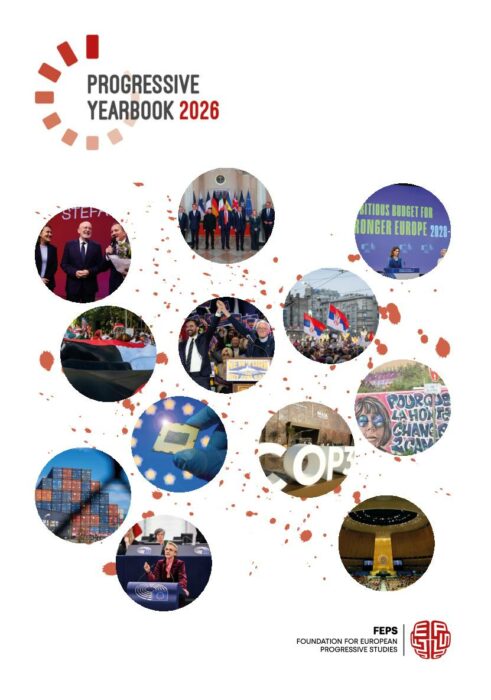
Progressive Yearbook 2026

In an eerie manner, 2025 resembled the ‘time of monsters’, which, according to the great […]
15/01/2026

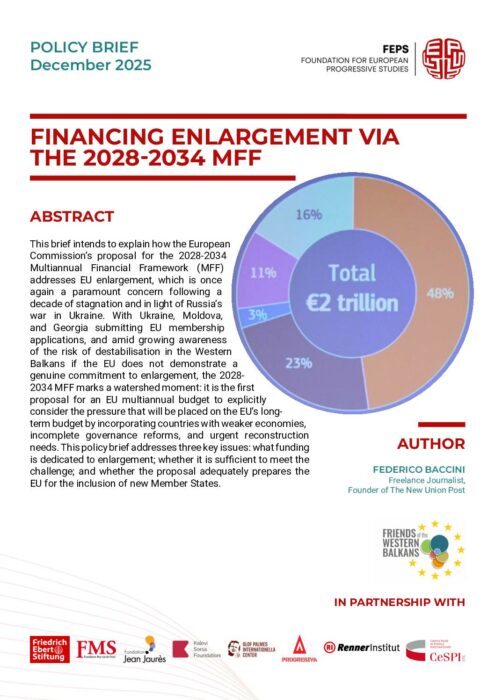
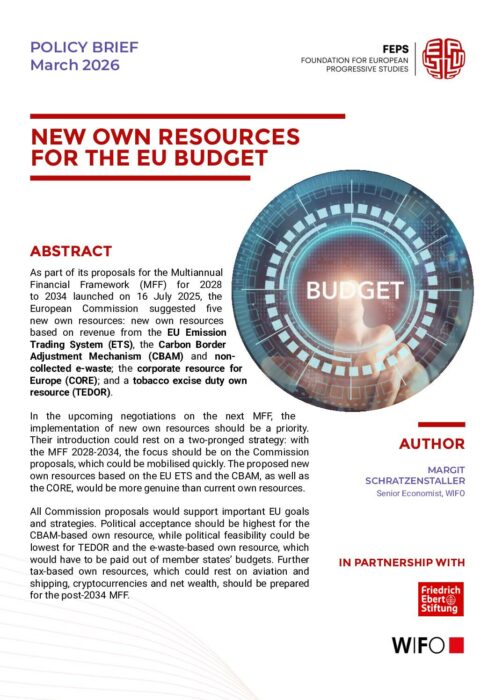
Financing enlargement via the 2028-2034 MFF

This brief intends to explain how the European Commission’s proposal for the 2028-2034 Multiannual Financial […]
19/12/2025

Moving beyond neoliberalism in EU trade policy

European Union trade policy finds itself at a crossroads. After three decades of neoliberal dominance in the […]
15/12/2025

The great unravelling

“The great unravelling” examines the challenges that the new era of globalisation poses for progressive […]
Find all related Progressive Post
Progressive Post
12/02/2026

Europe needs animal spirits again – and deregulation will not stimulate them

Europe’s competitiveness debate is accelerating under a growing sense of urgency. Slowing growth, geopolitical rivalry […]
11/02/2026

Ensuring tax justice in a fragile and unequal world economy

When a handful of economists met over a century ago in Geneva to deliver a […]
11/02/2026

The elephant in the European room

Critical raw materials and open strategic autonomy
Find all related events
Events
Upcoming
19/03/2026
FEPS HQ

Place-based industrial policy in Europe

Any serious discussion of industrial policy must begin with the recognition that economic activity is […]
Past
03 - 04/02/2026
FEPS HQ

Go Beyond: Zero deaths at work

Brussels visit
30/01/2026
FEPS HQ (Expert meeting)

An EU social agenda for a geopolitical age

Five years after the Porto Social Summit and the adoption of the Action Plan for […]
Load more...
Find all related Audiovisual
Audiovisual
02/02/2026

‘An EU social agenda for a geopolitical age’ Flickr album

Photo album of the ‘An EU social agenda for a geopolitical age‘ event in FEPS […]
29/01/2026

“SHAPING the market rather than FIXING its failures” M. Mazzucato | Progressive Person of the Year

In a year marked by political backsliding and a return to outdated economic thinking, FEPS […]
29/01/2026

“SHAPING the market rather than FIXING its failures” M. Mazzucato | Progressive Person of the Year

In a year marked by political backsliding and a return to outdated economic thinking, FEPS […]
29/01/2026

‘FEPS’ New Year Reception & Progressive Yearbook launch’ Flickr album

Photo album of the ‘FEPS’ New Year Reception & Progressive Yearbook launch‘ event in FEPS […]
Find all related news
News
29/01/2026

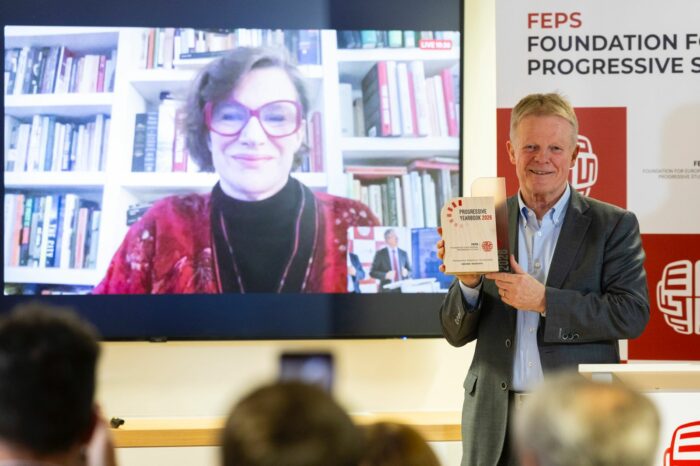
Marianna Mazzucato awarded FEPS ‘Progressive Person of the Year’

FEPS Progressive Person of the Year 2025-2026
16/12/2025

FEPS commentary on the EU Affordable Housing Plan

The announcement of the EU Affordable Housing Plan by Commissioner Dan Jørgensen is a historic milestone […]
04/12/2025

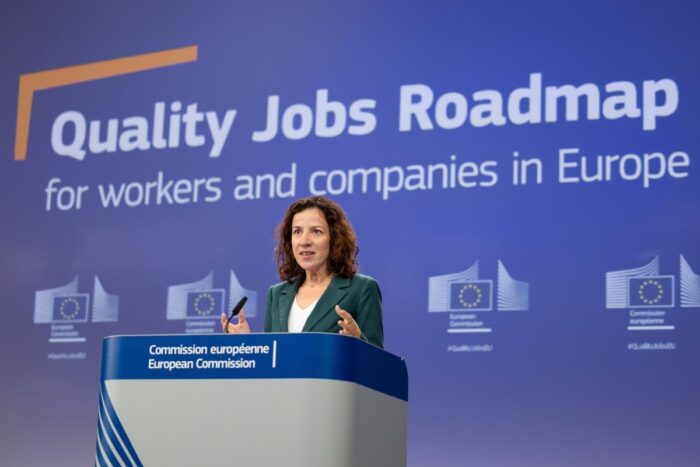
It is high time that the goal is set on “Quality”

FEPS commentary on the Quality Jobs Roadmap
21/10/2025

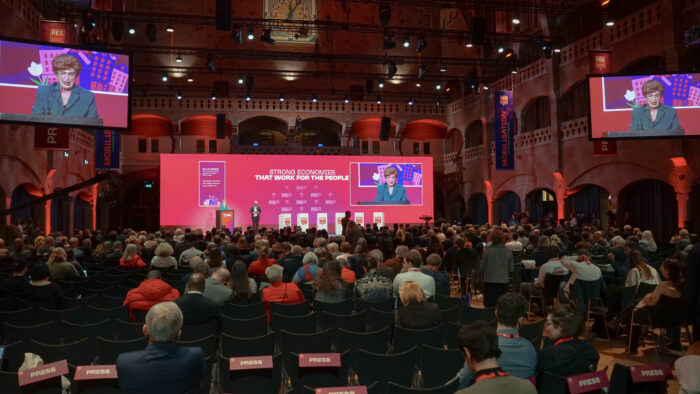
Maria João Rodrigues at PES Congress 2025

🇳🇱 🌹 FEPS attended the Party of European Socialists (PES) Congress in Amsterdam, which included […]
Find all related in the media
In the media

España los forma, Europa los contrata: así es el mapa de la nueva fuga de cerebros

by El Confidencial 10/02/2026
Spain trains them, Europe hires them: the map of the new brain drain: László Andor, FEPS Secretary-General, discusses the 'brain drain' as a result of the EU’s single market and highlights the need for a fairer mobility and retention strategy across the EU.

‘Regreso al futuro. El gran reseteo’ by Lina Gálvez

by Tinta Libre 02/02/2026
“Back to the Future: The Great Reset” Opinion article by FEPS Vice-President, Lina Gálvez reflecting on the current global crisis marked by rising authoritarianism, digital power and extreme inequality, and tracing its roots through a historical analysis of capitalism — from the post-1945 social and geopolitical settlement led by social democratic forces, through neoliberal financialisation, to what she describes as a new phase of fascist capitalism.

Liberal democracy’s social, societal fabric under threat – Live from the EPC Annual Conference 2025

by EPC 08/12/2025
In a podcast by the European Policy Centre (EPC), FEPS Secretary General, László Andor, discusses how liberal democracy in Europe is being challenged not only at the institutional level but also through the erosion of social rights and what Europe must do to defend its social foundations.

László Andor: Miből fejleszt az EU ezután?

by Portfolio 28/08/2025
“What will the EU develop from now on?” Analysis by FEPS Secretary General László Andor in Portfolio (HU), highlighting the new MFF’s shift toward increasing EU own-resources, boosting funding for strategic domains like defense, stabilisation and competitiveness, and calling for a flexible crisis-response mechanism such as the proposed Emergency Crisis Response Mechanism