
Download
The great unravelling
Book
15/12/2025
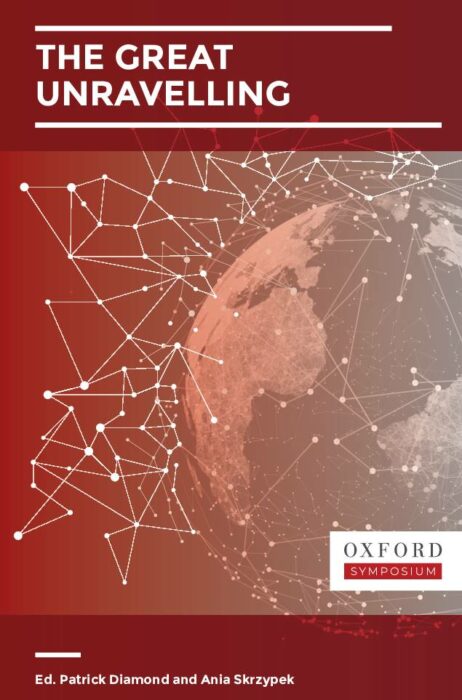
“The great unravelling” examines the challenges that the new era of globalisation poses for progressive parties and movements in Europe and across the world. It brings together leading politicians, thinkers and experts to debate the structural causes and political consequences of the new phase of globalisation that is reshaping Western economies and liberal democracy.
Major changes are occurring both in economics and politics as the form of globalisation that became dominant in Western countries in the 1990s and 2000s is evolving, and in some instances, apparently in retreat. To be clear, globalisation has not come to an end. It has entered a distinctive phase that is generating considerable turbulence and instability. The ‘unravelling’ of globalisation undoubtedly leads to greater volatility as the structural changes taking place in the global economy are feeding directly into domestic politics.
In recent decades, the impact of growing economic interdependence, free trade and technological change has fuelled increasing dissatisfaction with established political systems, leading to new forms of political polarisation that exploit the resentments fuelled by the rise of globalisation. This shift in politics has been evident in the rise of populist parties on the radical Left and Right throughout much of Europe.
While globalisation’s detractors insist that the Left’s purpose is to resist globalisation to prevent the commodification and dehumanisation of labour, it is more tenable for the centre-left to focus on brokering a viable compromise between globalisation and social progress, between competitive markets and social justice. The chapters in this volume address that theme from a range of compelling perspectives.
With chapters including:
Opening – László Andor, Adam Langleben and Sascha Obrecht
- The great unravelling: The next phase of globalisation? – Patrick Diamond and Ania Skrzypek
Ensuring economic competitiveness, sustainable growth and equality amid the ‘unravelling’ of globalisation
- Economic growth in Europe and the USA in the Age of Rivalisation: From hyper-globalisation to precautionary capitalism – Pascal Lamy
- The new approach on growth: Leading the race for competitiveness – Victor Negrescu
- Industry in transition: How to successfully implement transformation – Anita Sowińska
- Industrial strategy and a green transition – Dimitris Tsarouhas
- Globalisation’s impact on a generation – João Martins Pereira
Activating the state and reinventing public services to strengthen modern societies
- Critiquing conservative progressivism: Why the left must rethink globalisation and welfare – Dominic Afscharian
- Under pressure and inspiration: Reshaping public services and welfare states in Europe – László Andor and François Balate
- The world in 20 years in the context of globalisation and technological development: The tasks of European social democracy – Krzysztof Gawkowski
- Can European public investment still provide progressive results? – Giacomo Benedetto
Forging collective security and investing in defence in times of multifaceted confrontation
- Security: A new partnership – Tomáš Petříček
- Don’t wait for Washington: Time for a European plan for US retrenchment – Michelle Haas and Tim Haesebrouck
- European security: A new paradigm – Nicoletta Pirozzi
- Reclaiming the social democratic security tradition: Linking defence, social progress, and democratic resilience in Europe – Tobias Cremer
Governing inclusively to confront the challenge of the populist right in liberal democracies
- The shiver beneath the vote: Populism and the nervous body politic – Kata Tüttő
- Populism through history: Lessons from the past – Ana Catarina Mendes, André Ribeiro De Costa and Maria João Dornelas
- The place of the European city in the climate transition – Paul Magnette
- The role of engaged universities: Agents for resilient democracies – Eva-Maria Holzleitner
- Rebuilding the progressive coalition – Colin Crouch
- Economic policy in a changing world – Mikael Damberg
Afterword – Andreas Schieder
The book was launched at the 11th Oxford Symposium. Conceived amidst ideological challenges and electoral setbacks for the centre-left, the Symposium has become a vital platform for academics, politicians, and thought leaders for a decade. Featuring cutting-edge analysis, it addresses critical issues like the rise of the radical right, polycrisis, and strategies for progressive resurgence in the face of digital, environmental, and demographic transitions.
Network


Related publications
Related events
Find all related publications
Publications
Find all related Progressive Post
Progressive Post

Find all related events
Events
No upcoming events at the moment.
Online

Vienna, Austria (Training)
Warsaw, Poland (Training)
Barcelona, Spain (Expert meeting)
Load more...
Find all related Audiovisual
Audiovisual
26/02/2026
26/02/2026
28/06/2024
28/06/2024
Find all related news
News

Find all related in the media
In the media
“Back to the Future: The Great Reset”
Opinion article by FEPS Vice-President, Lina Gálvez reflecting on the current global crisis marked by rising authoritarianism, digital power and extreme inequality, and tracing its roots through a historical analysis of capitalism — from the post-1945 social and geopolitical settlement led by social democratic forces, through neoliberal financialisation, to what she describes as a new phase of fascist capitalism.
László Andor: «En Hongrie, malgré l’érosion de la popularité d’Orbán, la gauche peine à regagner en crédibilité»
by Le Figaro 25/08/2025